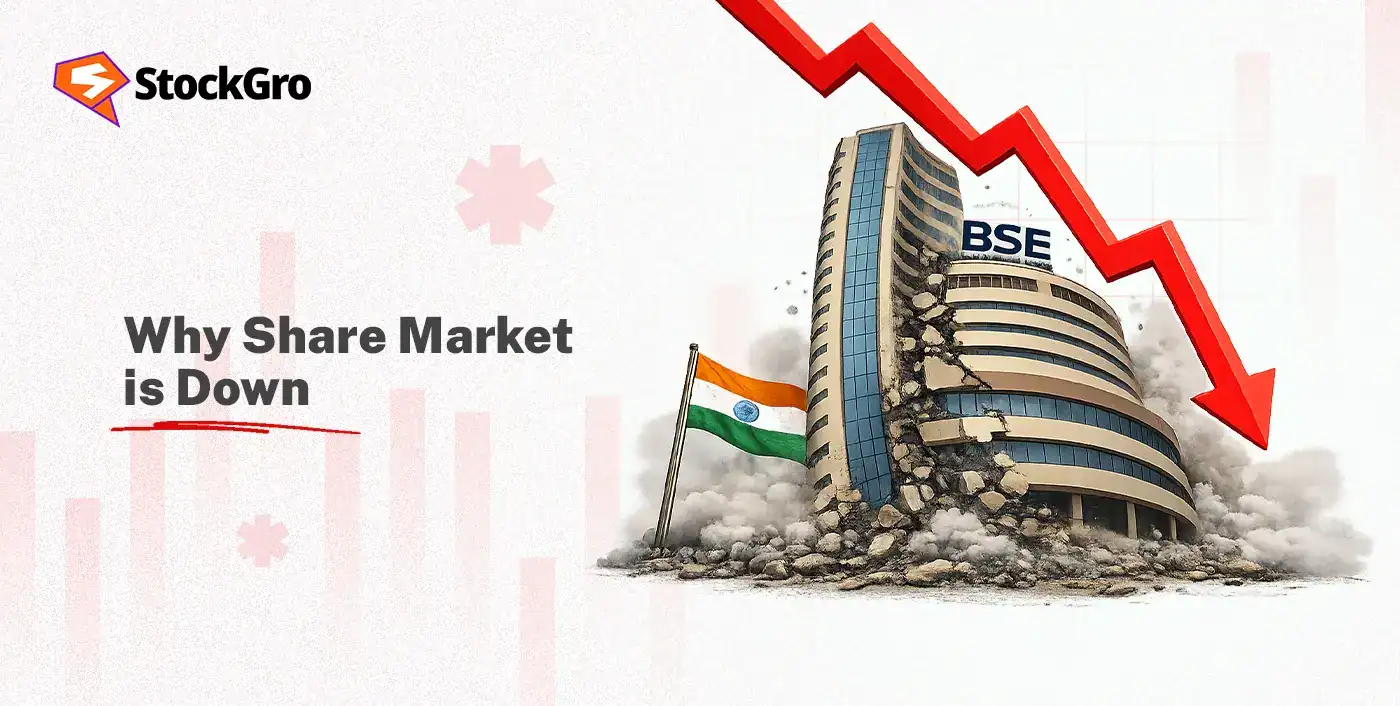
Stock market declines rarely arrive quietly. Screens flash red. News alerts pile up. Conversations turn cautious. Yet falling markets are not sudden accidents. They arise from built-up pressure and follow a pattern. Understanding why the share market is down helps investors move away from fear-driven decisions and toward clearer thinking during uncertain phases.
What is the Share Market Down?
When the share market is described as down, it means stock prices have dropped noticeably within a short span. Sometimes this happens in one sharp session. At other times, it unfolds slowly over weeks as momentum fades.
A falling market does not suggest businesses have stopped operating or vanished overnight. It reflects changing confidence. Investors start to reevaluate the earnings and risk. When their expectations weaken, prices adjust to match that new outlook.
Why is the Share Market Down?
A market decline does not usually have one specific cause; rather, it is a result of many things, both factual and emotional. When looking at factors: decreased economic activity, higher costs of borrowing, weakened demand worldwide, and the ambiguity in our policies, it is often observed that these factors cross paths at some point.
When that happens, caution spreads quickly. Investors begin shifting money away from risk. Prices fall faster than logic would suggest because sentiment accelerates the move.
Understanding Market Downturns
Market downturns are part of the investing journey. Growth phases do not run endlessly. Corrections step in to cool excess optimism and reset valuations.
During periods of high market volatility, there are sharp price swings because certainty from the market starts disappearing. A revelation like a policy change, earnings report, or a global headline can quickly change the investor demand.
Market downturns are important because they help in correcting mispricing and making the market more stable.
Common Reasons for Market Declines
Here are five common forces that tend to be at the root of large market downturns:
1. Speculation
Too much speculation without understanding the fundamentals creates a mismatch between market prices and real valuation. Once the confidence gets weak, selling starts, momentum picks up and the market declines.
An example is the Nifty 50 soaring to 26,277 on November 27, 2024, to fall around 13% in the next five months to close at 22,929 on February 14, 2025.
2. Excessive leverage
When borrowed money is used for investing in the stock market, it increases the risk. Leverage can help in amplifying the gains, but increase the risk when markets fall.
SEBI has revealed that more than 90% of individual F&O traders lose money. Traders with high borrowings are forced to exit when markets go through fluctuations, which adds to the selling pressure.
3. Inflation and interest rates
When inflation is rising, the RBI increases the repo rate to keep it under control. It makes borrowing costly and weakens the market sentiment.
On August 8, 2024, when the RBI announced a repo rate of 6.5% for the ninth-consecutive time, the Nifty 50 fell 0.74% to close at 24,117.
4. Policy and political uncertainty
Markets value predictability. Sudden shifts reduce visibility and growth. Investors respond by reducing their equity exposure.
A recent example was observed after the Budget 2026 announcement on February 1, 2026. As the STT on futures and options were increased to 0.5% and 0,15% respectively, traders panicked by the increased costs, quickly exited their positions.
Sensex fell to 80,722, a drop of 1.9%. and the Nifty 50 declined around 2% to close at 24,825.
5. Global economic factors
Markets around the world are connected to each other. A change in one market is visible in other markets, and it adds volatility.
Following the US strike on Venezuela, Sensex fell 322 points to 85,439.62, falling 0.38% on January 5, 2026.
These reasons often overlap, making declines sharper and faster.
Impact of Interest Rates on the Stock Market
When interest rates rise, people tend to borrow less due to the increased cost. Expansion plans are slow. Profit margins tighten. Investors start comparing equity returns with safer fixed income options and rebalance accordingly.
Even after the repo was brought down to 6% on April 9, 2025, by the RBI, the investors still took a cautious approach, with the Nifty 50 closing at 22,356, a fall of 179 points and the Sensex dropping 554 points to 73,673.
The interest rate impact is especially visible in growth stocks. Their value depends on future earnings. Higher rates reduce the present worth of their earnings, leading to valuation cuts and price weakness.
How Inflation Affects the Stock Market
Inflation works gradually but persistently. It slowly reduces the purchasing power of consumers. Businesses start to struggle as input costs rise and their margins drop.
When the inflation for 2024 was announced to be 4.85%, the markets reacted negatively, with the Sensex falling 793 points to close at 74, 244, on April 12, 2024.
This inflation stock market correlationstrengthens when inflation remains elevated. Central banks keep liquidity tight and borrowing conditions restrictive. Markets react negatively as easy money disappears and future growth becomes harder to justify.
Even strong companies feel pressure when inflation stays high for long periods. Cost control becomes difficult, and expectations start to drop.
Government Policies and the Stock Market
Government actions shape markets in visible and subtle ways.
Changes in fiscal policies and monetary policies influence spending liquidity and confidence. Lower government spending creates less economic momentum. With higher taxes, individuals are left with very little disposable income.
The markets reacted negatively to the Union Budget 2026’s conservative approach and tighter regulations, with the Nifty falling to 593 points to close at 24,825.
By tightening monetary policies, the government is giving a message of caution and taking away excess liquidity from the system.
Is It the Right Time to Buy Stocks When the Market Is Down?
Even when the markets are down, investment opportunities still exist.
It is difficult to achieve perfect market timing, so some investors choose to buy stocks over time. This approach helps avoid emotional stress.
Businesses with strong financials and robust fundamental standing recover easily. One should track and research such companies if they want to invest during downturns. In uncertain markets, patience and discipline outperform precision.
Can You Make Profits During a Market Downturn?
Profits are possible even in falling markets, but approach matters.
Some traders will use short sellingas a way to profit from a falling price during a period of weakness. Those who want to manage risk and preserve their capital adopt bear market strategies.
Downturns are a risky-trail and one should proceed with caution if they want to make profits from them.
Historical Market Downturns and Their Recovery
There have been major market downturns in history. Every major market fall appeared permanent, yet each phase slowly moved toward recovery.
Indian Stock Market Crash In 1992
The stock price manipulation by Harshad Mehta exposed weaknesses in the transparency and regulation of the markets. As a result, investors abandoned the markets, resulting in a steep decline in the value of the market.
Sensex witnessed its largest fall at that time, dropping 570 points, a loss of 12.7% on April 28, 1992.
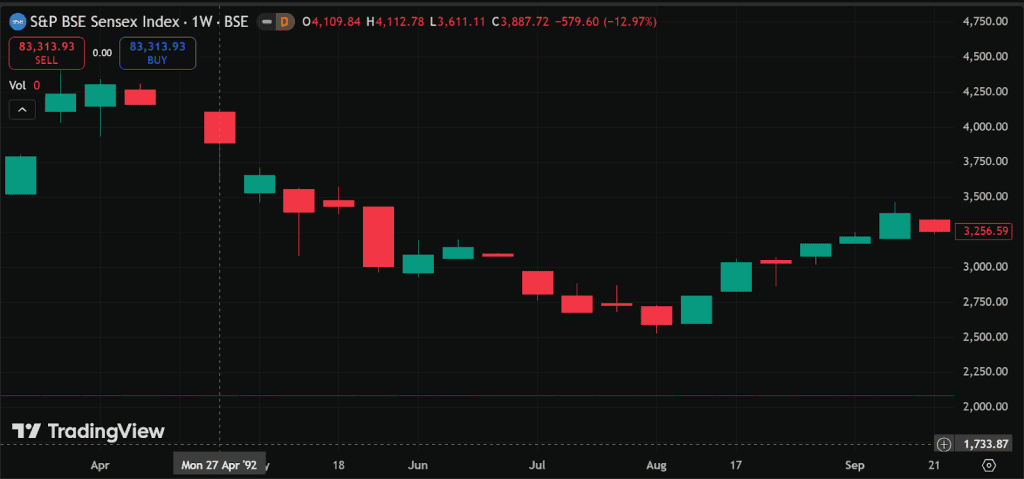
Stricter regulatory measures and better disclosure norms helped in the recovery.
Global Financial Crisis 2008
The housing market bubble burst revealed vulnerabilities in the banking systems around the globe. Credit froze, institutions failed, and markets fell sharply across regions.
The Sensex fell by over 7.4%, dropping 1,408 points on January 21, 2008.
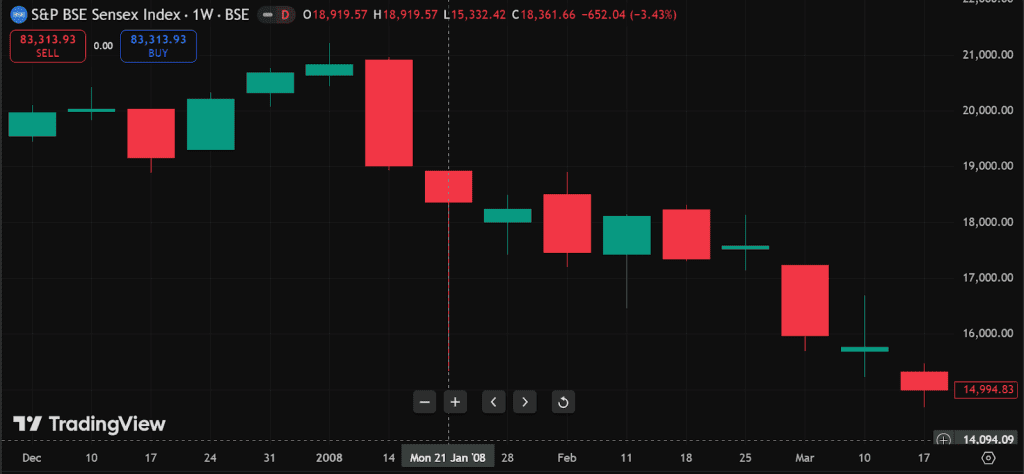
With coordinated government intervention, aggressive monetary support, and structural repair of financial systems, the markets recovered over time.
Pandemic Crash 2020
As soon as the pandemic started, global economic activity came to a halt. Markets reacted immediately with dramatic declines in value.
This outbreak resulted in the highest single-day crash in Indian markets, with the Sensex dropping 3,935 points, falling 13.2% on March 23, 2020.
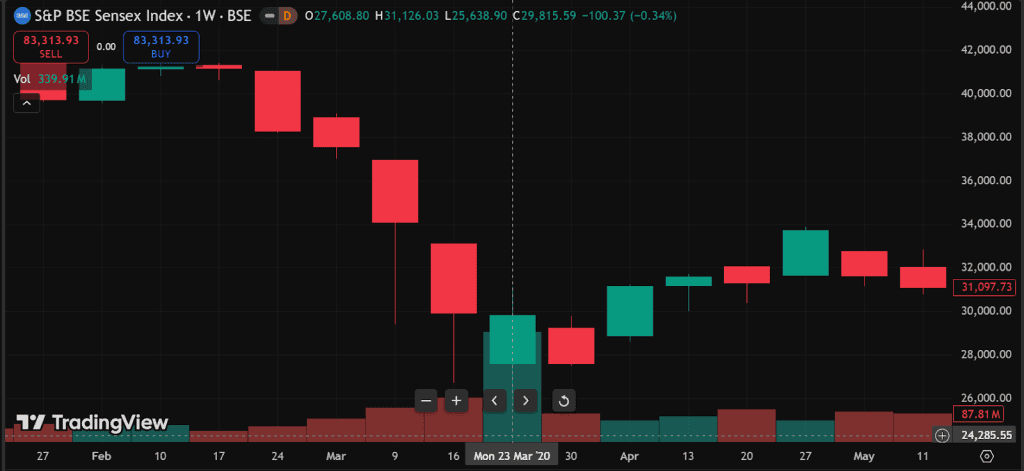
However, the market recovered much quicker than expected due to a combination of both the liquidity support available through policies and the reopening process, which helped restore investor confidence.
Conclusion
Downturns can create panic, but it is important to understand that they are a part of the market’s natural rhythm. Despite the historical crashes, markets have always managed to bounce back.
Staying patient puts you in a better position when confidence comes back, and the markets regain their strength.
FAQ‘s
The share market is falling due to weak global cues, economic slowdown, rising interest rates, foreign investor selling, and uncertainty around government policies.
Stock markets go down when growth slows, inflation rises, borrowing costs increase, global risks emerge, or investors lose confidence and shift money toward safer investment options.
Inflation raises business costs and reduces consumer spending. It also leads to tighter monetary policy, which limits liquidity and puts pressure on company profits and stock valuations.
You can make money when the market is down by focusing on phased investing, strong companies, defensive sectors, dividends, and suitable trading strategies, depending on your risk tolerance and investment horizon.
A downturn signals higher uncertainty but also creates opportunities. It encourages investors to reassess strategies, manage risks, and invest with a fresh perspective.
Historically, markets have recovered after every major decline. While timing varies, economic growth, policy support, and improved sentiment usually drive long-term recovery.

Leave a Comment