A plain bond feels simple until you notice one detail that can change everything. The bond might not run for the full tenure printed on the page. It can end early, and the timing may not be in your hands.
That is where callable and puttable bonds come in. They add an extra layer to how long you stay invested, how predictable your cash flows feel, and what happens to your returns when interest rates shift.
If you are comparing bonds that look similar on coupon and maturity, this one feature can quietly tilt the outcome. This blog breaks down how these options shape price behaviour, holding period, and reinvestment decisions, so you can read the fine print with confidence.
What are Callable Bonds and its Working
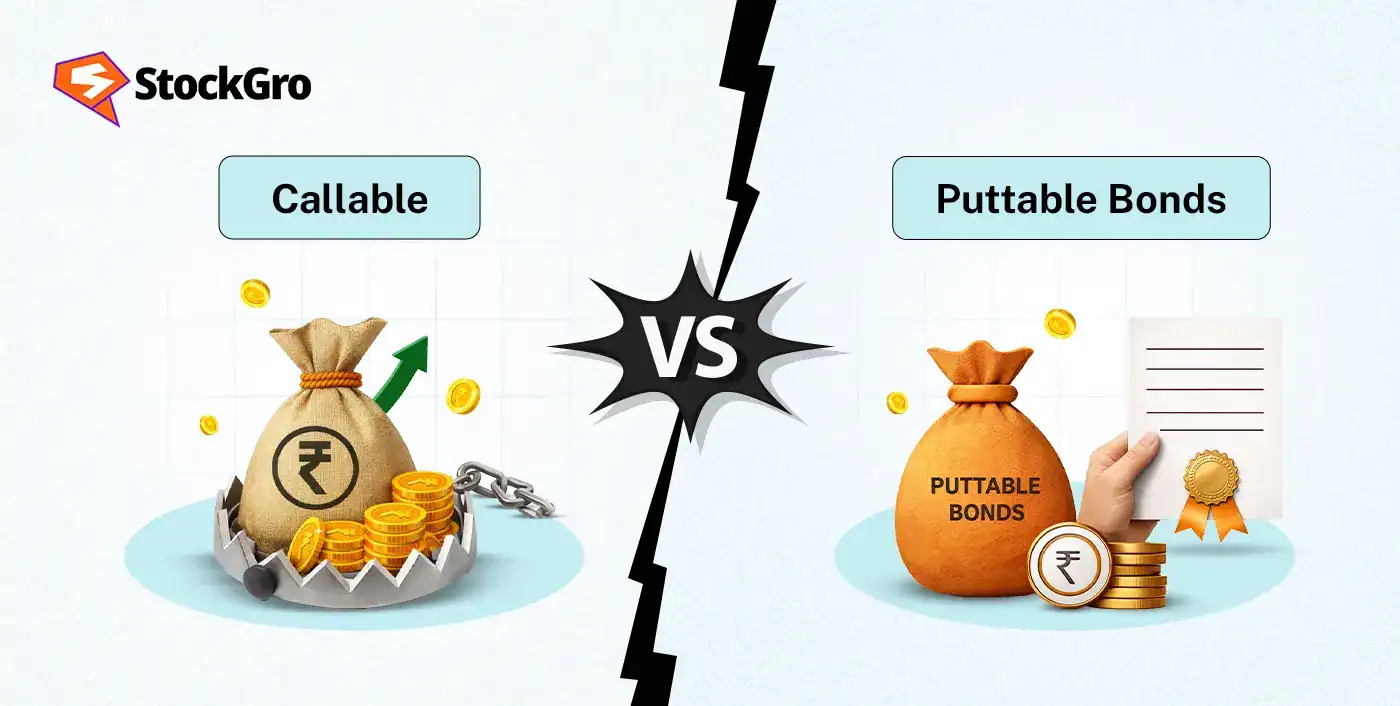
A callable bond is a bond the issuer can redeem before maturity, following the rules written into the bond terms. Some bonds include embedded options like calls (issuer can redeem early) and puts (investor can sell back early).
If the issuer calls the bond, investors receive the call price (often face value, sometimes with a small premium) plus accrued interest up to the redemption date. After that, coupons stop.
Issuers usually call bonds to reduce borrowing costs, often when market rates fall, and refinancing is cheaper
Here’s how it works:
- Issue and coupon payments: You buy the bond and receive coupons as scheduled.
- Call protection and first call date: Many callable bonds can’t be called for a set period (call protection). After that, the issuer may be able to redeem on the stated call date(s).
- Redemption amount: If called, you receive the call price + accrued interest.
Example of Callable Bonds
Assume the following bond terms
| Terms | Details |
| Face value | ₹1 lakh |
| Coupon | 9% a year, paid once a year |
| Maturity | 10 years |
| Callable after | 5 years |
| Call price | 102% of face value (₹1,02,000) |
If the bond is not called, you receive ₹9,000 each year for 10 years. At the end of year 10, you also receive the face value back of ₹1 lakh.
Assume market interest rates fall after 5 years. The issuer may prefer to call the bonds.
Therefore, if the bond is called:
You receive coupons for 5 years: ₹9,000 * 5 = ₹45,000
On the call date (end of year 5), the issuer repays you: ₹1,02,000
So, total cash received by the end of year 5 is: ₹45,000 + ₹1,02,000 = ₹1,47,000
In this case, the issuer benefits because it can replace a 9% loan with cheaper borrowing after rates fall, cutting future interest outgo and improving cash flow.
The buyer benefits because they get their money back earlier, plus a call premium of ₹2,000, and can redeploy the proceeds into another opportunity that fits their needs at that time.
What are Puttable Bonds and its working?
Puttable bonds are bonds that give you, the investor, the right to sell the bond back to the issuer before maturity, as per the bond terms. This “put option” is an embedded feature, like a built-in exit door on specific dates.
Put options are valuable when:
- Interest rates rise and new bonds offer higher yields
- The issuer’s risk feels higher, and you want an exit
- You want more control over your holding period
Because the investor gets extra flexibility, puttable bonds often have a slightly lower coupon than similar non-puttable bonds.
Here’s how this works:
1) Issue and coupon payments
You buy the bond and receive coupons as scheduled.
2) Put dates are defined upfront
The bond terms mention the put date(s) when you can choose early repayment. Some bonds also have a “put protection” period, where you cannot put it back yet.
3) You decide whether to use the put option
On the put date, you choose one of two paths:
- Use the put and get repaid early
- Do not use it and keep holding the bond
4) If you use the put
The issuer pays you the put price (often face value, sometimes with a premium) plus accrued interest up to the put date. Then, coupon payments stop.
Example of Puttable Bonds
Assume the following bond terms
| Terms | Details |
| Face value | ₹1 lakh |
| Coupon | 8% a year, paid once a year |
| Maturity | 10 years |
| Puttable after | 5 years |
| Put price | 100% of face value (₹1 lakh) |
If you do not use the put, you keep receiving ₹8,000 each year until year 10 and then you receive ₹1 lakh at maturity.
Suppose you use the put in year 5,
You receive coupons for 5 years: ₹8,000 * 5 = ₹40,000
On the put date (end of year 5), you sell it back and receive: ₹1 lakh (plus any accrued interest up to that date)
So, total cash received by end of year 5 is: ₹40,000 + ₹1,00,000 = ₹1.4 lakh
Difference between Callable and Puttable Bonds
| Basis | Callable Bond | Puttable Bond |
| Who can trigger early end | Issuer | Investor |
| What the option does | Issuer can redeem before maturity | Investor can sell back before maturity |
| Typical trigger | Rates fall and refinancing becomes cheaper | Rates rise, or the investor wants to cut risk |
| Holding period | Can shorten without your choice | More predictable because you choose whether to exit |
| Price behaviour | Price gains often slow near the call price | Price falls often reduce as the put date approaches |
| Coupon level (vs plain bond) | Often higher to offset call and reinvestment risk | Often lower because the exit option has value |
| Key risk for the investor | Getting repaid when reinvestment rates are lower | Lower income if coupon is smaller, and protection only helps if you use it |
| What to check before investing | Call dates, call price, call protection, yield to call, yield to worst | Put dates, put price, put protection, yield to put, yield to worst |
| Works best for | Investors prioritising income who can handle an early redemption | Investors who want an exit route and tighter control over rate risk |
When interest rates fall
Callable bond
- Prices try to rise, but the climb often slows as the bond gets closer to the call price.
- The chance of being called goes up, so your holding period becomes shorter than you planned.
- The main annoyance is reinvestment. Your money comes back when new bonds pay less.
Puttable bond
- The put feature sits in the background. You will rarely use it in this scenario.
- The bond behaves closer to a plain bond, so price gains can flow through more normally.
- You keep control. Nobody forces an early exit.
When interest rates rise
Callable bond
- Call risk fades, so the bond starts behaving more like a plain long-maturity bond.
- Price falls can be meaningful because there is no built-in floor from your side.
- You are basically “locked in” unless you sell in the market at a lower price.
Puttable bond
- The put becomes valuable because it gives you a practical exit route.
- Market price weakness is often limited as the put date comes closer, since investors know there is a sell-back option.
- You can reset. Exit at the put date, then reinvest at higher yields.
Callable bonds can cap upside when yields fall. Puttable bonds can cushion downside when yields rise.
FAQ‘s
In most cases, the coupon you receive is taxed as income at your slab rate, unless the bond is issued as tax-free. The call or put feature usually does not change this.
Many issuers stick to plain, non-callable bonds. Call and put features tend to show up only in specific deals, based on funding strategy and investor demand.
Yes, this is possible in some issues. The terms usually set different call and put dates. Check the offer document for the exact triggers and prices
You might get repaid earlier than planned, often when rates are lower. That can limit price upside and make it harder to find a similar yield again.