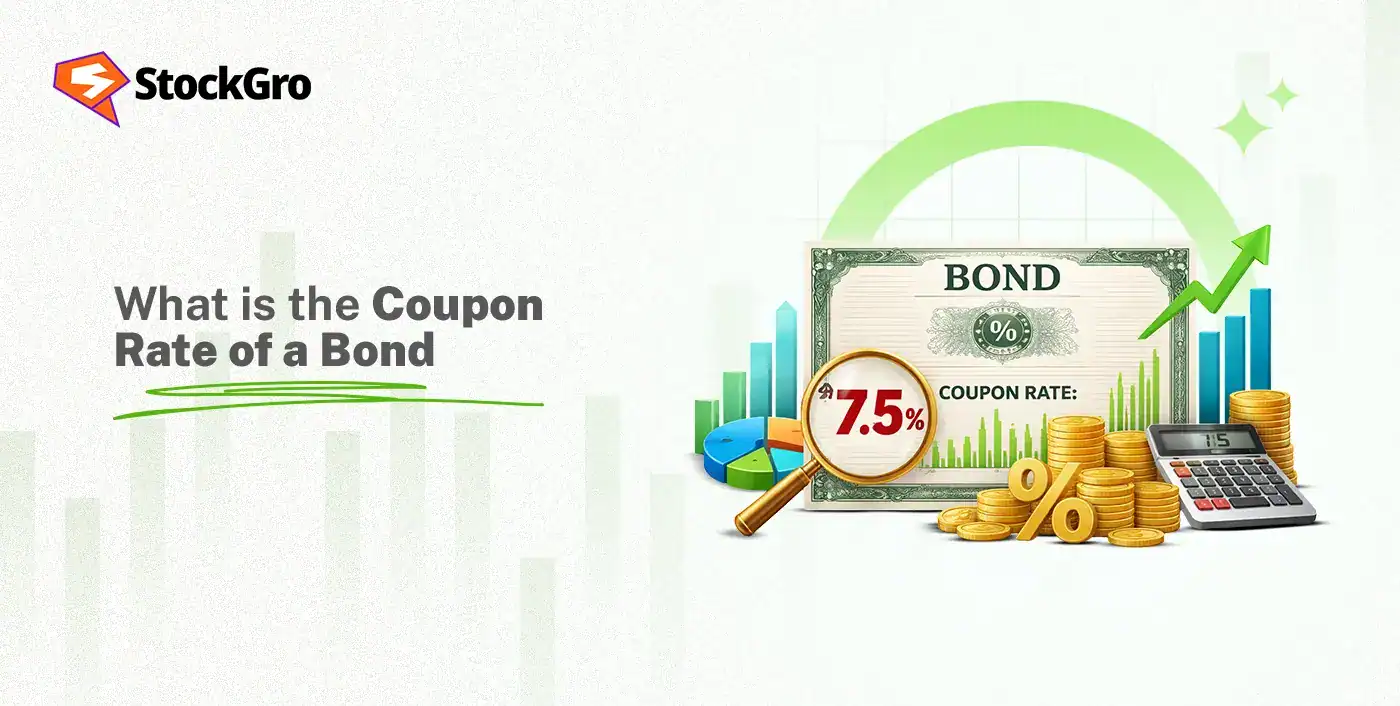
In mid-February 2026, the 10-year benchmark government bond yield was hovering around 6.68%. Now, the security is named as “6.48% Government Security 2035”. A number often sits in the bond’s name. That number is the coupon rate. It is the fixed interest applied to the bond’s principal amount and paid on set dates.
Knowing the coupon rate helps you estimate cash flow, understand why a bond trades above or below face value, and avoid mixing it up with yield. In this blog, we will break it down with simple examples you can use straight away.
What Is a Coupon Rate?
A coupon rate is the fixed interest rate a bond pays each year on its par value, also called face value. It is expressed as a percentage and is set when the bond is issued.
The coupon rate tells you the bond’s promised interest payout, not the return you will earn if you buy or sell the bond in the market. The actual return depends on the price you pay and is captured by the bond’s yield.
Importance of coupon rate
The coupon rate matters because it tells you what income a bond is designed to pay, and it helps you judge whether that bond fits your goals.
- Cash flow planning: Shows the interest amount you can expect from the bond, based on its par value and payment frequency
- Income suitability: Helps you decide if the bond’s interest payouts match your monthly or yearly income needs
- Pricing impact: Explains why a bond can trade above par when market yields fall, or below par when market yields rise
- Yield clarity: Reduces confusion between the stated interest rate on the bond and the return you may earn at the price you pay
- Interest rate sensitivity: Influences how sharply the bond price may react when yields change, with lower coupons often showing larger swings
- Reinvestment risk: Regular interest receipts may need reinvestment, and future reinvestment rates can raise or reduce overall returns
- Portfolio fit: Supports better selection across bonds when you balance income stability, holding period, and expected market moves
How To Calculate The Coupon Rate
In real life, the coupon rate is set by the issuer and published when the bond is issued. It’s part of the bond’s terms. You do calculate it in two common situations:
- When you’re given the coupon payment but not the coupon rate.
- To double-check.
Here’s how to calculate.
Coupon Rate Formula
To calculate a bond’s coupon rate, you only need two elements:
- The annual interest (coupon) payment
- And the face value.
Coupon rate (%) = (Annual coupon payment / Face value) × 100
Steps to calculate:
- Find the coupon payment per year
- If the bond pays yearly, it is just that payment.
- If it pays half-yearly, add both payments to get the annual total.
- Divide the annual coupon payment by the face value
- Multiply by 100 to convert to a percentage
Example of Coupon Rates
Assume:
Face value = ₹1000
Coupon paid half yearly = ₹35
Therefore, annual coupon payment = ₹35 + ₹35= ₹70
Coupon rate (%) = (70 / 1000) x 100 = 7%
Types of Coupon Rates
Here are the main types of coupon rates you’ll see on bonds:
Fixed Coupon
- The bond pays the same interest amount every period (for example, 6% a year).
- If market interest rates go up or down, your coupon doesn’t change.
- You know your cashflows in advance, which makes it easier to plan.
Floating Coupon
- The coupon moves over time based on a reference rate (often a benchmark rate) plus a margin (for example, “benchmark + 1%”).
- If interest rates rise, your coupon payments usually rise too (and vice versa).
- Cashflows are less predictable, but it can reduce interest-rate risk compared with fixed coupons.
Zero Coupon
- Zero coupon bond pays no regular interest at all.
- Instead, it’s issued at a discount and you receive the full face value at maturity.
- Your return comes from the difference between what you pay and what you get back.
Here are examples for each type, assuming a 3-year bond with annual payments and face value ₹1,00,000.
| Coupon type | Coupon rule | Example assumptions | Year 1 cashflow | Year 2 cashflow | Year 3 cashflow (incl. principal) |
| Fixed coupon | Same rate every year | 6% fixed coupon | ₹6,000 | ₹6,000 | ₹1,06,000 |
| Floating coupon | Benchmark + margin | (Benchmark + 1%)Benchmark: Y1 4%, Y2 5%, Y3 3% | ₹5,000 | ₹6,000 | ₹1,04,000 |
| Zero coupon | No coupons paid | Buy at ₹80,000, redeem at ₹1,00,000 | ₹0 | ₹0 | ₹1,00,000 |
Factors Affecting Coupon Rates
1) Market interest rates
When overall interest rates rise, new bonds usually need higher coupons to stay attractive.
When rates fall, issuers can offer lower coupons.
2) Credit risk of the issuer
If the issuer is seen as less reliable, investors demand a higher coupon as compensation.
Strong, stable issuers can borrow at lower coupons.
3) Time to maturity (tenure)
Longer-term bonds often offer higher coupons because there’s more uncertainty over time.
Short-term bonds may have lower coupons.
4) Inflation expectations
If investors expect higher inflation, they want a higher coupon so their returns don’t lose purchasing power.
5) Bond features and structure
Some terms change the coupon needed, such as:
- Callable bonds (issuer can repay early): Usually need a higher coupon.
- Secured vs unsecured: Secured bonds may carry a lower coupon.
- Floating vs fixed: Floating coupons may start lower/higher depending on the benchmark and outlook
Benefits of Coupon Rate
Benefits for investors
- Predictable income: The coupon rate tells you what cash payments you should expect each year (as long as the issuer pays). That’s useful if you want steady income.
- Easier planning and budgeting: Because the coupon payment is set at issue, it’s simpler to plan future cashflows compared with investments where payments vary.
- Can help reduce overall portfolio ups and downs: Regular coupon payments can provide stability alongside more volatile assets like shares.
- Potentially attractive in higher-rate markets (for older bonds): If interest rates rise after a bond is issued, an existing bond with a higher coupon can be more appealing, which may support its price in the market (though prices can still move around).
Benefits for issuers
- Clear cost of borrowing: A fixed coupon rate means the issuer knows exactly what interest they’ll pay each year, making cashflow management easier.
- Helps attract investors: A competitive coupon rate can make a new bond issue more appealing, especially when investors want reliable income.
- Flexibility in financing choices: Issuers can choose coupon levels and structures (fixed, floating, zero-coupon) to match their funding needs and what investors are looking for.
Coupon Rate vs. Yield
Coupon rate and yield both relate to the interest you get from a bond, but they answer different questions.
| Aspect | Coupon rate | Yield |
| Meaning | Stated interest rate on the bond’s face value | Return linked to the price you pay and, for some measures, the time you hold it |
| Base used | Face value (par value) | Market price (and sometimes face value plus time to maturity) |
| Changes over time | Fixed for fixed-rate bonds | Moves as bond prices and market interest rates change |
| What it helps with | Estimating interest cash flows | Comparing return potential across bonds at today’s price |
| What it does not show | Return if you buy at a premium or discount | The bond’s stated interest rate on face value |
FAQ‘s
When borrowing costs move, new bond issues usually arrive with different promised payments. Higher yields often push issuers to offer a larger annual rate to win buyers. Older bonds keep the original figure. Their prices often do the adjusting instead. Special terms like floating coupons or early redemption rights can change the story.
One figure shows the stated interest on the bond’s face value. Coupon rate is the stated percentage. YTM is an estimated annual return based on today’s price, time to maturity, rand reinvestment assumptions.