Every market movement has a story, but not every participant knows how to act on it. Commodity derivatives provide a structured way to interpret the price trends and respond with more clarity. They are widely used across trading and business landscapes to manage risk, discover prices, and ensure liquidity.
In this guide, you will learn the meaning of commodity derivatives, key types, and their importance.
What is a Commodity Derivative?
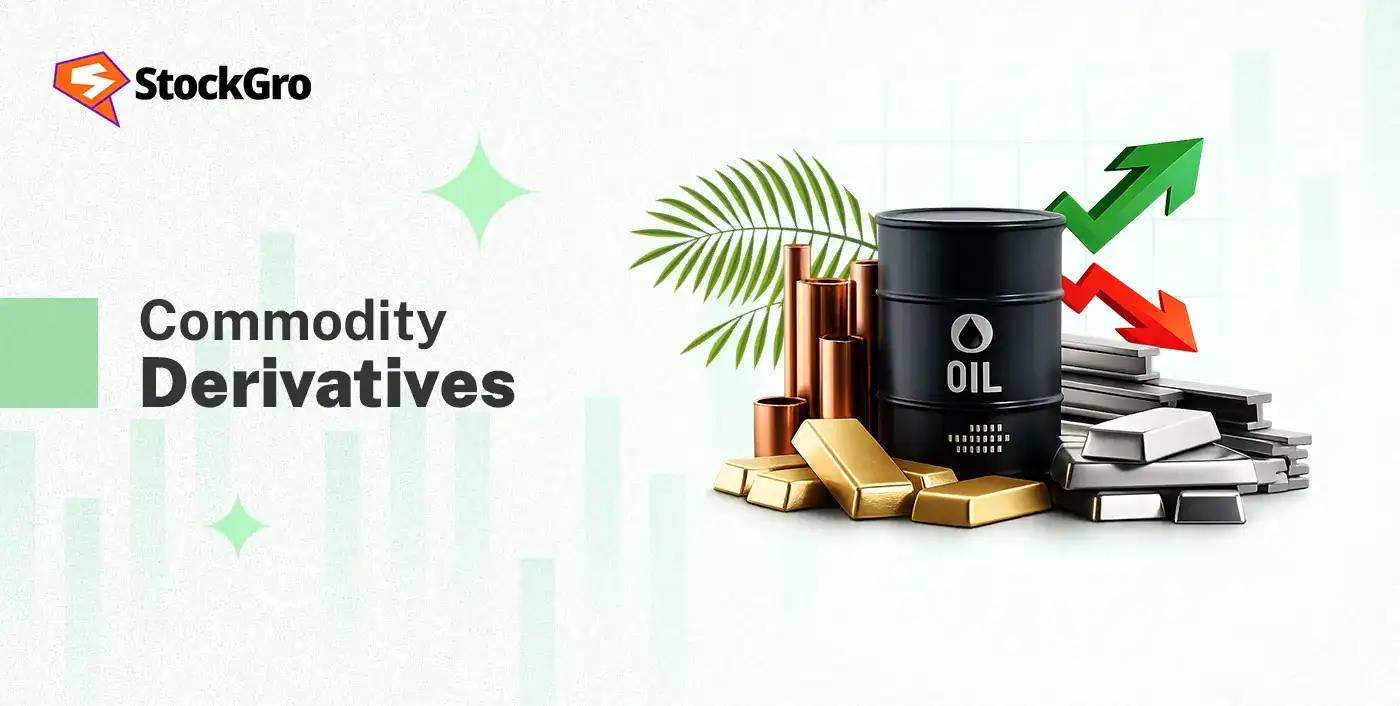
A commodity derivative is a financial contract which bases its value on the price of an underlying commodity. The commodities are of two kinds:
- Soft: Products which are grown or raised, such as cotton, sugar, and wheat
- Hard: Natural resources requiring extraction, like gold, silver, copper, and petroleum
Instead of dealing with the actual commodity, these derivatives allow us to use contracts that represent their future value. This makes it easier to plan, speculate, or manage exposure to price changes in a structured manner.
Overall, commodity derivatives act as a bridge between physical markets and financial markets by allowing interaction with price movements in a flexible and organised manner.
Types of Commodity Derivatives
Each type of commodity derivative is designed to serve specific purposes. Understanding how they differ and function is essential to using them in real-life scenarios.
Futures contracts
They are formal agreements that fix the price of a commodity for buying or selling at a future date. Trading of these contracts takes place on regulated exchanges, offering a transparent trading environment with strong liquidity.
They follow fixed specifications such as contract size, expiry date, and settlement terms, which simplifies trading and ensures uniformity. This standardisation allows efficient planning and execution of trades while aligning the positions with expected market movements and timing.
Example: Rohit expects oil prices to soar amid the rising geopolitical tensions. He buys an MCX crude oil futures contract at ₹5,000 per barrel with a one-month expiry. The contract covers 10 barrels, making the total value ₹50,000.
After a month, crude oil prices rose to ₹5,400 per barrel. Rohit exits his position and earns ₹400 per barrel. His total profit comes to ₹4,000 (₹400 × 10 barrels).
Options contracts
As the name implies, option contracts grant the holder the right, without any obligation, to buy or sell an asset at a fixed price during a specified period. Options are bifurcated into two types:
- Call Option: They give the right to buy and are generally used when the market seems bullish.
- Put Option: They grant the right to sell and are typically used to benefit from bearish momentum.
To gain this right, the buyer pays a premium, and the seller is obligated to fulfil the contract if the option is exercised. This allows more flexibility in trading and aids in managing the risk.
For example, assume Neha anticipates upward movement in gold prices during the festive season. She wants to take advantage of this while maintaining a little legroom. She buys a call option on MCX gold with a strike price of ₹60,000 per 10 grams. She pays a premium of ₹2,000 per unit for 2 units. Her total premium paid is ₹4,000.
At expiry, gold is at ₹64,000. She exercises the option and gains ₹4,000 per unit. After deducting the premium, her net profit comes out to a total of ₹4,000 (₹2,000 per unit). If gold prices had stayed below ₹60,000, her loss would be the premium paid.
Forwards contracts
They are customised agreements between two parties to buy or sell a commodity at a future date for a price agreed upon today. These contracts are privately negotiated, which means their structure can be tailored to suit specific needs of the involved parties.
Both parties can define contract terms such as quantity, pricing, and settlement timelines. However, since these contracts are not centrally cleared, they depend on the credibility of the counterparties.
As an example, suppose Amit runs a bakery and wants to secure raw materials at reasonable costs. He enters a forward contract with a supplier to buy wheat at ₹2,400 per quintal for 50 quintals after two months. The total contract value is ₹1,20,000.
After two months, the price of wheat has risen to ₹2,700 per quintal. Amit ends up saving ₹300 per quintal. His total gain amounts to ₹15,000 (₹300 × 50 quintals). If prices had fallen, he would still be obligated to buy wheat at ₹2,400.
Swaps
A swap allows two parties to exchange their cash flows, which are linked to different pricing methods over a period of time. Every swap has:
- Party A (Fixed-Rate Payer): Agrees to pay a fixed rate and receive payments at a floating rate
- Party B (Floating-Rate Payer): Receives a fixed rate by paying a variable interest rate usually tied to a benchmark
These contracts are executed over-the-counter. They are highly customisable, which makes them suitable for longer-term financial planning. Swaps are used by businesses that want consistency in pricing or payments over time.
Example: Alpha Logistics is looking for stable fuel costs. They enter a swap agreement linked to diesel prices. They agree to pay a fixed price of ₹80 per litre for 1,000 litres of diesel per month over the next 3 months.
During this period, the diesel price rose to ₹90 per litre. Over 3,000 litres (1,000 × 3 months), the company’s total gain is ₹30,000 (₹10 × 3,000 litres). If prices had fallen below ₹80, the fixed payment would still apply under the agreement.
How Are Commodity Derivatives Traded in India?
Each method of trading commodity derivatives has its own structure, transparency, and participant base. Let’s understand them.
1. Over-the-counter (OTC)
In OTC trading, contracts are negotiated directly without being routed through an exchange platform. These contracts are privately negotiated, which allows customisation of terms such as the price, quantity, and settlement date.
OTC trading offers flexibility, making it suitable for participants who need tailored contracts. As there is less regulation over these transactions, they rely on mutual trust and are exposed to failure from the counterparty not fulfilling the agreement terms.
This form of trading is typically used by large institutions and businesses that require customised solutions over standardised contracts.
2. Exchange-traded
When commodity derivatives are exchange-traded, they come under regulatory supervision and take place on formalised exchanges. These contracts are structured with fixed parameters such as lot size, maturity date, and settlement conditions.
Trading on exchanges ensures greater transparency, as prices are determined through market forces. It also provides better liquidity, allowing easy entry and exit.
Additionally, the presence of a clearing corporation reduces counterparty exposure, making it a preferred choice for most retail and institutional participants.
The National Commodity and Derivatives Exchange (NCDEX) and the Multi Commodity Exchange of India (MCX) are the leading exchanges where we can trade in commodity derivatives.
Importance of Commodity Derivative
Commodity derivatives have a vital role. Their importance lies in multiple dimensions of trading, planning, and market efficiency.
- Price Discovery
Commodity derivatives reflect the demand and supply in real time, which helps to establish transparent pricing. Continuous trading activity ensures dynamic adjustment of the prices, allowing participants to interpret trends and make informed decisions. - Risk Management and Hedging
Prices can be locked in advance, which stabilises the cash flows and reduces the impact of sudden price fluctuations. Businesses use commodity derivatives for planning future production, procurement, or sales. - Market Liquidity
These instruments attract a wide range of participants that include traders, institutions, and businesses. Higher volume of trading means smooth order execution, lower price gaps, and efficient entry and exit from positions. - Strategic Planning
They allow planning transactions by aligning decisions with future market expectations. This structured approach helps businesses and traders maintain consistency in execution and better adapt to changing market conditions. - Standardised Framework
Commodity derivatives operate under predefined contracts that ensure transparency. This standardisation encourages higher participation and builds trust by providing a regulated trading environment. - Leverage
One can take trade positions by committing only a margin rather than the full contract value through commodity derivatives. It leads to capital efficiency and allows participation in larger exposure with relatively lower initial investment.
Commodity Derivatives vs Financial Derivatives
The given table helps in clarifying how commodity derivatives differ from financial derivatives:
| Basis of Difference | Commodity Derivatives | Financial Derivatives |
| Underlying Asset | Tangible physical assets such as coffee, oil and gold | Financial instruments like stocks and bonds |
| Market Drivers | Supply, demand, and production factors | Financial data, interest rates, and market sentiment |
| Usage | Producers, businesses and commodity traders | Investors, institutions and portfolio managers |
| Settlement | May involve settlement in cash or physical delivery | Mostly settled in cash without any physical delivery component |
| Application | Used for operational planning and aligning business price expectations | Used for portfolio strategies, speculation, and financial positioning |
Conclusion
Commodity derivatives make it easier to understand and respond to changing prices in a more organised way. There exists a variety of them, like futures, forwards, options, and swaps, each with a unique structure serving different purposes. With the help of commodity derivatives, we can align decisions with market movements. They also support future planning and make execution more efficient.
Understanding how they work adds confidence to your market approach.