In financial markets, a single derivative instrument can produce remarkably different outcomes depending on how it’s used, and options trading illustrates this contrast vividly.
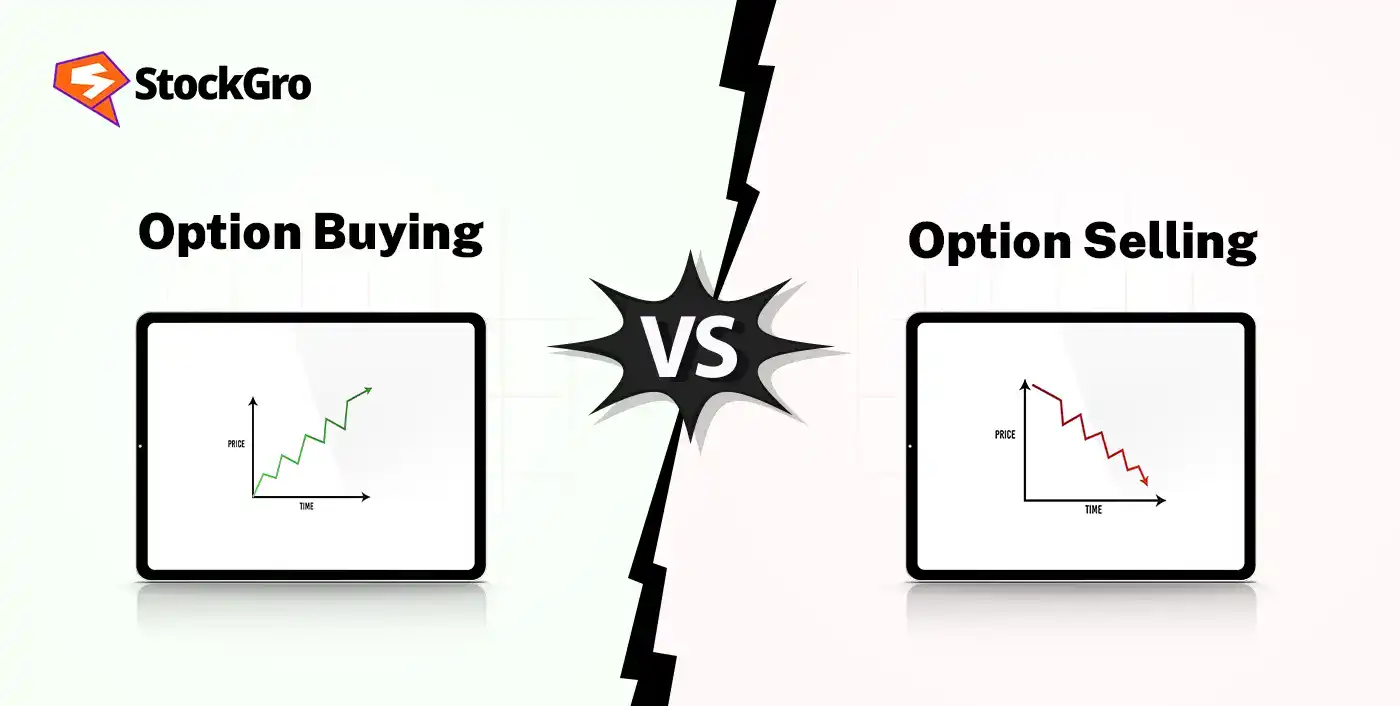
The same contract may be approached with opposing intentions. While one might purchase the option for potential directional gain, another might write the contract to collect premium income. These contrasting approaches form the foundation of the debate around Option Buying vs Option Selling.
To know more about option buying vs option selling, their risks, advantages, and practical uses, read this blog!
What is Option buying?
Option buying refers to purchasing an options contract, which gives the holder the right, without an obligation, for purchasing or selling an asset at a fixed price before the expiry.
For example, you believe the shares of a company, currently trading at ₹1,000, may rise soon. So you decide to buy a call option at ₹1,050 (strike price) which gives a premium of ₹20.
If the share price rises to ₹1,120 before expiry, the option becomes more valuable because it allows you to purchase the shares at ₹1,050 while the market price is higher. After accounting for the premium paid, you can earn a profit.
What is Option Selling?
Option selling refers to writing an options contract and receiving a premium in exchange for taking on the obligation associated with the contract.
Assume a stock, trading at ₹1,000, and you believe its price will remain below ₹1,050 for the next month. So you sell a call option with a strike price of ₹1,050 and receive a premium of ₹25.
If the stock price actually stays below ₹1,050 until expiry, the option expires worthless, and you keep the ₹25 premium as profit.
In case the share price reaches ₹1,120, the buyer of the option may decide to exercise the agreement. And you, the seller, then have to deliver the shares at ₹1,050 while the market price is higher, which can lead to a loss that exceeds the premium received.
Risks When Buying Options
Option buying offers limited loss but introduces risks related to timing, price movement, and declining option value.
- Time decay pressure: The value of options declines as the expiry comes near, which means even a correct market view may not generate profit if the move occurs too late.
- Need for price movement: Option buyers require the underlying asset to move sufficiently beyond the strike price to offset the premium paid and transaction costs.
- High probability of losses: Many purchased options expire without value, which means the traders may face frequent premium losses before capturing a profitable move.
Risks When Selling Options
Option selling generates premium income but carries obligations that can create substantial losses when markets move sharply.
- Large downside risk: When the underlying asset moves strongly against the position, the seller’s losses can grow significantly beyond the premium received.
- Margin requirements and capital commitment: Option selling generally requires maintaining a certain margin with the broker, which ties up capital and creates pressure during volatile market conditions.
- Exposure to sudden market shocks: Unexpected news, earnings announcements, or macro events can trigger abrupt price movements that challenge the risk profile of short option positions.
Pros and Cons of Buying Options
Let’s discuss the pros and cons of buying options:
| Pros of buying options | Cons of buying options |
| Option buyers risk only the premium paid, which creates a defined maximum loss regardless of how the underlying asset moves. | If the option remains out-of-the-money at expiry, the premium paid for the contract may be lost entirely. |
| Buying options allows the traders to participate in large price movements while committing relatively smaller capital compared to purchasing the actual asset. | Time decay erodes the option’s value as expiry approaches, which means the position loses value even if prices remain unchanged. |
| Options provide strategic flexibility through calls and puts, allowing traders to position for rising prices, falling prices, or volatility changes. | Profitable trades often require both accurate direction and timely movement, which makes consistent success challenging for many traders. |
Pros and Cons of Selling Options
Now, let’s discuss the pros and cons of selling options:
| Pros of selling options | Cons of selling options |
| Option sellers receive premium at the start of the trade, which becomes income if the contract expires without being exercised. | The losses can grow substantially when the asset moves beyond the strike price, particularly in uncovered option positions. |
| Short option strategies benefit from time decay, as the option’s value gradually declines while the seller holds the position. | Option selling requires margin with the broker, which ties up capital and may lead to margin calls during volatile market movements. |
| When options expire without value, sellers experience a higher probability of small but consistent premium gains. | Sudden market events such as earnings or macro news can result in price changes that expose short positions to significant losses. |
Is Buying or Selling Options Right for You?
The choice between option buying and option selling largely depends on a trader’s market outlook, capital availability, and tolerance for risk.
Option buying generally appeals to participants who expect a strong directional move and prefer a defined loss limited to the premium paid. It requires patience and an understanding that timing plays a decisive role, as option values decline with passing time.
Option selling, in contrast, suits traders who prefer generating premium income and who believe prices will remain within a certain range. However, this options trading strategy demands careful position sizing and strict discipline because losses can grow when markets move sharply.
In practice, the appropriate method depends on market conditions, trading objectives, and the trader’s ability to manage risk with consistency.
When option buying works best
Option buying tends to work best when traders anticipate strong directional movement and prefer defined risk within the option’s life.
- Expecting a strong directional move: Option buying works well when major events such as earnings announcements or economic developments are likely to move prices.
- Lower implied volatility environment: When implied volatility is relatively low, option premiums are cheaper, which allows the traders to benefit more if the market makes a strong move.
- Limited capital with defined risk: Option buying suits traders who prefer a strictly defined loss, since the maximum risk remains limited to the premium paid.
When option selling works best
Option selling generally performs better when markets remain stable, allowing traders to collect a premium while time gradually reduces option value.
- Range-bound market conditions: Option selling works well when the underlying asset is expected to move within a range rather than show a strong trend.
- Higher implied volatility levels: The volatility increases option premiums, which allows the sellers to collect larger income and maintain a wider margin for error.
- Structured strategies with margin support: Selling out-of-the-money options may provide a safety cushion when the traders maintain sufficient capital and risk discipline.
Can You Combine Buying and Selling Options?
Yes, option buying and option selling can be combined within the same strategy. In practice, traders often create positions by buying one option and selling a different option at the same time. These combinations allow traders to structure positions with greater control over possible gains and losses.
These structures are generally known as option spreads. For example, a trader expecting a modest upward move may create a position with a long call and a short call at a higher strike level. The premium received from the sold option reduces the cost of the purchased option, though it also places a limit on the maximum possible profit.
Through such combinations, traders can manage capital requirements, control risk, and align the position more closely with their expectations of price movement and market conditions.
Final Thoughts
Option buying and option selling represent two distinct ways of participating in the options market. Both of these approaches differ in terms of risk profile, capital usage, and likelihood of profit.
While some traders focus on directional opportunities through option buying, others may prefer the balanced income potential of option selling. In practice, success depends more on disciplined risk management and clear market judgment, and less on the method.
FAQ’s
Option buying is often considered more suitable for beginners because the maximum possible loss is limited to the premium paid. This allows traders to participate in the options market while maintaining defined risk and avoiding large margin obligations.
Option selling generally makes more sense when the markets are expected to remain stable or move within a limited range. In such conditions, time decay gradually reduces option value, allowing the seller to retain the premium if the contract expires without value.
Both direction and timing are important for option buyers. A trader may correctly predict the market direction, yet still lose money if the expected price movement occurs too late before the option’s expiry.
Option buying may benefit from strong directional moves, while option selling often performs well in stable markets. The suitable approach depends on the trader’s outlook, capital, and risk management ability.
Profitability depends on market conditions and trading discipline rather than the role itself. Option sellers often benefit from higher probability trades, while option buyers can capture larger gains during strong market movements. Both approaches can be profitable when managed carefully.