
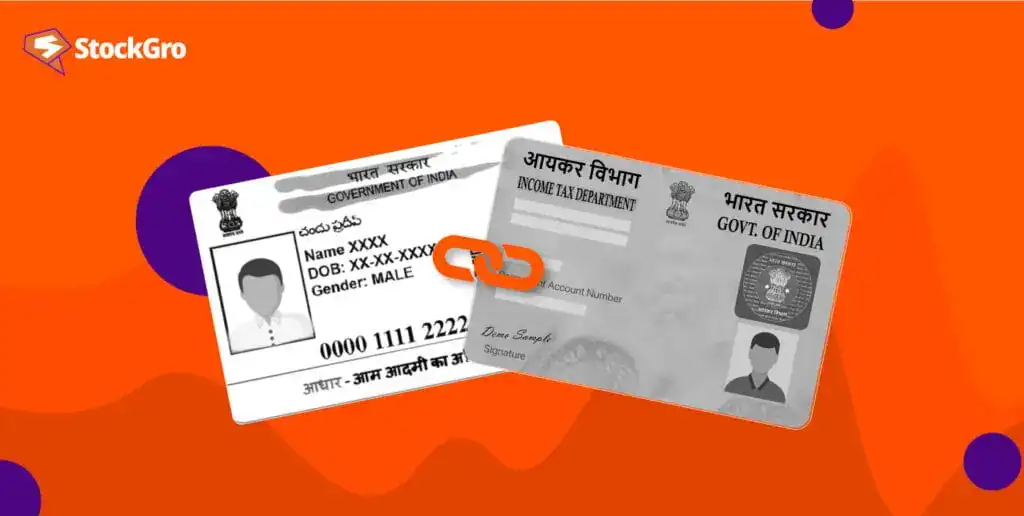
Linking a PAN card to an Aadhaar card is one of those compliance tasks everyone talks about, but only a few fully understand. As 2025 is about to wrap up, this requirement pops up across tax filings, bank updates, and investment paperwork.
The government has tightened the rules around the PAN usage, making its linking to Aadhaar unavoidable for the taxpayers. Understanding this link and knowing how to complete it correctly saves time, money, and last-minute stress.
Read further to understand how to link a PAN card to an Aadhaar card, penalties, exemptions, TDS impact, and what really happens if the PAN stops working.
Why is PAN Card to Aadhaar Card Linking necessary?
- PAN validity and ITR filing: If the PAN and Aadhaar are not linked, the PAN can turn inoperative, and an inactive PAN means an individual won’t be able to file an income tax return, even if they’re legally required to.
- Banking and high-value transactions: Banks rely on PAN cards for KYC and transaction monitoring. Without the linkage, bank services and high-value transactions may be restricted or put on hold.
- Investments and financial products: Investments in mutual funds, stocks, bonds, and insurance require a valid PAN card, and an inactive PAN can block new investments, redemptions, and portfolio updates.
- Loan eligibility and credit access: PAN status plays an important role in loan approvals. If the PAN is inactive, applying for personal loans, home loans, or lower-interest credit options can become difficult.
- Higher TDS deductions: When the PAN becomes inoperative, TDS may be deducted at higher rates. This increases the tax outgo and creates avoidable issues during tax filing.
Link PAN to Aadhaar: Step-by-Step
| Step-1 | Go to the Income Tax e-Filing website | Navigate to the Income Tax e-Filing website, and within the Quick Links section, select Link Aadhaar |
| Step-2 | Enter PAN and Aadhaar details | Fill in the PAN number and Aadhaar number exactly as per records, then submit for validation. |
| Step-3 | Verify using OTP | Enter the OTP sent to the mobile number linked with Aadhaar to confirm the identity |
| Step-4 | Pay the linking fee (if applicable) | If an individual links their PAN and Aadhaar after the deadline, they’ll be redirected to e-Pay Tax to pay the ₹1,000 feeSelect the appropriate assessment year and choose Other Receipts (500) as the type of payment |
| Step-5 | Complete payment and confirm linking | Finish the payment through net banking or other available modes, and return to the linking page to complete the process |
| Step-6 | Check confirmation status | Once submitted, an on-screen confirmation is received, which can be later verified using the status of the Link Aadhaar Status option on the portal |
How to Verify PAN-Aadhaar Linking
| Step-1 | Go to the Income Tax e-Filing page | Open the Income Tax e-Filing website |
| Step-2 | Access Link Aadhaar Status | On the homepage, go to Quick Links and click Link Aadhaar Status |
| Step-3 | Enter Details | Input your PAN and Aadhaar numbers in the designated fields |
| Step-4 | View Status | Tap on View Link Aadhaar Status The status will appear as: PAN is already linked, PAN is not linked, or Request is under process |
Penalty for Missed Deadline
As per the Ministry of Finance, individuals who were allotted PAN using an Aadhaar enrolment ID before 1 October 2024 must intimate their Aadhaar number to the Income Tax Department on or before 31 December 2025. After that, PAN cards not linked by this date will become inoperative from 1 January 2026, affecting income-tax filing, refunds, banking services, and other financial transactions.
If the deadline is missed, it will attract a ₹1,000 penalty, which must be paid through the Income Tax e-Pay option before completing the linking process on the Income Tax e-Filing portal.
TDS & its Significance
Linking PAN with Aadhaar directly affects how tax is deducted and credited. When the PAN becomes inoperative due to non-linking, the Income Tax Act treats it as invalid for tax purposes, which triggers stricter rules.
In such cases, TDS is deducted at a higher rate under Section 206AA, which means salaries, interest income, professional fees, or any other income subject to TDS will see higher tax cuts. In the case of TCS, tax is collected at elevated rates as per Section 206CC.
Also, any tax refund due will not be issued while the PAN remains inoperative, and no interest is paid for the delay period. These provisions make PAN to Aadhaar linking critical, not just for compliance, but to avoid excess tax deductions and cash flow issues.
Who is exempt from PAN-Aadhaar Linking?
The Income Tax Department states that PAN-Aadhaar linking is not required for the following categories of individuals:
- Individuals residing in Assam, Jammu and Kashmir, or Meghalaya
- Individuals considered non-residents in accordance with the Income-tax Act, 1961
- Senior citizens aged 80+ at any time in the previous year
- Non-citizens of India
Bottom line
PAN card to Aadhaar card linking is not an option. An unlinked PAN can disrupt tax filing, refunds, banking, investments, and loan access, while also triggering higher TDS deductions. Completing the linkage within the deadline keeps the PAN active and avoids penalties, excess tax cuts, and last-minute compliance issues that can easily be prevented with timely action.
FAQs
Yes, PAN-Aadhaar linking is mandatory for most taxpayers in 2025. PAN cards not linked by 31 December 2025 will become inoperative from 1 January 2026, affecting income-tax filing, refunds, banking transactions, investments, and other financial activities linked to PAN validity.
An inoperative PAN cannot be used for filing income-tax returns, receiving refunds, or completing many financial transactions. Banks, investment platforms, and lenders may restrict services, and tax deductions or collections can happen at higher rates until the PAN is reactivated through Aadhaar linking.
Yes, missing the deadline attracts a ₹1,000 penalty. The amount must be paid through the Income Tax e-Pay facility before completing the linking process. PAN can be reactivated only after the fee is paid and Aadhaar details are successfully updated on the portal.
The linking status can be checked on the Income Tax e-Filing portal using the Link Aadhaar Status option under Quick Links. Enter the PAN and Aadhaar numbers to see whether the PAN is linked, not linked, or if the request is still in process.
Yes, non-linking leads to higher TDS and TCS rates under applicable sections of the Income-tax Act. In addition, tax refunds are not issued while PAN remains inoperative, and no interest is paid for the delay period caused by the inactive PAN.
PAN-Aadhaar linking is not mandatory for residents of Assam, Jammu and Kashmir, and Meghalaya, non-residents under the Income-tax Act, individuals aged 80 years or above, and non-citizens of India, as specified by the Income Tax Department.