Summary
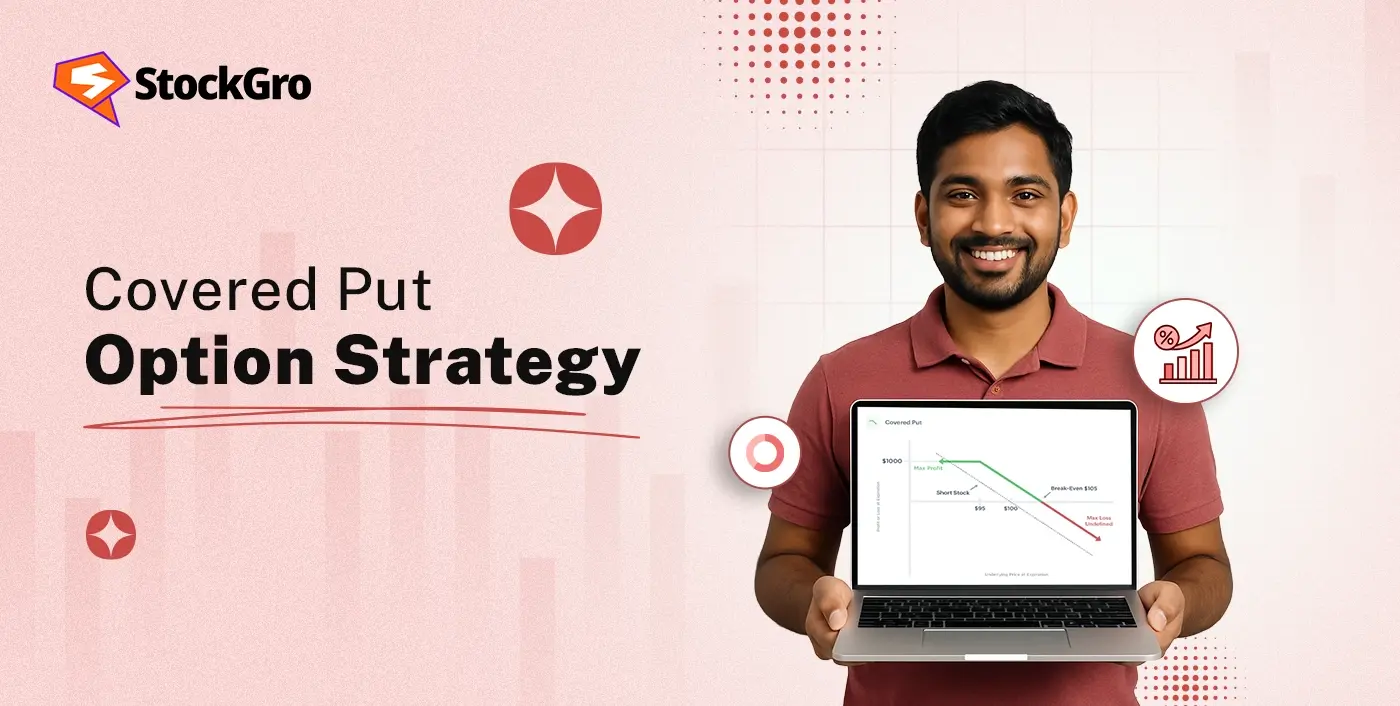
A covered put involves shorting a stock while simultaneously selling a put option on the same stock to earn premium income.
The strategy benefits from a moderately bearish market but carries risk if the stock price rises sharply.
Traders use covered puts to generate income, hedge positions, and take advantage of expected moderate downward price movements.
What is Covered Put Option Strategy?
A Covered Put Option Strategy is an options trading approach where an investor holds a short position in the underlying stock and simultaneously sells a put option on the same asset. This strategy is designed to generate additional income through option premiums while maintaining a bearish or neutral market outlook.
Unlike naked option selling, the covered put provides partial protection because the trader already has an existing short position in the stock. The premium received from selling the put helps offset potential losses if the stock price moves against expectations.
This strategy is commonly used by experienced traders who expect the stock to remain flat or decline slightly, allowing them to benefit from both price movement and option premium decay.
How Covered Put Works (Basics)
The Covered Put strategy works through a combination of short stock position + sold put option.
- Step 1: Short Sell the Stock
The trader borrows and sells the stock at current market price expecting it to fall. This creates profit potential if the price declines. - Step 2: Sell a Put Option
The trader sells a put option on the same stock at a lower strike price. This generates upfront premium income. - Step 3: Combine Both Positions
The premium from the put reduces the effective risk of the short position. If the stock remains stable or falls moderately, the strategy generates profit. - Step 4: Expiry Outcome
If the stock stays above the strike price, the put expires worthless and the trader keeps the premium. If it falls below, assignment may occur.
Step-by-Step Implementation Covered Put Option Strategy
- Step 1: Identify Bearish or Neutral Market Conditions
The strategy works best when the trader expects a slight decline or sideways movement. Strong bullish trends are not suitable. - Step 2: Select a Liquid Stock
Choose high-volume stocks to ensure smooth execution of short selling and options trading. Liquidity reduces slippage risk. - Step 3: Short Sell the Stock
Enter a short position at current market price. This forms the base of the covered put strategy. - Step 4: Sell Out-of-the-Money Put Option
Sell a put option at a lower strike price to collect premium income. This defines the risk boundary of the trade. - Step 5: Monitor Position Continuously
Track price movement, volatility, and option premium decay. Adjust or exit if market conditions change significantly.
Risk Management & Common Mistakes
- Ignoring Unlimited Upside Risk: If the stock rises sharply, short positions can incur unlimited losses. Traders must use stop-loss levels or hedging tools.
- Overlooking Assignment Risk: If the stock falls below the strike price, the put may be assigned. This increases exposure to the underlying position.
- Poor Stock Selection: Using illiquid or highly volatile stocks increases execution risk. Stable, liquid stocks are more suitable for this strategy.
- Misjudging Market Direction: Covered puts are not suitable for strongly bullish markets. Incorrect directional bias can lead to losses.
- Ignoring Margin Requirements: Short selling requires margin, and fluctuations can trigger margin calls. Proper capital planning is essential.
Real-World Examples & Use Cases
Example 1: Sideways Market Scenario
A trader shorts a stock at ₹1,200 and sells a ₹1,000 put option for ₹40 premium. If the stock remains between ₹1,000–₹1,200, the trader earns from both positions.
Example 2: Moderate Downtrend Scenario
If the stock falls from ₹1,200 to ₹1,050, the short position generates profit. The sold put expires worthless, and premium is fully retained.
Example 3: Sharp Downside Scenario
If the stock crashes below ₹1,000, the put may be assigned. While the short position profits, assignment risk increases exposure and must be managed carefully.
Example 4: Strategy Comparison Insight
When comparing covered call vs protective put, covered puts are bearish income strategies, while covered calls are bullish income strategies. This contrast helps traders choose based on market outlook and volatility conditions.
Final Thoughts
The Covered Put Option Strategy is a structured income-generating and risk-managed approach suitable for bearish or sideways markets. It combines short selling with option premium collection, offering dual profit potential but also requiring disciplined risk control.
While it provides attractive income opportunities, traders must carefully manage margin exposure, assignment risk, and directional bias. With proper execution, it becomes a powerful tool in advanced options trading strategies.
FAQs
Yes. It generates income through option premiums while holding a short stock position.
Yes. It is relatively safer because it is backed by an existing short stock position.
No. It is an advanced strategy and better suited for experienced traders.
Yes. If the stock falls below the strike price, assignment risk increases.
Yes. It performs well when markets are stable or mildly bearish.