

Bonds are debt instruments that are one of the suitable investment avenues for investors looking for stable income. Bonds come in various types based on their features. Deep discount bonds are one of those types where bonds are offered at a discount.
Let us discuss the meaning, features and calculations of deep discount bonds. Read further to know if this option meets your investment objectives.
What are bonds?
Bonds are debt financing instruments. They are also called fixed-income instruments, as they provide a fixed interest to investors at periodic intervals. Governments and corporations issue bonds to the public to raise funds in the form of loans.
Depending on the interest rate and issue price, bonds are classified into different types like zero-coupon bonds, inflation-indexed bonds, deep discount bonds, floating rate bonds, etc.
What is a deep discount bond?
Before we delve into deep discount bonds, it is essential to understand the meaning of the two primary concepts of bonds – the face value and the issue price.
- The face value refers to the value at which the bond was created. It is the value that the issuer will pay the bondholder at the time of maturity.
- The issue price is the cost at which the bondholder purchases the bond.
- When the issue price = face value, the bonds are issued at par.
- When the issue price > face value, the bonds are offered at a premium.
- When the issue price < face value, the bonds are issued at a discount.
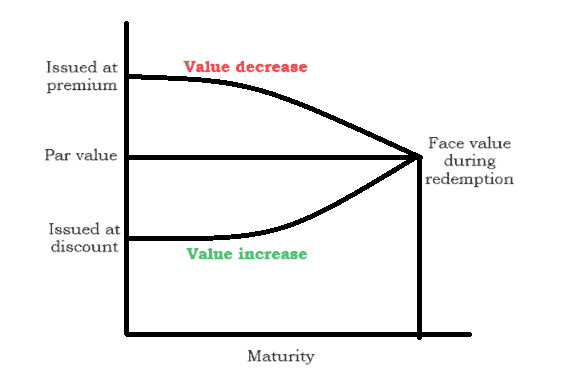
When bonds are issued at a significant discount, they are called deep discount bonds. The distinction between the face value and the issue price of such bonds is 20% or more, i.e., the issue price of deep discount bonds is 20% less than the face value of the bonds.
Also read: Government bonds in India – Meaning, types and features
Features of deep discount bonds
- Deep discount bonds are high-risk bonds whose demand is significantly lower than others in the debt market.
- Deep discount bonds carry minimal to no periodic interest at all in some cases, as they offer heavy discounts at the time of issuance.
- Some deep discount bonds fall under the category of junk bonds as the creditworthiness of the issuer of such bonds is low. These bonds usually have concerns around repayment, making them highly risky.
- Similar to other bonds, the issuer must pay the face value to the owner of the bond during redemption, if it is held until maturity.
Bond prices and interest rates move inversely. If the interest rate in the market increases, the value of existing bonds offering lower interest rates falls. The low value naturally impacts the demand for such bonds. Issuers resort to offering bonds at discounts to overcome the lack of demand. When investors still do not find it attractive, issuers offer further discounts, leading to deep discount bonds.
Deep discount bond calculation
The price of deep discount bonds can be calculated as below if the face value, discount rate and maturity period are known:
P = F/ (1+r)^n

P = Price, F = Face value, r= discount rate, n = Number of years till maturity.
The formula to calculate the yield-to-maturity (YTM) on discount bonds:
YTM = {C + [(F-P)/n)]} / {(F + P)/2}

C = Interest, F = Face value, P = Issue price, n = Number of years till maturity
Yield to maturity helps to ascertain the total returns earned from a bond that is held until its maturity.
Deep discount bonds example
Consider Company ABC Ltd offering bonds of face value ₹1,000 at an issue price of ₹750, with a maturity period of 3 years.
These bonds are issued at a discount of 25% and will be redeemed at ₹1,000 upon maturity.
Below are examples of some of the deep discount bonds issued in India:
- IDBI deep discount bonds: Industrial Development Bank of India (IDBI) was one of the initial issuers of discount bonds in 1992. The face value of the bond was ₹1,00,000, to be redeemed after a maturity period of 25 years. The bond was issued at ₹2,700.
- Sardar Sarovar Narmada Nigam Ltd deep discount bonds: SSNNL issued deep discount bonds in 1993 for a period of 20 years, with a face value of ₹1,11,000. The bond was offered at ₹3,600 in 1993.
You may also like: What are bonds and debentures? How are they different from each other?
Deep discount bonds: Pros & cons
Pros of investing in deep discount bonds:
- Given the significant difference between the issue price and face value, deep discount bonds result in high profits.
- Deep discount bonds are usually low-priced compared to other bonds in the market, making discount bonds accessible to all kinds of investors.
- Deep discount bonds are suitable for long-term investors as they reap high profits at the time of maturity.
- Discount bonds are easily tradable in the secondary market, making these bonds highly liquid.
Cons of deep discount bonds:
- Issuers offering deep discount bonds are generally considered to be in distress. Anything available at a discount is usually seen as an item of low quality. Similarly, deep discount bonds are seen as instruments with low reputations.
- The possibility of defaults is high for deep discount bonds, making them high-risk investments.
- A zero-coupon bond is a variant of a deep discount bond that does not pay any interest. Such bonds defeat the purpose of fixed-income securities.
What is the difference between a zero coupon and a deep discount bond?
At first glance, zero-coupon bonds and deep discount bonds may seem similar—both offer no regular interest payouts and are sold at a price significantly lower than their face value. However, there are key differences:
| Feature | Zero Coupon Bond | Deep Discount Bond |
|---|---|---|
| Interest Payout | No periodic interest | No periodic interest |
| Issued By | Typically governments or corporates | Usually issued by government agencies, PSUs, or large corporates |
| Price Discount | Moderate to significant | Steep discount (up to 80–90% lower than face value) |
| Maturity | Typically 1 to 10 years | Often long-term (10–30 years) |
| Tradability | Actively traded in secondary markets | Traded but less liquid due to longer maturities |
In short: Every deep discount bond is a zero-coupon bond, but not every zero-coupon bond is deeply discounted.
Best Strategies for Profitable Deep Discount Bond Trading
Trading deep discount bonds isn’t about short-term gains—it’s about timing, patience, and understanding interest rate cycles. Here are some strategies to help you make the most of them:
1. Buy During High-Interest Rate Periods
Deep discount bonds benefit the most when interest rates are falling. Buying them when rates are high means their value could rise as rates drop, allowing you to sell before maturity at a higher price.
2. Hold Till Maturity for Tax-Efficient Gains
If you’re a long-term investor, holding the bond until maturity ensures you receive the face value, which is significantly higher than your purchase price. This is especially effective for tax planning.
3. Use as a Long-Term Goal Investment
Want to fund your child’s education or your retirement? A ₹1,000 face value deep discount bond might cost ₹300 today—making it ideal for long-term compounding without market volatility.
4. Pair with Short-Term Income Instruments
Balance your portfolio by combining deep discount bonds with income-generating assets like fixed deposits or dividend stocks to maintain liquidity.
5. Monitor Market for Exit Opportunities
If interest rates decline and bond prices rise, consider selling in the secondary market before maturity to book profits early.
Key Challenges and Risks in Trading Deep Discount Bonds
While deep discount bonds can be highly rewarding, they come with their own set of risks:
1. Long Lock-In Period
These bonds often mature after 10, 15, or even 30 years. If your financial goals change, early exit might not be easy.
2. Interest Rate Sensitivity
Bond prices and interest rates move in opposite directions. If interest rates rise, your bond’s market value could fall.
3. Liquidity Risk
Not all deep discount bonds are actively traded. If you need to sell before maturity, finding a buyer could be difficult.
4. Tax Implications
Capital gains on redemption may be taxable depending on your holding period. Without proper planning, taxes can reduce your effective returns.
5. Credit Risk
Although many deep discount bonds are issued by PSUs or government-backed institutions, those from private companies carry the risk of default.
Deep Discount Debentures
A Deep Discount Debenture (DDD) is a type of fixed-income instrument that is issued at a significantly lower price than its face value (also known as par value). The bond does not pay periodic interest (coupon), but the investor receives the face value of the bond upon maturity. The difference between the issue price and the maturity value represents the investor’s return.
- Issued at a significant discount: DDDs are sold at a deep discount, often well below their face value.
- No periodic interest payments: Unlike traditional bonds, deep discount debentures do not pay any regular interest or coupon during the life of the bond.
- Mature at par value: At maturity, the investor receives the full face value of the debenture, which is higher than the original price they paid for it.
- Attractive for tax planning: Investors can benefit from tax efficiency in certain jurisdictions, as the interest income is typically recognized at maturity.
- Risk profile: Like other debt instruments, DDDs carry the risk of issuer default, but their high discount price compensates for this risk with potential for a significant return.
Deep discount debentures are generally favored by investors seeking long-term capital appreciation rather than regular income. They can be an excellent option in a low-interest-rate environment, where traditional fixed-income instruments may not offer attractive returns.
Deep Discount Bond Characteristics
A Deep Discount Bond (DDB) is a debt security issued at a price far below its face value, usually because it does not provide periodic interest payments. The investor profits when the bond matures and is redeemed for its face value.
- Issued at a substantial discount: The bond is sold at a much lower price than its par value, often below 50% of its face value.
- No coupon payments: Unlike regular bonds, DDBs do not provide periodic interest payments during their term. Instead, the investor’s return is derived from the difference between the purchase price and the face value paid at maturity.
- Maturity value: Upon maturity, the bondholder receives the full par value of the bond. This creates a capital gain equal to the difference between the purchase price and the par value.
- Long-term investment horizon: DDBs typically have long maturities, often 10 years or more, and are suitable for investors with a long-term investment outlook.
- Tax treatment: The return on deep discount bonds is often treated as interest income for tax purposes, though this varies by jurisdiction.
Due to the absence of periodic payments and the low price at issuance, deep discount bonds are generally viewed as riskier than traditional bonds, but they can be highly attractive for investors looking for a lump sum payout at maturity.
Bottomline
Deep discount bonds are debt instruments offered by the government and corporations to raise loans from the public. These bonds are offered at a price that is quite lower than their face value. Deep discount bonds are associated with high risks and returns. Hence, these bonds are a suitable avenue for those investors who are willing to take high risks for high returns in the long term.
Frequently Asked Questions (FAQs)
A deep discount bond is a zero-coupon bond issued at a steep discount to its face value. It doesn’t pay periodic interest. Instead, you receive the full face value at maturity. For example, you might buy a bond at ₹250 today that matures at ₹1,000 in 20 years.
Redemption usually happens automatically at maturity, when the issuer credits the face value to your registered bank account. If held in demat form, the bond is credited and settled through your broker or depository.
Yes, but only if the bond is listed and actively traded in the secondary market. Keep in mind that early redemption might not fetch the full face value and depends on market demand.
Yes. The difference between your purchase price and redemption value is considered capital gain. If held for more than 12 months, it qualifies as a long-term capital gain (LTCG) and may be taxed accordingly.
While both zero-coupon bonds and deep discount bonds are issued at a discount and do not provide periodic coupon payments, the key difference lies in their issuance price and structure:
Zero-Coupon Bonds: These are typically issued at a discount but are not meant to be a specific type of bond; they can be issued at any price below face value, not necessarily a “deep” discount. The primary characteristic is that they do not pay any interest over their life and are redeemed at par value at maturity.
Deep Discount Bonds: These bonds are issued at a significantly lower price, often less than 50% of their face value. Deep discount bonds are a subset of zero-coupon bonds but are distinguished by the larger discount to face value. The difference between zero-coupon bonds and deep discount bonds is that DDBs usually have a much larger discount, representing a higher potential return.
Deep discount bonds are generally issued at a price that is substantially below their face value (par value). This could be anywhere from 10% to 50% of the face value, depending on the specific terms of the bond and the issuer’s financial conditions. These bonds are often issued when the issuer needs to raise capital quickly or when market conditions lead to lower interest rates, making it difficult for traditional bonds to attract buyers.
A deep discount bond is issued at a deep discount and redeemed at par (face value) upon maturity. This means that the bondholder purchases the bond for much less than its face value, and at maturity, they receive the full face value of the bond. The difference between the issue price and the redemption price represents the investor’s return on the investment.