

What is your opinion about low-cost investment? The normal tendency is that most investors grab such opportunities with both hands. But are such investments really safe?
Today, we will discuss one such instrument in the stock market, available at reasonable costs. However, the risks associated with this instrument are high. Read further to know how penny stocks work and the impact of investing in such costs.
What are penny stocks?
Penny stocks belong to listed companies whose market capitalisations are low. There is no exact range to determine a penny stock, however, the penny share price in the Indian stock market is usually below ₹10.
In the Western markets, stocks whose share prices are below $5 come under this category.
Understanding penny stocks
In India, penny stocks work like all other stocks in the market. They are available for trading on the National Stock Exchange (NSE), Bombay Stock Exchange (BSE) and on Over-the-Counter (OTC) markets, as well.
In the Western markets, penny stocks usually trade on the OTC markets. Their listing is rare on stock exchanges.
It is essential here to note that all penny stocks are small-cap stocks, too. But, all small-cap stocks are not penny stocks.
Small-cap stocks relate to companies with a market capitalisation of ₹5,000 crores or lower. Market capitalisation represents the value of a company’s stocks in the market. It is the market share price of the stock multiplied by the number of shares outstanding.
Since the share prices of penny stocks are low, they will impact the market capitalisation of companies.
The low prices of stocks may be due to various reasons. Sometimes, it can be for genuine reasons where companies are new to public exposure. Other times, it can be for severe reasons where companies are not performing well.
When the goodwill of companies is affected, the demand for their stocks reduces, thereby decreasing their share prices. Stocks falling under the penny stock category due to such reasons are generally risky.
How to find penny shares?
Investors often mistake small-cap stocks for penny stocks. Hence, it is essential to understand the features of penny stocks that will help investors identify penny stocks:
- Penny stocks are highly volatile. Since penny stocks belong to companies with weak balance sheets, they react aggressively to market conditions. Such companies are not stable like large-cap companies.
- Penny stocks lack liquidity. Given the risks, the number of investors willing to invest in penny stocks is low. So, finding buyers and sellers for penny stocks is difficult.
- The possibility of return on penny stocks is uncertain. Either they fail and go so low to the extent of being delisted, or they grow in manifolds and offer huge returns to investors. Stability in returns is rare.
The pros and cons of investing in penny stocks
Advantages of investing in penny stocks:
- Penny stocks are an ideal investment avenue for new investors who do not have sufficient experience in investing and trading. Since penny stocks require low investments, this is a risk worth taking.
- Some penny stocks have the ability to turn into multi-bagger stocks. Multibagger stocks are those which provide returns in manifolds to investors. Since the investment needed is low, an increase in share prices of penny stocks can reap high benefits for investors.
Disadvantages of investing in penny stocks:
- Speculative risk is an in-built feature of penny stocks. The probability of profit and loss are equal owing to the uncertainty in their prices. So, such stocks are ideal for investors who are willing to high-risk exposure.
- Penny stocks are often subjected to financial scams like the pump-and-dump. Pump and dump is where scammers buy large quantities of stocks through fake accounts and investors to increase the demand and price of such stocks. They then sell it to benefit from the increased price.
Examples of penny stocks in India
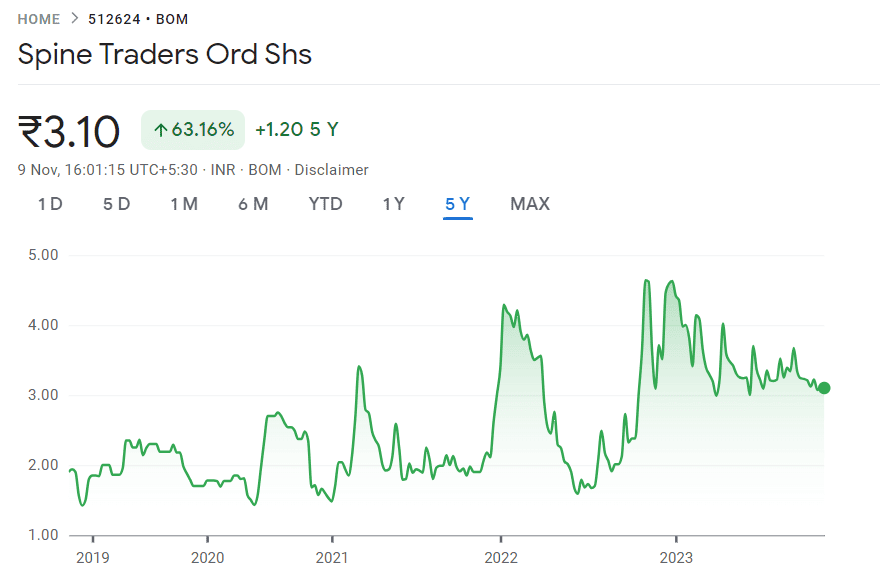
- Regent Enterprises Ltd
The shares are listed on the Bombay Stock Exchange (BSE) under Spine Traders Ord Shs.
Share price as of 09 Nov 2023: ₹3.10
Market capitalisation: ₹10.40 crores
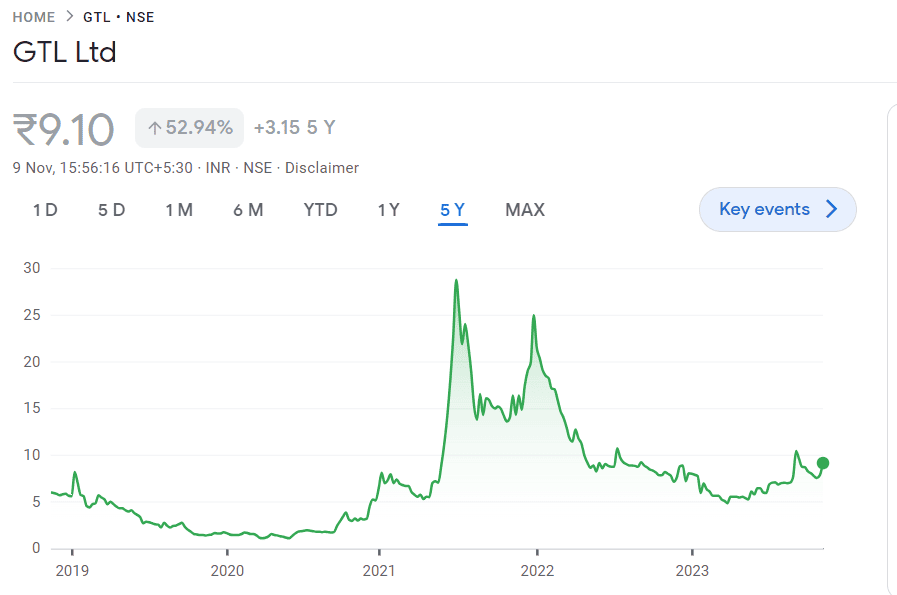
- GTL Ltd
The shares are listed on the National Stock Exchange (NSE).
Share price as of 09 Nov 2023: ₹9.10
Market capitalisation: ₹143 crores
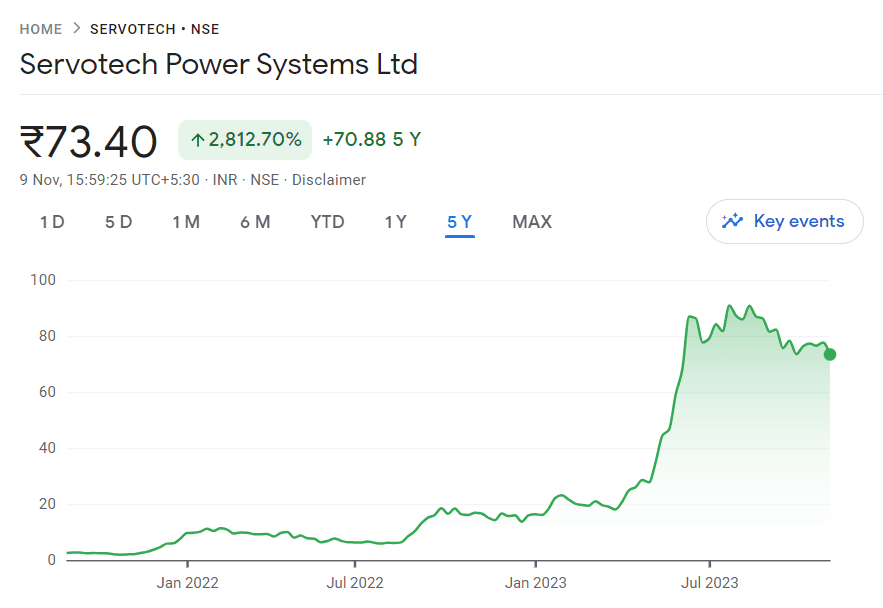
Here is an example of a penny stock that turned into a multi-bagger recently.
The share price of Servotech Power was ₹2.50 in 2021. It raised to ₹86 in August 2023, offering a 3,300% return to investors.
So, if you had invested ₹1 lakh in Servotech’s shares in 2021, the value of your investment would be ₹34 lakhs in August 2023.
How to buy penny shares?
Buying penny stocks is similar to regular stocks.
Investors must open a demat account with a brokerage firm and select the penny stocks they wish to invest in.
Though the process of buying such stocks is simple, it requires a thorough analysis of different factors before investing in the penny stock market.
- Investors must essentially analyse their risk appetites before anything else.
- Going through the financial statements of penny stock companies and analysing them through various ratios can be significant in making investment decisions.
What Is The Penny Stock Market?
The penny stock market refers to a segment of the stock market where very low-priced shares of small companies are traded. These stocks usually trade at very low prices, often below ₹10, ₹20, or ₹50 per share in India, although the exact threshold can vary depending on the exchange or market classification.
Penny stocks are typically issued by small-cap or micro-cap companies with relatively low market capitalisation. Many of these companies are still developing their business models, expanding operations, or trying to scale their revenues.
Unlike large, well-established companies listed on major indices like the Nifty 50 or Sensex, penny stock companies often operate in niche sectors or emerging industries. Because they are small businesses with limited financial history, their stock prices tend to fluctuate more dramatically.
These stocks are usually traded in lower volumes and may be listed on smaller exchanges or traded in specific segments designed for smaller companies. As a result, the penny stock market is often seen as a high-risk, high-reward space where prices can move sharply within short periods.
For some investors, penny stocks represent an opportunity to enter companies early before they potentially grow into larger businesses. However, the same factors that create this opportunity also make penny stocks significantly riskier compared to established companies.
How Does Penny Stock Investing Work?
Penny stock investing works similarly to regular stock investing, but with some key differences in risk, volatility, and liquidity.
Investors purchase shares of low-priced companies in the hope that the company will grow and the stock price will increase significantly. Because the share price is small, even a modest increase can generate large percentage returns.
For example, if a penny stock priced at ₹5 rises to ₹10, the investor earns a 100% return. This potential for large percentage gains is one of the main reasons some investors are attracted to penny stocks.
However, penny stock investing usually involves more speculation than traditional investing. Many investors rely on:
- Business turnaround stories
- Early-stage company growth potential
- Sector momentum
- Short-term trading opportunities
Penny stocks are often traded through regular brokerage accounts on exchanges like the BSE and NSE, although some may also trade in smaller or less liquid segments.
Because these companies are smaller and less widely tracked by analysts, investors usually need to perform their own research. This includes studying company fundamentals, management credibility, and business sustainability before making any investment decisions.
Some traders also treat penny stocks as short-term trading opportunities, taking advantage of quick price movements rather than holding them for long-term growth.
Characteristics Of Penny Stocks
Penny stocks have several unique characteristics that differentiate them from large-cap or blue-chip stocks.
Low Share Price: The most defining feature of penny stocks is their low trading price. Many penny stocks trade below ₹10 or ₹20 per share, which makes them accessible even to investors with small amounts of capital.
Small Market Capitalisation: Companies issuing penny stocks usually have very small market capitalisations, often falling into the micro-cap or small-cap category. This means their total market value is significantly lower than that of established companies.
High Volatility: Penny stocks often experience large price swings in short periods. A stock might rise or fall by 10–20% in a single trading session, making them highly volatile.
Low Liquidity: Liquidity refers to how easily a stock can be bought or sold. Penny stocks often have lower trading volumes, meaning fewer buyers and sellers are active in the market. This can make it harder to enter or exit positions quickly.
Limited Public Information: Unlike large companies that publish detailed financial reports and receive constant analyst coverage, penny stock companies often have limited publicly available information. This makes evaluating their financial health more difficult.
High Speculative Interest
Because of their low prices and potential for quick gains, penny stocks often attract speculative trading. This can sometimes lead to rapid price spikes that may not always reflect the company’s actual performance.
Risks Of Investing In Penny Stocks
While penny stocks can offer the potential for high returns, they also come with significant risks. Investors need to understand these risks before entering this segment of the market.
High Price Volatility: Penny stocks can move sharply within a short period. While this volatility can generate gains, it can also lead to sudden losses if the stock price drops quickly.
Liquidity Risk: Because trading volumes are often low, it may be difficult to sell a penny stock when you want to exit the investment. This can trap investors in positions during falling markets.
Limited Financial Transparency: Many penny stock companies provide limited financial disclosures compared to larger firms. This makes it harder to analyse their true financial position and growth potential.
Susceptibility To Price Manipulation: Due to their small size and low trading volumes, penny stocks are sometimes vulnerable to price manipulation schemes such as pump-and-dump activities, where prices are artificially inflated before large investors exit their positions.
Weak Business Fundamentals: Some penny stock companies may have unstable or unproven business models. Without strong revenue streams or profitability, the company may struggle to sustain long-term growth.
High Probability Of Loss : Because of the combination of volatility, limited information, and speculative activity, penny stocks carry a higher probability of loss compared to investing in established companies.
Bottomline
Penny stocks trading are low-cost investment options available on the exchange. They can be called budget investments, given their reasonable market prices. However, the performance of such stocks is uncertain to the highest level. While some perform well and yield high returns, others can lead to heavy losses.
Hence, investors must use their discretion to see if such stocks are essential in meeting their investment objectives.
FAQ’s
Junk stocks are shares of companies that have very weak financial health, poor business performance, or high debt levels. These companies often struggle to generate stable profits and may face serious financial difficulties. Because of this, their stocks are considered highly risky by investors.