Introduction
You may have come across the term ‘range-bound’ in reference to Nifty and Sensex. This is a common phenomenon in equity markets where prices oscillate within a specific range for a certain period. When these markets eventually break out of this range, it can present significant profit opportunities for traders.
However, predicting the timing and direction of these breakouts can be speculative, often leading to potential trading losses. Instead, traders can consider range-bound trading.
This strategy capitalises on the predictable price movements within the defined range, thereby minimising risk exposure and maximising profit potential.
What is a range-bound market?
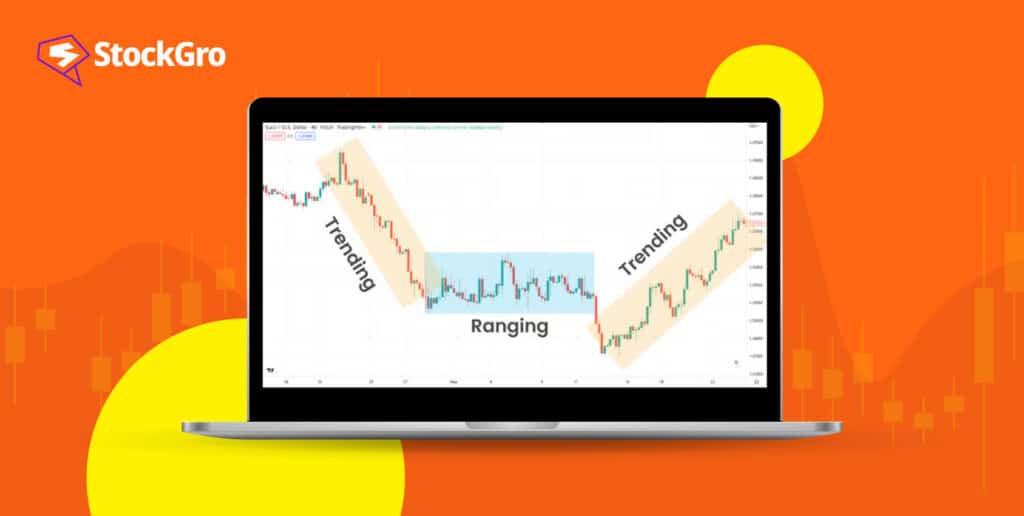
As the name suggests, a range-bound market is a situation where a security’s price, such as a stock’s price, commodity’s price, or crypto’s price, remains within range. The price oscillates between a specific high price and a low price for a certain period.
Here, the high price acts as a resistance level that the security struggles to break through, while the low price serves as a support level where the security tends to bounce back.
This constant bouncing between the support and resistance levels creates a ‘range’ that the security is ‘bound’ by, hence the term ‘range-bound market’. In a range-bound market, the market does not exhibit a significant trend in any direction.
Prices typically oscillate, reaching previous highs before retreating to former lows.
How to identify a range-bound market?
Recognising a range-bound market necessitates a sharp eye and a deep comprehension of market trends.
Traders can spot a market that is ranging by keeping an eye on the market’s support and resistance levels and pinpointing the best spots to set entry and exit orders.
Technical indicators like the average directional index (ADX) and Bollinger Bands can also be used to verify that the market is in a trading range.
ADX
The ADX is an indicator of trend strength that can assist traders in determining whether the market is trending or ranging. A reading below 25 on the ADX indicates that the market is range-bound, while a reading above 25 suggests a trending market.
Bollinger Bands
Bollinger Bands, a volatility indicator, can also be used to identify range-bound markets. It consists of a moving average line with two standard deviation lines above and below it.
When the price of the security touches the upper or lower Bollinger Band, it indicates an overbought or oversold market condition, respectively, suggesting that the price is likely to revert to the mean.
Options strategy for range-bound market
Here are some of the option strategies that traders can utilise for the range-bound market:
1. Iron condor strategy:
To set up an iron condor, a trader does two things at once. They sell a put and a call option that are not likely to be exercised (out-of-the-money). Then, they buy a put and a call option that are even less likely to be exercised (further out-of-the-money).
The most they can earn from this strategy is the money they get from selling the options (the net premium). The maximum loss they can incur is the difference between the strike prices of the two options (call or put), subtracting the net premium they received.
2. Calendar spreads
In this strategy, you buy an option that lasts a long time until it expires, and simultaneously, you sell another option that has the same type and exercise price but expires sooner.
In a long calendar spread, the maximum profit is made when the stock price equals the strike price at the expiration of the short call. The maximum loss is the total cost of the spread.
3. Short strangle or straddle
In a straddle strategy, a trader can sell an at-the-money (ATM) call and put options.
However, if traders think the price will move a lot, they can opt for a short strangle strategy, where they can sell out-of-the-money (OTM) call and put options that are not likely to be exercised.
In both cases, the most they can earn is the money they get from selling the options (the premium), but the loss could be unlimited.
Is range-bound trading effective?
Range-bound trading can be an effective strategy, especially in a stable market where the price of the security is not making significant moves up or down. This enables traders to reap profits from minor price fluctuations within the range.
However, it is important to note that this strategy requires careful monitoring of the market, as a breakout from the range can lead to losses. Further, to employ range-bound trading, traders must have a good grasp of technical analysis and the fundamental elements that influence an asset’s price range.
This strategy involves purchasing at the lower trendline, known as the support, and selling at the upper trendline, known as the resistance.
This allows you to capitalise on the temporary peaks and troughs within the range, potentially leading to market gains.
When you are dealing with range-bound markets, ensure that you verify the range before initiating any buy or sell orders.
Who should use range-bound trading?
Range-bound trading is best suited for investors who are patient and are comfortable with waiting for the price to reach the desired levels. In such cases, traders will preferprofiting from the oscillations of an asset’s price within a certain boundary, rather than forecasting the broader market trend.
This strategy can be beneficial for those who aim to execute short-term trades and exploit the price variances within a clearly delineated range. It is fair to say that it is well-suited for those who lean towards a more cautious trading strategy.
However, it necessitates a solid grasp of technical analysis and options trading.
How To Find Range Bound Stocks
Range bound stocks are stocks that move within a fixed price range for a certain period instead of trending strongly upward or downward. In such stocks, the price repeatedly moves between a support level (lower boundary) and a resistance level (upper boundary).
To find range bound stocks, traders usually analyse price charts and technical indicators. The first step is to identify clear support and resistance zones. If a stock repeatedly bounces between two levels without breaking out, it is likely trading in a range.
For example, if a stock keeps moving between ₹100 and ₹120 for several weeks, ₹100 becomes the support level and ₹120 becomes the resistance level.
Some common methods used to identify range bound stocks include:
Support and resistance analysis: Look for stocks where prices frequently reverse at the same levels. These zones indicate strong buying and selling interest.
Low trend strength indicators: Indicators like the Average Directional Index (ADX) can help detect range-bound conditions. When ADX is low, it often signals that the market lacks a strong trend.
Moving averages flattening out: When short-term and long-term moving averages move sideways rather than trending up or down, it often indicates consolidation.
Volume behaviour: Range-bound stocks often show relatively stable trading volumes without sudden spikes.
By identifying these characteristics, traders can focus on stocks that are moving sideways and plan strategies accordingly.
How To Identify A Range Bound Market
A range bound market occurs when the broader market or a specific stock moves sideways without forming a clear upward or downward trend.
In this situation, prices fluctuate within a defined range and investors wait for a major trigger such as economic data, corporate earnings, or global events before taking strong positions.
Some key signs of a range bound market include:
Sideways price movement: The price repeatedly moves between support and resistance without breaking out.
Low trend strength:Technical indicators like ADX often show weak trend momentum.
Repeated price reversals: The market keeps bouncing from similar price levels.
Lower volatility compared to trending markets: Although prices fluctuate, they usually stay within a predictable range.
Range bound markets often appear during periods of uncertainty or consolidation, when investors are waiting for new information before driving the next big trend.
Best Option Strategy For Range Bound Market
Range bound markets are ideal for options strategies that benefit from stable price movement rather than strong directional trends.
One commonly used strategy is the Iron Condor. In this strategy, traders sell an out-of-the-money call option and an out-of-the-money put option while also buying further out-of-the-money options to limit risk. This approach generates profit if the underlying stock or index remains within a specific price range.
Another strategy is the Short Strangle. In this approach, traders sell both a call option and a put option at different strike prices. The goal is to earn premium income as long as the stock stays within the expected range.
A slightly safer alternative is the Short Straddle, where traders sell both a call and put option at the same strike price. However, this strategy carries higher risk if the market moves sharply.
For many traders, range bound markets provide an opportunity to earn option premiums through time decay, as option values gradually decline when the underlying asset does not move significantly.
However, these strategies require careful risk management because a sudden breakout can lead to losses. Therefore, traders usually monitor support and resistance levels closely before applying range-bound strategies.
Bottomline
Becoming proficient in navigating markets that do not have a strong trend can be a great asset for any trader, helping traders to make gains even when prices are not moving significantly on either side.
But remember, like all trading strategies, it demands consistent practice, self-control, and a deep knowledge of how markets work. Note that it is not a universal trading strategy that fits everyone. The most effective strategy often varies depending on the trader’s style and their comfort with risk.