
A key element of investing that often perplexes new investors is diversification. Not just limited experience, but constrained capital and other roadblocks also hinder optimal allocation and diversification of funds.
In such a scenario, an investment medium like multicap mutual funds can aid diversification and propel portfolio growth. As of early 2026, over 30 multi-cap schemes across asset management companies (AMCs) collectively manage approximately ₹2.23 lakh crore in assets under management (AUM), indicating broad adoption among equity-oriented investors.
This significant AUM base displays the growing preference of investors in multi-cap funds as a strategic tool for long-term wealth creation across market capitalisation. Therefore, this blog explores the top multicap funds in India.
Understanding multicap mutual funds
According to the product categorisation circular issued by SEBI in October 2017, mutual funds can be categorised into large-cap, mid-cap and small-cap funds based on the nature of company stocks held by them.
| Equity mutual fund | Nature of stock held (based on market capitalisation) |
| Large-cap funds | The top 100 publicly listed companies |
| Mid-cap funds | 101st to 250th listed companies |
| Small-cap funds | Companies from the 251st onwards |
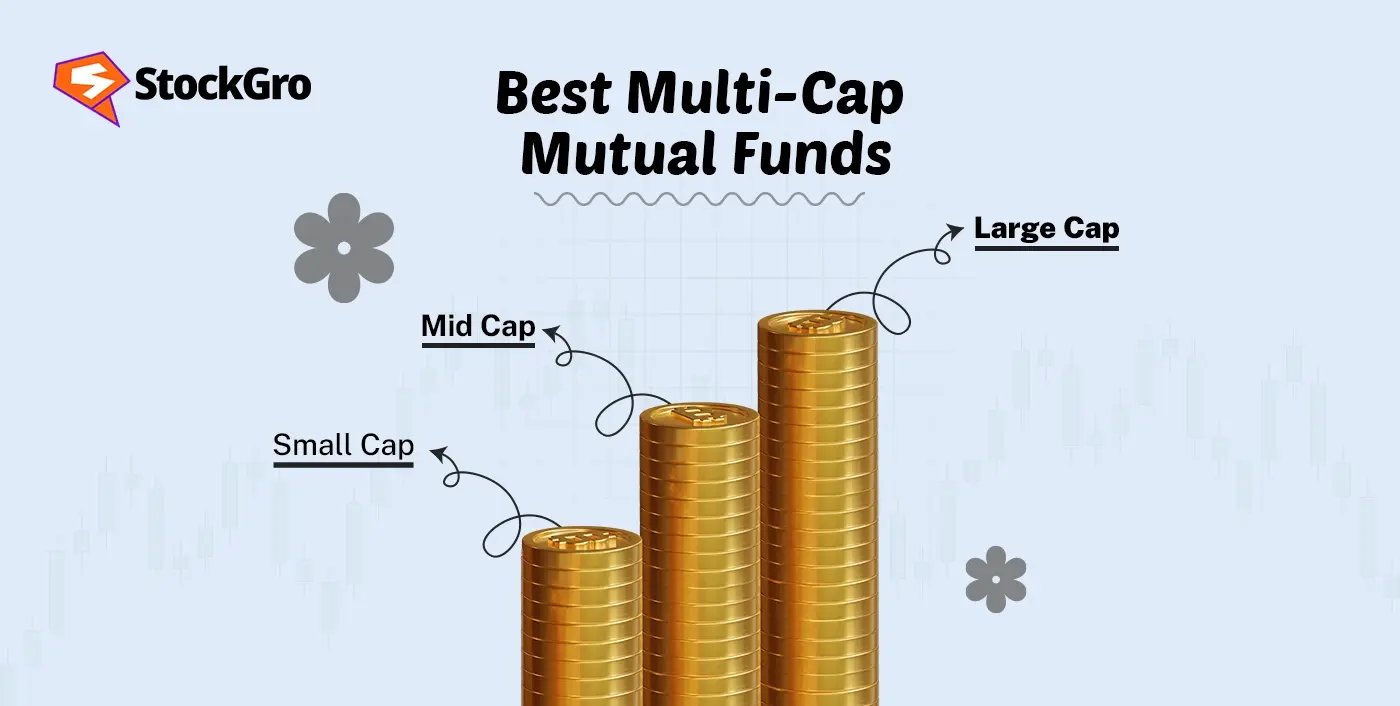
Unlike large-cap, small-cap and mid-cap funds, multi-cap mutual funds can invest in equities across the spectrum. It implies that they can invest in companies of all sizes. However, there are certain criteria specified by SEBI for their asset allocation.
| Size category | Minimum allocation |
| Large-cap companies | At least 25% |
| Mid-cap companies | At least 25% |
| Small-cap companies | At least 25% |
| The remaining 25% can be invested in any instruments according to the discretion of the mutual fund house. | |
Multicap mutual funds offer diversification that can yield both stability and high returns. However, some factors must be considered before choosing the best multicap fund.
Factors to consider before investing in the best multicap fund
Choosing the best multi-cap mutual funds requires analysis of particular funds along with the consideration of some industry-specific and investor-specific factors as of 19 Jan 2026.
- Category returns: The category average returns offered by the multi-cap mutual funds stand at 5.43%. The top category performer offered a return of 12.64%, whereas the poorest performer recorded a negative return. However, the category performance in the long term is more important than the short-term performance. Therefore, the table below shows the metrics for more intervals.
| Tenure (years) | Average (%) | Top performer (%) | Bottom performer (%) |
| 3 | 18.37 | 24.65 | 8.51 |
| 5 | 18.10 | 24.08 | 14.04 |
| 10 | 15.96 | 18.09 | 14.12 |
- Category risk: Since the multi-cap mutual fund invests across different sectors, the risk is diversified and targets minimisation. Therefore, discussed below are some category average risk meters. Comparison of individual risk metrics with fund-specific metrics can aid in optimal decision-making.
| Particulars | 3 years (%) | 5 years (%) | 10 years (%) | 15 years (%) |
| Standard deviation | 13.6799 | 21.9340 | 17.8778 | 18.0489 |
| Sharpe ratio | 0.8799 | 0.9263 | 0.5706 | 0.4417 |
| Sortino ratio | 1.4413 | 1.7079 | 0.8325 | 0.6511 |
- Nature of investors: While investment in midcap mutual funds is not restricted to any category of individual, certain investors, like beginners, benefit more accurately through this investment medium due to its diversified nature.
Along with these metrics, an analysis of individual mutual funds is important as well. Therefore, this blog explores the top 5 multicap funds for long term.
Top 5 multicap funds for long-term
Discussed below are the five multicap funds listed based on the 3-year returns as of 19 Jan 2026.
| Particulars | Kotak Multicap Direct Growth Fund | Axis Multicap Fund Regular Growth | Nippon India Multicap Direct Growth Fund | Mahindra Manulife Multicap Fund | HDFC Multicap Direct Growth Fund |
| AUM (₹ crores) | 21,848 | 9,270.66 | 50,352.17 | 6,132.78 | 19,884.94 |
| Risk (₹) | High | Very High | Very high | Very high | Very high |
| Expense Ratio | 0.45 | 1.77 | 0.72 | 1.78 | 0.77 |
| Sharpe Ratio | 1.18 | 1.10 | 1.18 | 0.88 | 1.02 |
| Standard Deviation | 15.04 | 13.58 | 12.96 | 14.67 | 14.03 |
| 3-year return (%) | 24.62 | 21.75 | 21.27 | 19.38 | 20.27 |
Discussed below is a detailed analysis of the top multicap fund. It might aid optimal investor research before choosing a fund.
- Kotak Multicap Direct Growth Fund: This top multicap fund has the lowest expense ratio among its top 5 peers. The high standard deviation reflects high volatility but delivers optimum risk-adjusted returns, considering the optimum Sharpe along with 3-year returns of the mutual funds.
- Axis Multicap Fund Regular Growth: The regular plan’s nature means you are paying 1.77% in expenses, which is significantly higher than direct alternatives. Despite this cost drag, the fund has managed reasonable performance over three years. The relatively lower volatility compared to peers might appeal to investors who want multicap exposure without extreme price swings.
- Nippon India Multicap Direct Growth Fund: It has the largest AUM among the two 5 multicap funds for long-term growth. It also has a high Sharpe ratio and 3-year returns, indicating strong performance and investor confidence comparatively.
- Mahindra Manulife Multicap Fund: This one’s the smallest fund in the group and trails on most performance metrics. The combination of high costs and lower returns makes it a harder sell, especially when compared to the other options available. Investors would need compelling reasons beyond the numbers to choose this fund over its better-performing peers.
- HDFC Multicap Direct Growth Fund: It offers a moderate fund with moderate metrics. 98.56% of the portfolio is invested in equity, with 1.44% invested in others. However, asset allocation in all other sectors, namely large-cap, mid-cap, and giant-cap, is lower than the respective industry average.
It is necessary to consider the applicable taxation on the mutual fund category because it has an important bearing on the amount of gain an investor can generate from the fund.
Best multi-cap mutual funds: Taxability
The applicable tax rate on the multicap sector is discussed in this section.
| Particulars | Tax Rate (%) |
| Short-term capital gain on funds transferred before 23 July 2024 | 15 |
| Short-term capital gain on funds transferred on or after 23 July 2024 | 20 |
| Long-term capital gain on units transferred before 23 July 2024 | 10 |
| Long-term capital gain on units transferred on or after 23 July 2024 | 12.5 |
| Moreover, according to section 112A, long-term capital gain up to ₹1,25,000 is not taxable. | |
Bottomline
Multicap mutual funds might simplify diversified investing by allocating investor funds across companies of different capital structures. Not only do they allow risk mitigation through large-cap and giant-cap allocations, but they also aid portfolio growth through diversification into small-cap and mid-cap stocks. Understanding the portfolio allocation is important before investing. Moreover, along with fund-specific metrics, checking allocation distribution might aid investors in choosing a mutual fund that fits their investing objective and rationale.
FAQs
Multi-cap mutual funds are a subset of equity mutual funds that distribute assets among large-cap, mid-cap, and small-cap corporations. These funds invest in various market capitalisation categories, allowing the possibility of both capital appreciation and risk diversification, to strike a balance between stability and growth. However, an optimum analysis of mutual fund metrics is important before making any decision.
Multicap mutual funds diversify across equities of different capital structures. Therefore, even with limited funds, investors can diversify across various bands and mitigate risk. However, since the majority of the allocation is towards equity, it is a market-linked security. Plus, like any market-linked security, it is impacted by the volatility of the equity market and is not completely risk-free.
Investors should consider the category average metrics and compare them with the metrics recorded by the mutual fund. It can offer valuable insights into how the fund is performing compared to its peers and the category. Moreover, the asset allocation of the fund should also be noted. An investor should also consider their own financial goal and risk appetite before choosing an asset.
The top five multicap mutual funds based on their AUM are Nippon India Multicap Direct Growth Fund, SBI Multicap Direct Growth Fund, Kotak Multicap Direct Growth Fund, HDFC Multicap Direct Growth Fund, and ICICI Prudential Multicap Direct Growth Fund. However, only considering their AUM is not enough. Investors should also take into account other fund-specific metrics and compare them to the industry average to get a holistic view of the performance.
Long-term capital gain of up to ₹1,25,00 from multicap mutual funds is not taxable according to Section 112A of the Income Tax Act. However, STCG and LTCG (above the exemption limit) are taxable. If the LTCG or STCG occurs on or after 23 July 2024, a tax of 20% and 12.5% respectively, applies to them. Investment planning should be complemented with tax planning for optimum fiscal decision-making.
The best multi-cap funds for long-term investment typically include those with a solid track record and experienced fund management. Popular choices for long-term growth include Mirae Asset India Equity Fund, SBI Magnum Multicap Fund, and Parag Parikh Long Term Equity Fund. These funds have consistently delivered strong returns and diversified exposure to large, mid, and small-cap stocks, making them reliable options for long-term investors.
Multi-cap funds invest in a defined mix of large, mid, and small-cap stocks, providing structured diversification across market segments. Flexicap funds, on the other hand, offer more flexibility, allowing the fund manager to adjust the allocation based on market conditions without fixed restrictions. If you prefer a structured, diversified approach, multi-cap funds may suit you better. If you want flexibility and adaptability to market changes, flexicap funds might be a better choice.
The best multi-cap fund depends on your investment goals and risk tolerance. Some top options include Mirae Asset India Equity Fund, SBI Magnum Multicap Fund, and Franklin India Flexi Cap Fund. These funds have demonstrated strong long-term performance and have experienced fund managers behind them, making them a good choice for most investors.
To choose a multi-cap fund, look at its performance history, particularly over a 3 to 5-year period. Evaluate the fund manager’s experience, as strong leadership is crucial for navigating market cycles. Also, consider the expense ratio, with lower costs typically leading to better net returns. Ensure the asset allocation is well-diversified across large, mid, and small-cap stocks, and check if the risk profile aligns with your investment objectives.