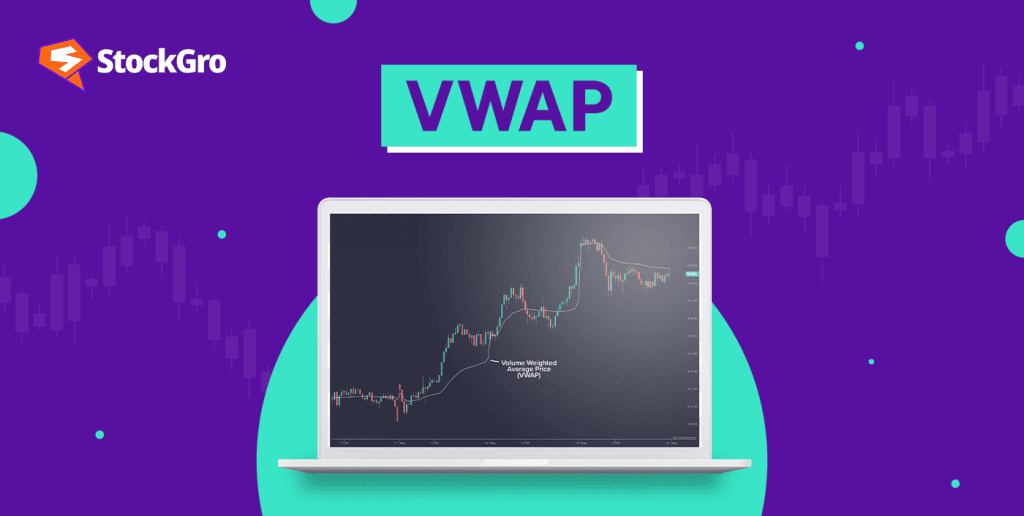
Prices in the market are always moving, but not every price level reflects the true balance of trading activity. There are some technical indicators that combine both price and volume to reveal the level of market participation. The Volume Weighted Average Price (VWAP) is one such widely used benchmark that offers deeper context to price movements.
If you want to learn about VWAP and how it is used, then this guide is for you.
What Is the Volume-Weighted Average Price (VWAP)?
The VWAP uses both price and trading volume to show a security’s average price over a specific trading session.
Unlike some indicators that only consider price, VWAP assigns greater importance to levels with higher trading volume. This helps in creating a more realistic representation of the trading activity.
VWAP is generally calculated throughout a trading session and resets at the beginning of each new session. Because of this, it is widely used as a benchmark for evaluating how the price compares with the average trading level.
How to Calculate VWAP
The Volume Weighted Average Price (VWAP) is calculated by combining both price and trading volume. The formula ensures that price levels with higher trading activity have a greater influence on the final average.
VWAP = Σ (Typical Price × Volume) / Σ Volume
Where Typical Price = (High + Low + Close) / 3
Volume is the number of shares traded during the time period.
Assume a stock trades during three time intervals with the following values:
| Time Period | High | Low | Close | Volume | Typical Price | Price × Volume |
| 1 | ₹102 | ₹98 | ₹100 | 1,000 | ₹100 | ₹100,000 |
| 2 | ₹104 | ₹100 | ₹102 | 1,500 | ₹102 | ₹153,000 |
| 3 | ₹106 | ₹101 | ₹105 | 2,000 | ₹104 | ₹208,000 |
Step 1: Calculate the Typical Price
Period 1: (₹102 + ₹98 + ₹100) / 3 = ₹100
Period 2: (₹104 + ₹100 + ₹102) / 3 = ₹102
Period 3: (₹106 + ₹101 + ₹105) / 3 = ₹104
Step 2: Multiply Typical Price by Volume
This step assigns greater weight to price levels where higher trading volume occurred.
Period 1: ₹100 × 1,000 = ₹100,000
Period 2: ₹102 × 1,500 = ₹153,000
Period 3: ₹104 × 2,000 = ₹208,000
Step 3: Calculate the Cumulative Totals
Total Price × Volume = ₹100,000 + ₹153,000 + ₹208,000 = ₹461,000
Total Volume = 1,000 + 1,500 + 2,000 = 4,500
Step 4: Apply the VWAP Formula
VWAP = Σ (Typical Price × Volume) / Σ Volume
VWAP = ₹461,000 / 4,500 = ₹102.44 approximately
How Is VWAP Used?
VWAP can be used in different ways when analysing price behaviour. It often serves as a reference point for interpreting how price interacts with the broader trading activity.
VWAP as Support & Resistance
VWAP can act as a dynamic support or resistance level in a trading session.
When the price is above VWAP and falls toward it, buyers appear, making it behave like support. Similarly, when price approaches VWAP from below, selling pressure can emerge, causing the VWAP to act as resistance.
For example, assume a stock has a VWAP of ₹250. The price rises to ₹258 and later falls to ₹250. The buyers step in and push the price back to ₹255, showing support.
In another case, if the price rises from ₹242 to ₹250 but drops again to ₹244, VWAP serves as the resistance level.
Entry & Exit Strategies using VWAP
VWAP can also be used when looking for potential entry and exit opportunities. When prices move meaningfully away from the VWAP, it indicates stronger momentum.
Observing how the price behaves around this level can help in identifying when participation is increasing or weakening and taking positions.
As an example, suppose a stock trades with a ₹150 VWAP, and it rises from ₹147 to ₹153. An entry might be considered near ₹153, placing a stop-loss around ₹149 below VWAP to manage risk.
If the upward move continues, a target around ₹160 may be considered. However, if the price falls back toward ₹150, the position may be exited to limit losses.
VWAP for Day Traders vs Institutions
VWAP is valuable for both day traders and institutional traders, although the purpose may differ.
For traders, the VWAP serves as a real-time reference point. It helps them in assessing whether the price is relatively at a premium or discount compared with the average trading level of the session. This supports decision-making based on trends and reversals.
For institutions, VWAP is more than just an indicator. It serves as a benchmark for execution quality. Large institutions look to place orders in a manner that doesn’t cause aggressive shifts in the market. They try to execute trades close to or better than VWAP.
In simple terms, day traders may use VWAP for timing, while institutions may use it for performance evaluation and efficient trade execution.
VWAP vs Simple Moving Average
The following table compares how VWAP and the Simple Moving Average (SMA) differ in representing average price levels in the market.
| Feature | VWAP | SMA |
| Data Used | Uses both price and trading volume data | Uses only price data |
| Calculation | Average price weighted by traded volume | Arithmetic average of selected closing prices |
| Reset Period | Resets at the beginning of each session | Continues across periods based on selected window |
| Purpose | Shows average traded level with participation volume | Helps smooth price data to identify trends |
| Use Case | Used for session-based price evaluation | Used to analyse broader price trend and direction |
| Sensitivity | Responds strongly to periods of higher volume | Influenced only by price changes over time |
Limitations of VWAP
Although VWAP is widely used, it also has certain limitations that traders should consider before using it.
- Lagging Nature: It is based on historic price and volume data. It does not predict future price movement but only shows what has already happened.
- Session-Based: The VWAP resets in each trading session. This makes it more suitable for short-term trades rather than longer trend analysis.
- Low Volume Inaccuracy: When trading activity is low, VWAP is not reliable as a few trades can disproportionately affect the average.
- False Signals: Range-bound conditions or rapid movements can cause the price to cross the VWAP line multiple times, creating misleading signals.
- Not a Standalone Tool: It is more effective when used with other indicators, chart patterns, and risk management. Using it alone can lead to inconsistent results.
What does the VWAP indicate?
VWAP indicates the average price level after accounting for volume. Comparing the current price with VWAP aids in determining the market behaviour:
- When the price stays above the VWAP, it means the momentum is positive, and buyers are in control. It suggests that demand is dominating the trading activity.
- When the price remains below the VWAP, it reflects sellers growing stronger. This indicates that supply is currently outweighing demand in the market.
In essence, VWAP provides context about the price movements by linking them with actual trading activity.
Why Is the Volume-Weighted Average Price Important?
VWAP plays a notable role in market analysis. Its relevance can be understood through the following key aspects:
- Institutional Benchmark
Institutional traders use it to evaluate if the shares they bought or sold were close to the fair price. This ensures they don’t move the market with large orders. - Trend Confirmation
VWAP helps in identifying the overall direction of the market. Price above VWAP reflects buying momentum, while prices below it indicate selling pressure.
- Key Reference
The VWAP can act as a dynamic support and resistance level where the market may pause, bounce, or struggle to move beyond in a trading session. - Trade Position
It helps in identifying potential entry and exit points based on whether a security is trading above or below its average traded level.
Is VWAP a Leading Indicator?
Yes, VWAP is considered a lagging indicator because it is based on the past price and volume of the trading session.
It does not tell about the future price movement. Instead, it helps in interpreting the current market conditions. For this reason, VWAP is commonly used as a reference or confirmation tool rather than a signal generator.
Although it is not predictive, VWAP remains valuable because it offers a structured way to evaluate how the price reacts with the overall trading activity.
Bottomline
The VWAP brings together price and trading volume to highlight the average level where the most market activity has occurred. By reflecting how strongly the market has behaved at different price points, it offers a clear perspective on the price behaviour and overall participation levels. While it works best when used alongside other forms of analysis, VWAP remains a widely referenced benchmark for market evaluation.
The real market story lies not just in price, but in where trading activity truly happens.
FAQ’s
VWAP is used by comparing the current market price with the VWAP line. If the price is above VWAP, it suggests buying strength, while a price below VWAP indicates weakness. Traders often combine it with trend analysis and volume.
VWAP and EMA serve different purposes in technical analysis. VWAP incorporates both price and volume to show the average traded level, while EMA focuses on recent price movements. They can be used together depending on your trading strategy and market conditions.
VWAP can be fairly accurate for evaluating a security’s average traded price during a session because it incorporates both price and volume. However, as a lagging indicator, it may react slowly to sudden market movements. It should be combined with other indicators and broader market analysis for better trading outcomes.