In India, commodity trading has always revolved around a few dominant players, such as gold, crude oil, natural gas, and base metals. These might sound like just some popular names, but they are the best commodities to trade in India because of their high liquidity, global relevance, and consistent participation on exchanges like MCX.
With the given short-term fluctuations in the trend, investors/traders maintain their focus on the traded volume, volatility, and macro trends to identify opportunities. The beginner, on the other hand, might be drawn to sudden price movements or short-term momentum, without considering where the actual market participation is.
This is where understanding the best commodities to trade in India becomes essential, as the most actively traded commodities tend to offer better opportunities regardless of short-term market noise.
Read further to find the best commodities to trade in India in 2026!
What is Commodity Trading?
In the financial markets, commodity trading means the purchasing and selling of derivatives contracts, which are based on commodities such as gold, silver, crude oil, cotton, wheat, coffee, etc. Unlike shares, these contracts have an expiry date, on which they are exercised, or the delivery of commodities is supposed to be undertaken.
Now, when we say commodity trading, it doesn’t mean we are actually buying the asset, like a barrel of crude, to store it in our place; instead, we purchase a contract, which represents the asset or commodity. While in certain cases, actual delivery of the commodities takes place, retail traders usually settle the contracts with cash. That is, when the contracts expire, the price difference is settled with cash.
Top Traded Commodities in India
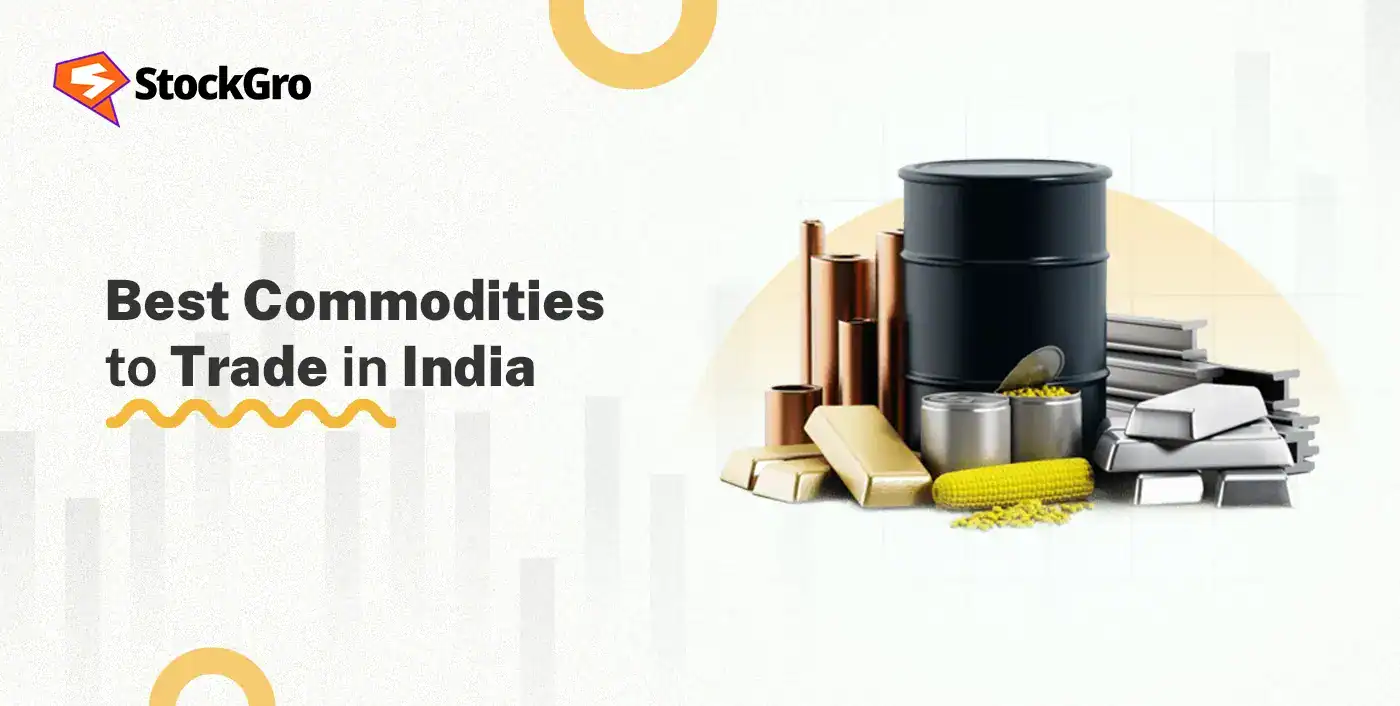
The top traded commodities in India, which are primarily active on the Multi-Commodity Exchange (MCX), are influenced by industrial usage and hedging needs. Commodities such as crude oil and natural gas lead the energy segment, while gold and silver serve as safe-haven assets. Copper stands out among base metals for industrial demand, and cotton plays a major role as an agricultural commodity linked to textile consumption.
Gold
Gold has so far been one of the most traded commodities in India due to its demand during global uncertainty, strong institutional and central bank buying, and continuous high trading volumes on MCX.
In the financial year 2025–2026, gold, one of the safe-haven assets, grew at an unexpected speed and remained in a strong long-term uptrend, reaching near ₹1.61 – ₹1.62 lakh per 10 grams on MCX in March 2026 amid geopolitical tensions.
As of 19 March 2026, gold prices are around ₹1.55 lakh, indicating consolidation after reaching record highs.
Crude Oil
Crude oil dominates commodity trading in India due to its high trading volumes on MCX, strong global price linkage, and volatility driven by macro and geopolitical events.
As of 19 March 2026, crude oil prices have climbed above $112 per barrel, marking a rally driven by the ongoing geopolitical conflicts affecting the energy infrastructure.
Given this, with MCX crude oil futures surging 62% in just six sessions amid supply concerns, crude oil has emerged as one of the most actively traded commodities.
Natural Gas
Natural gas continues to stand as one of the best commodities to trade in India due to its strong price movements creating trading opportunities, close correlation with crude oil and global energy trends, and consistent market participation during high-impact events.
Over FY2025-26, natural gas has remained an active energy commodity, with prices reacting to the West Asia war. Natural gas prices have climbed more than 5%, supported by escalating geopolitical tensions impacting the energy infrastructure.
Copper
In FY2025, copper delivered a strong rally and reached nearly 50%. Amongst the best commodities to trade in India, copper prices have reached record highs, driven by supply shortages colliding with growing demand from AI infrastructure, EVs, and clean energy sectors, which supports sustained momentum in copper markets.
Silver
Silver stands out because of its dual demand from an industrial and investment point of view, higher volatility than gold, and strong trading volumes in MCX contracts.
As of 19 March 2026, silver is trading at around ₹2.60 lakh/kilogram, showing consolidation after a sharp rally. Overall, earlier in March 2026, it had seen a strong upward momentum alongside gold, with prices reaching ₹2.7 lakh/kilogram – ₹2.8 lakh/kilogram levels.
Cotton
Cotton is amongst the best commodities to trade in India because of its price stability, global demand from the textile industry, and structured seasonal cycles that offer predictable trading opportunities.
In FY2025–2026, the cotton industry saw strong government backing, with MSP increased to ₹7,710–₹8,110 per quintal for the 2025–26 season, ensuring stable pricing and farmer participation. The government has further approved ₹1,718 crore MSP support to Cotton Corporation of India, strengthening price stability and preventing sharp downside risks in the market.
Conclusion
The Indian commodity market continues to revolve around a few highly traded assets that consistently attract strong participation. The Indian investors prefer commodities such as gold, crude oil, natural gas, copper, silver, and cotton due to their liquidity, global relevance, and consistent demand. While short-term price movements may vary, these commodities offer better trading opportunities, which makes them a practical choice for both beginners and experienced traders in 2026.
FAQs
The best commodities to trade in India include gold, crude oil, natural gas, copper, silver, and cotton. These commodities are preferred due to their high liquidity and strong price movements. They react to global events, which makes them suitable for active traders. Investors usually focus on volume and volatility to identify the most suitable option.
The 7 C commodities refer to agricultural products that start with the letter “C”, such as crude oil, corn, cotton, coffee, cocoa, copper, and cattle. These commodities are widely traded in global markets due to their economic importance and consistent demand across industries, making them relevant for both trading and hedging purposes.
Crude oil is considered the most actively traded commodity in India due to its high trading volumes and strong global demand. It plays a major role in the economy and is closely linked to inflation and energy needs. Gold also ranks among the top due to its cultural importance and investment demand across the country.