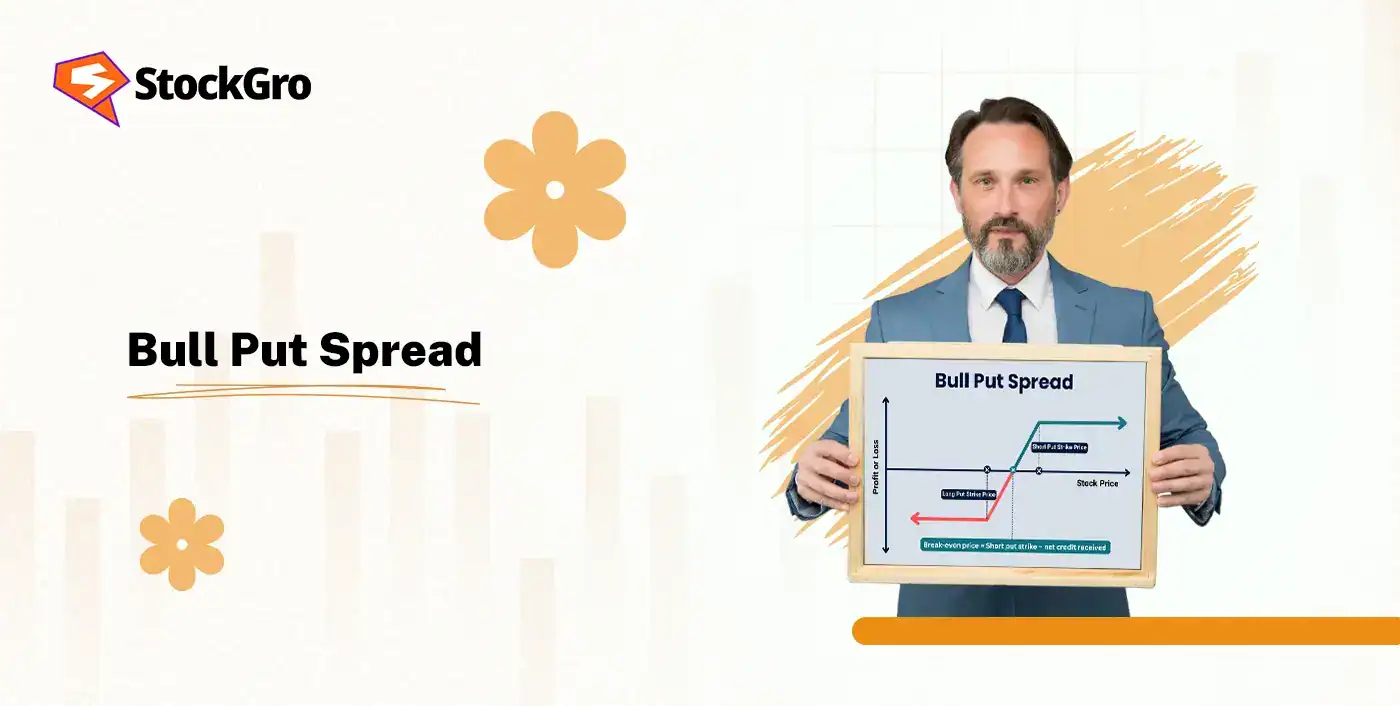

Buying single call options can be expensive and risky due to time decay, often leaving traders with losses even if the market moves slightly up. The Bull Call Spread offers an effective solution to this problem by reducing upfront costs and defining risk. With market data from 2025 showing that retail investors now account for nearly 39% of equity option premiums, a 17-year high, understanding risk-managed strategies is more important than ever. Read this blog to learn how this strategy works, its construction, and when it is typically applied.
What Is a Bull Call Spread?
A bull call spread is designed with two coordinated option legs and is suitable when only a gradual price climb is expected. Rather than taking only one call, the trader opens two legs at once, purchasing a call and selling a second call at a higher-strike call on the same security. By design, this setup offers fixed risk while placing a ceiling on how much profit can be earned. It is also commonly referred to as a “debit call spread” because the trader pays a net amount to enter the position
The Construction of a Bull Call Spread
The construction of this strategy involves a specific setup of buying and selling option legs to create a hedged position. The usual approach for initiating a bull call spread involves entering both option positions at once on the same instrument and expiration period, as follows:
- Buying the lower strike: The long leg is created by acquiring a call that is often At-The-Money (ATM) or marginally In-The-Money (ITM).
- Selling the higher strike: The trader simultaneously sells (writes) another call option (short position) at a higher strike price, usually Out-Of-The-Money (OTM).
- Same expiration: Both the long and short call options must share the exact same expiration date to act as a vertical spread.
- Net debit calculation: The premium received from the sold call partially funds the purchase of the long call, resulting in a net debit (cost) for the trade.
Key Attributes of a Bull Call Spread
Before executing this trade, it is essential to understand the mathematical boundaries that define its performance. The main attributes of this strategy include:
- Defined risk: The maximum loss is strictly limited to the net premium paid upfront. The trader’s downside risk remains fixed at the initial debit, irrespective of how much the price sinks.
- Capped reward: Maximum gains equal the spread between the two strikes after subtracting the cost paid. Once the stock price surpasses the higher strike call, profits no longer increase.
- Lower breakeven point: Because the sold call reduces the overall cost basis, the stock price does not need to rise as much for the trade to become profitable compared to a naked long call.
- Directional bias: The strategy requires a bullish market view. The strategy benefits when the asset rises, but theta affects the long and short calls in separate ways.
Why Do Traders Use Bull Call Spread?
Traders often prefer this strategy over a simple long call because it offers a more structured approach to speculation. The primary reasons for using a bull call spread are:
- Cost reduction: Purchasing a naked call often requires a large premium, particularly when dealing with costly shares. Writing the upper-strike call reduces the net cost of establishing the spread.
- Volatility management: High implied volatility can make buying options prohibitively expensive. By selling an option simultaneously, the trader neutralises some of the volatility risk, as they are both buying and selling expensive premiums.
- Targeted profitability: If a trader believes a stock will rise but encounters resistance at a specific level, selling a call at that resistance level monetises the limited upside view.
- Psychological comfort: Knowing the exact maximum loss at the time of entry allows for better emotional discipline and trade management compared to undefined risk strategies.
Structure of a Bull Call Spread
The “structure” refers to the payoff profile and how the trade behaves as the market moves between the two strike prices. The mechanics of the spread include:
- The floor (below lower strike): If the asset closes below the bought call’s strike, both legs lapse with zero worth. The structure dictates that the loss is frozen at the net debit paid.
- The slope (between strikes): As the stock rises past the lower strike (breakeven), the long call gains value. The profit accumulates point-for-point as the stock moves toward the higher strike.
- The ceiling (above higher strike): Once the stock passes the sold call strike, the short position begins to lose money, offsetting further gains from the long position. This creates a “flat” profit line.
- Net debit impact: The structure is always initiated for a cost (debit), meaning the account balance decreases immediately upon entry, requiring the market to move up to recoup the cost.
Advanced Variations of Bull Call Spread
Once traders master the basic vertical spread, they may look to adjust the risk profile or possibility of profit using variations. Some advanced variations as follows:
- Call ratio spread: Instead of a 1:1 ratio, a trader might buy one lower strike call and sell two higher strike calls. This can reduce the cost to zero or create a credit, but it introduces undefined risk if the stock price skyrockets.
- Bull call diagonal spread: This involves buying a long-term call option (LEAPS) and selling a shorter-term call option against it. This benefits from time decay differences between the two expiration dates.
- Bull ladder spread: This adds another leg by selling an additional put or call to finance the trade further, creating a complex three-legged structure with different risk parameters.
- Deep ITM bull call spread: A trader might use deep in-the-money options for both legs. This structure mimics the behaviour of the underlying stock (high delta) with very little extrinsic value, functioning as a stock replacement strategy.
When NOT to Use a Bull Call Spread
While useful, this strategy is not a universal solution for all bullish scenarios. Avoid using this method when any of these conditions apply:
- Aggressively bullish view: If a trader expects the stock to double or make a massive move, the capped profit of the spread will result in significant opportunity cost compared to a naked long call.
- High transaction costs: Since the strategy involves two legs (two commissions), it may not be cost-effective for very small position sizes where fees eat into the potential spread width.
- Impending binary events: While it limits volatility risk, if a binary event (like earnings) might cause a move far beyond the short strike, the trader caps their upside while still risking 100% of the debit if the move is in the wrong direction.
- Bearish or neutral markets: This is a directional strategy. If the market falls or stays flat, the full debit paid will likely be lost.
Bull call spread vs Bull put spread
Both strategies are bullish and defined-risk, but they differ fundamentally in cash flow and execution. Here’s how they differ:
| Feature | Bull call spread | Bull put spread |
| Type | Debit Spread (You pay to enter) | Credit Spread (You receive money to enter) |
| Construction | Buy Low Strike Call, Sell High Strike Call | Buy Low Strike Put, Sell High Strike Put |
| Profit mechanism | Profits as the spread value increases | Profits as the spread value decreases (expires worthless) |
| Max loss | Net Debit Paid | Difference in Strikes − Net Credit Received |
| Best used when | Expecting a moderate rise (Active participant) | Expecting the price to hold or rise (Passive income) |
Bull Call Spread Pros and Cons
To thoroughly evaluate the bull call spread, it is important to assess the trade-off between its advantages and its limitations, such as:
Pros
- Premium offset mechanism: By selling a higher strike call to finance the purchase of the lower one, the total cash required to open the trade is significantly lowered.
- Absolute loss ceiling: The financial exposure is locked at the net debit paid at inception, meaning the maximum loss is pre-calculated regardless of how drastically the stock crashes.
- Optimised breakeven level: Since the entry cost is cheaper, the underlying asset requires a smaller upward move to become profitable compared to a standalone call option.
- Theta decay buffer: The daily value loss (time decay) suffered by the bought option is partially neutralised by the time decay gained from the sold option.
Cons
- Fixed upside limit: The strategy sacrifices unlimited potential; profits stop accumulating once the price surpasses the short strike, even if the stock rallies significantly.
- Dual commission impact: Executing two separate contracts simultaneously doubles the brokerage fees, which can eat into the tighter profit margins of the spread.
- Multi-leg management: Entering and exiting a spread requires monitoring the liquidity and bid-ask prices of two different options rather than just one.
- Rally underperformance: In a scenario where the stock price explodes upward unexpectedly, this spread will yield significantly lower returns than holding a single long call.
Conclusion
Think of the bull call spread as just one tool in a toolkit, not a perfect solution for every situation. It works well at specific times but requires patience. Self-awareness in trading capacity is equally crucial as grasping the technical details. As the market moves, staying adaptable and learning regularly helps you develop as a trader.
FAQs
The bull call spread is relatively safe for beginners compared to naked calls because it limits maximum loss to the net premium paid. It reduces upfront costs and defines risk clearly, offering better emotional comfort and easier trade management for less experienced traders.
Neither is universally better; bull call spread is a debit strategy profitable on moderate upward moves, while Bull Put Spread is a credit strategy benefiting from price holding or rising. The choice depends on your market view, risk tolerance, and preference for upfront cost versus premium received.
Maximum profit equals the difference between the two strike prices minus the net debit paid. Maximum loss is limited to the net premium paid upfront, regardless of how far the underlying asset declines.
Bull call spread involves buying a lower strike call and selling a higher strike call (debit spread), profiting when the asset rises. Bull Put Spread involves selling a higher strike put and buying a lower strike put (credit spread), profiting when the price holds or rises.
Use a bull call spread when expecting a moderate price rise, and you want to limit risk and upfront costs. It’s suitable when anticipating resistance at a certain level, as profits are capped beyond the short call strike.
Effectiveness depends on strike price selection, timing relative to the underlying asset’s movements, implied volatility levels, premium costs, time until expiration, and the ability to manage the position through market fluctuations and commissions. High volatility often favours this spread.