
One of the common challenges while trading for success in the market is not being able to buy or sell a stock quickly without affecting its price. This is where liquidity becomes important. In fact, studies show that high-turnover stocks consistently exhibit stronger liquidity, allowing large volumes to be traded with minimal price impact.
This makes understanding what is liquid stock essential, as it explains how easily shares can be traded in the market. Let’s dig into its details in this blog now.
What is a Liquid Stock
A liquid stock refers to a share that can be easily bought or sold in the market without causing a significant change in its price. These stocks usually have a high number of buyers and sellers actively trading them.
Liquidity in stocks depends on factors such as trading volume, market participation, and company size. Large-cap companies generally have higher liquidity because they attract more investors and institutions.
In simple terms, if a stock can be quickly converted into cash at a fair price, it is considered liquid. On the other hand, stocks with fewer buyers and sellers are called illiquid stocks, where transactions may take time or impact prices significantly.
Why does Liquidity Matter?
Liquidity determines how easily a stock can be traded and how efficiently the market reflects its true value. The key reasons liquidity matters are as follows:
- Quick buy & sell without delays: Highly liquid stocks allow investors to enter or exit positions swiftly because enough buyers and sellers are present, reducing trading friction.
- Lower transaction costs: Narrow bid–ask spreads in liquid stocks reduce hidden costs, ensuring more of your money goes into actual investment rather than price gaps.
- Price stability even for large trades: Liquid stocks can handle big transactions without sudden spikes or crashes, preventing unexpected losses during high-volume trading.
- Freedom to adjust positions anytime: High liquidity ensures investors can respond quickly to market changes, avoiding the risk of being stuck in an illiquid stock.
- True idea of market value: Active trading keeps prices realistic, reflecting genuine demand and supply instead of being distorted by low activity.
- Effortless portfolio rebalancing: Liquidity makes it easier to restructure or diversify your holdings without worrying about delays or price slippage
How to Identify Liquid Stocks?
Identifying liquid stocks involves analysing certain indicators that reflect how actively a stock is traded and how easily transactions can be executed. These indicators help in understanding whether a stock can be bought or sold quickly without causing a major change in its price. The main indicators are as follows:
- High trading volume
Stocks with consistently high daily trading volumes are generally more liquid. A higher number of shares traded indicates strong market participation and better availability of buyers and sellers. Few reports also suggest that higher average daily volume (ADV) is one of the most widely used measures of liquidity.
- Narrow bid-ask spread
The bid-ask spread refers to the difference between the buying price and selling price of a stock. A smaller spread indicates better liquidity, as buyers and sellers are willing to transact at similar prices, reducing transaction costs.
- Market capitalisation
Large-cap stocks are usually more liquid because they attract higher investor interest, including institutional participation. These stocks often have stable trading activity and deeper markets.
- Frequent market participation
Stocks with frequent buying and selling activity tend to be more liquid. A higher number of participants ensures that trades can be executed quickly without delays.
- Index inclusion
Stocks that are part of major indices such as Nifty or Sensex generally show higher liquidity, as they are widely tracked and traded by funds and institutional investors.
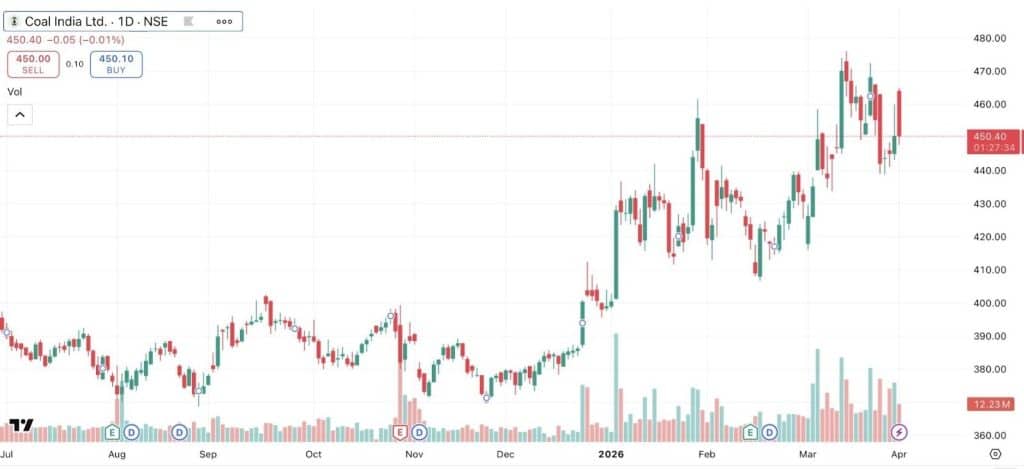
As a prominent Nifty 50 constituent, Coal India serves as a perfect example of these identifiers. It exhibits high liquidity through a massive daily trading volume, frequently exceeding 12 million shares and maintains an exceptionally tight bid-ask spread of just 10 paise (e.g., ₹450.00 vs. ₹450.10). Its large-cap status and constant institutional participation ensure that even high-value orders can be executed almost instantly with minimal price impact, making it a benchmark for liquid stocks in 2026.
Liquid vs Illiquid Stocks: Key Differences
When comparing liquid and illiquid stocks, the main differences lie in how easily they can be traded, the stability of their prices, and the costs involved in transactions. The table below discusses these distinctions clearly:
| Feature | Liquid stocks | Illiquid stocks |
| Trading convenience | Easy to buy/sell quickly with minimal delay | Difficult to execute trades; may take time to find buyers/sellers |
| Trading volume | High daily trading volume | Low or inconsistent trading volume |
| Bid–ask spread | Narrow spread, lower transaction cost | Wide spread, higher transaction cost |
| Price stability | Large trades cause minimal change in price | Small trades can cause significant price swings |
| Investor type | Preferred by institutional and active traders | Mostly small investors or speculative traders |
| Market depth | Deep market with many participants | Shallow market, fewer participants |
| Valuation accuracy | Prices are close to actual market value | Prices may not always match true market value |
Conclusion
Investors seeking smoother and faster trades benefit from understanding what is liquid stock. High liquidity ensures easier market entry and exit, reduces hidden costs, and improves pricing accuracy. While not all stocks remain equally liquid, tracking volume, spreads, and market participation helps make informed decisions. Learning these aspects strengthens overall trading and investment strategy.
FAQ‘s
Some of the most liquid Indian stocks include large-cap companies like Coal India, Vedanta, ICICI, Bank, Adani Power, ITC, and NMDC. These stocks have high trading volumes and tight bid-ask spreads, making them easy to trade efficiently.
Liquid stocks can be bought or sold quickly without impacting price, whereas non-liquid stocks have fewer buyers and sellers, causing price fluctuations and higher transaction costs during trades.
Liquid stocks are generally preferred for smoother transactions, lower costs, and price stability. However, for long-term investors, illiquid stocks may offer growth opportunities despite temporary trading challenges.
Yes, a stock’s liquidity can vary depending on market conditions, investor interest, company events, or macroeconomic factors, making some previously liquid stocks temporarily harder to trade.