
A regime change
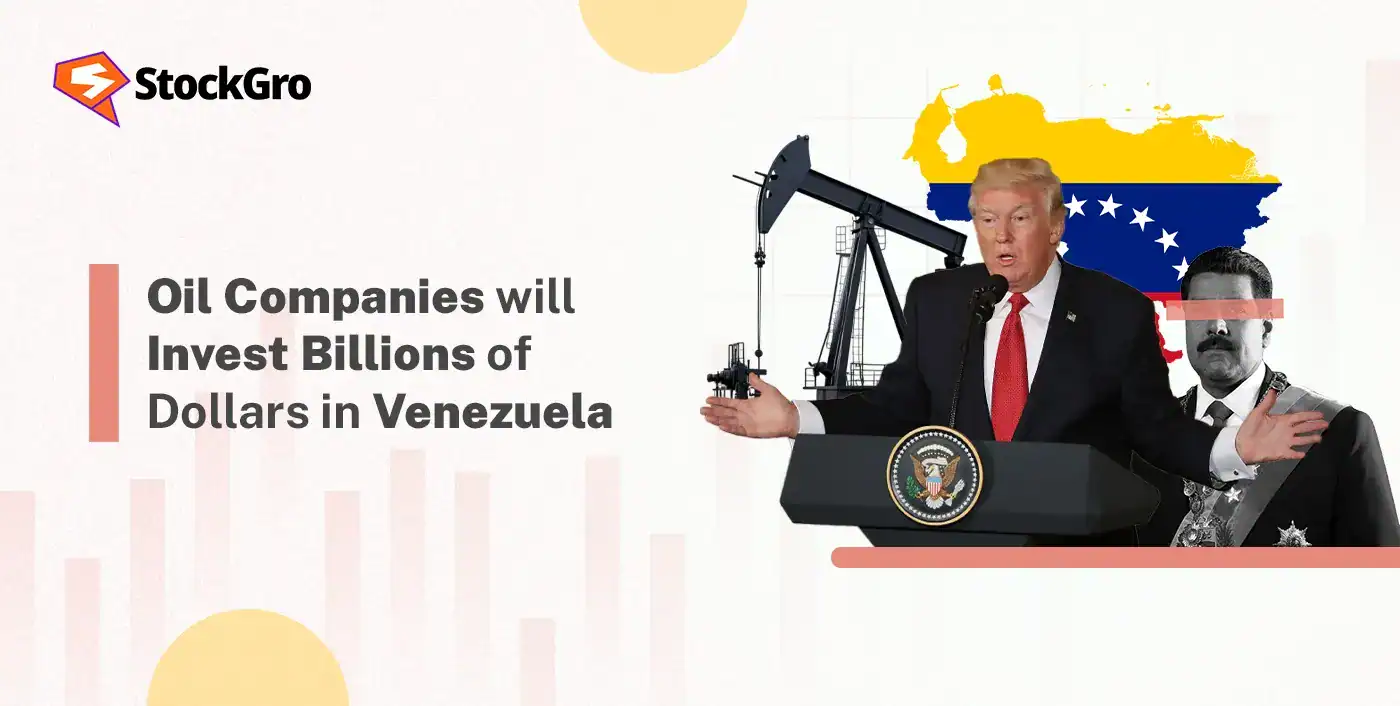
When Donald Trump held a press conference on January 3, 2026, he didn’t talk first about diplomacy, elections, or transition roadmaps. He talked about oil. Specifically, American oil.
Within hours of Nicolás Maduro’s capture, Trump laid out a vision: U.S. oil companies would enter Venezuela, spend “billions of dollars,” repair broken infrastructure, and get crude flowing again. Not eventually. Not theoretically. As a core objective of the operation itself.
Venezuela sits on 303 billion barrels of proven crude, roughly 17% of global reserves, the largest on Earth. Yet it currently produces a fraction of what it once did. The gap between its potential and actual output is huge. Such a condition automatically invites power.
Why Venezuela’s oil matters
Venezuela’s production peaked near 3.5 million barrels per day in the late 1990s. Today, it struggles to sustain around 800,000 barrels per day. That collapse wasn’t sudden. It unfolded over decades of underinvestment, nationalisation, and infrastructure decay.
The United States produced about 13.8 million barrels per day in late 2025. Venezuela, with far larger reserves, now produces less than one-tenth of that.
This mismatch is why the country never disappears from energy strategy conversations. Reserves determine long-term leverage. Production only reflects short-term capacity.
Trump’s comments effectively re-positioned Venezuela from a “failed potential” to “rebuildable asset.”
The infrastructure problem
Fixing Venezuelan oil isn’t about flipping a switch. The oil pipelines haven’t been modernised in nearly 50 years. The physical decay over time: corroded pipelines, unusable storage facilities, and obsolete refineries have hampered the country’s oil production capacity.
Even returning to the old capacity and restoring the infrastructure requires heavy investment. Petróleos de Venezuela, S.A. (PDVSA) itself has admitted that updating the infrastructure will cost around $58 billion.
Position of US Companies
Chevron is the only major U.S. company operating in Venezuela. It exported roughly 140,000 barrels per day from Venezuela in late 2025 and is responsible for about 23% of the nation’s output.
That positioning gives Chevron something rare in geopolitics: operational continuity. While others exited after the 2007 nationalisation, Chevron stayed, adjusted, and waited.
ExxonMobil and ConocoPhillips participated in Venezuela’s “oil opening” policy in the 1990s but left after the nationalisation. The claim of Conoco’s arbitration cases amounts to $10 billion. Exxon’s is closer to $2 billion.
That creates an unusual incentive structure. Returning to Venezuela isn’t just about new oil. For some firms, it may be the only realistic path to recovering old losses.
Heavy crude, and why it matters to the U.S.
The oil in Venezuela is not easy oil. Most of it is concentrated in the Orinoco belt and is extra-heavy and sour crude. Extracting it requires specialised equipment, capital, and patience.
Ironically, this is precisely why it matters to the United States. Most U.S. oil production is largely light, sweet crude, excellent for gasoline but less efficient for diesel and industrial fuels.
Diesel remains relatively tight in the global supply, and unlocking Venezuelan crude will allow U.S. easy access to it. Taking control over Venezuelan oil isn’t just about volume, but also about refinery optimisation.
Market Reaction
Energy stocks moved before clarity arrived. Chevron opened more than 4% higher as investors reacted to the prospect of renewed access to Venezuelan crude. Oilfield service company Halliburton climbed over 7% in early trading.
The logic wasn’t about near-term output. Rebuilding Venezuela’s oil system would demand years of work: rigs, seismic surveys, compressors, drilling fluids, logistics, and constant maintenance.
For service providers, the appeal lies in long-duration contracts rather than immediate production gains.
Long-Term View
Despite the risks, Venezuela represents something rare: scale without exploration risk.
The oil is there. It’s proven. It’s enormous. If political stability holds, and execution goes as per the plan, Venezuela could add several hundred thousand barrels per day in the upcoming years, and potentially millions over a decade.
That would not revolutionize oil prices. But it would reshape trade flows, refinery economics, and the U.S. energy sector.
Final Takeaway
Trump’s talk of “billions” is less a commitment and more a direction. It hints at where influence is shifting and which doors are suddenly open again for oil companies. It also sends a broader message: energy security is driving the agenda, not ideology.
What Venezuela ultimately becomes will depend on the choices made once the early declarations lose their force. Oil doesn’t rush. It waits, and it rewards consistency over spectacle.