
What is a Collar Option Strategy?
A Collar Option Strategy is a risk management strategy used by investors who already hold a stock and want to protect it from downside risk while limiting upside potential. It involves buying a protective put option and simultaneously selling a call option on the same stock. This creates a “collar” around the stock price, defining both maximum loss and maximum profit.
This strategy is widely used by long-term investors and portfolio managers who want to safeguard gains without exiting their positions. The premium received from selling the call often offsets the cost of buying the put, making it a cost-efficient hedging method. It is especially useful during uncertain market conditions.
In simple terms, a collar locks the stock within a price range. If the price falls, the put protects the downside, and if it rises significantly, the call limits the upside. This makes it a balanced approach between protection and income generation.
How does a collar options strategy work?
The collar strategy works by combining three components: holding the underlying stock, buying a put option, and selling a call option. The put option provides protection against price declines, while the call option generates income through premium. Together, they create a defined risk-reward structure.
When the stock price falls below the put strike price, losses are limited because the put increases in value. On the other hand, if the stock rises above the call strike price, gains are capped as the stock may be called away. This ensures both downside protection and limited upside.
The strategy is most effective when investors expect moderate price movement or uncertainty. It allows them to stay invested while reducing exposure to sharp market swings.
Collar Option Strategy Example
Suppose an investor owns a stock trading at ₹1,000. To protect against downside risk, they buy a put option with a strike price of ₹950 for ₹20. At the same time, they sell a call option with a strike price of ₹1,100 for ₹20.
If the stock falls below ₹950, the put option protects the investor by limiting losses. If the stock rises above ₹1,100, gains are capped as the call option may be exercised. In both cases, the net premium cost is minimal or zero due to offsetting premiums.
If the stock remains between ₹950 and ₹1,100, both options expire worthless, and the investor continues to hold the stock. This makes the collar a cost-effective hedging strategy.
Interpreting the Collar Option Strategy
The collar strategy creates a range-bound payoff structure, where profits and losses are limited within predefined levels. Investors should interpret it as a trade-off between protection and potential returns. It is not meant for aggressive profit generation.
The lower strike (put) defines the maximum loss, while the upper strike (call) defines the maximum profit. This makes the strategy predictable and easier to manage compared to unhedged positions.
Investors should carefully choose strike prices based on their risk tolerance and market outlook. A tighter collar offers more protection but limits upside, while a wider collar allows more upside with less protection.
Collar Option Payoff Diagram
The payoff of a collar strategy can be better understood using a payoff diagram. By mapping the combined payoff of the underlying asset, the long put, and the short call, we can clearly visualise how the overall position behaves across different price levels.
From the diagram, it is evident that once the price moves below the put strike (Kp) or above the call strike (Kc), the payoff becomes flat. This indicates that both downside risk and upside potential are capped within predefined limits.
The only range where the payoff varies with price movement is between the two strike prices. Within this zone, the collar position behaves like a normal stock holding, allowing gains or losses based on price changes.
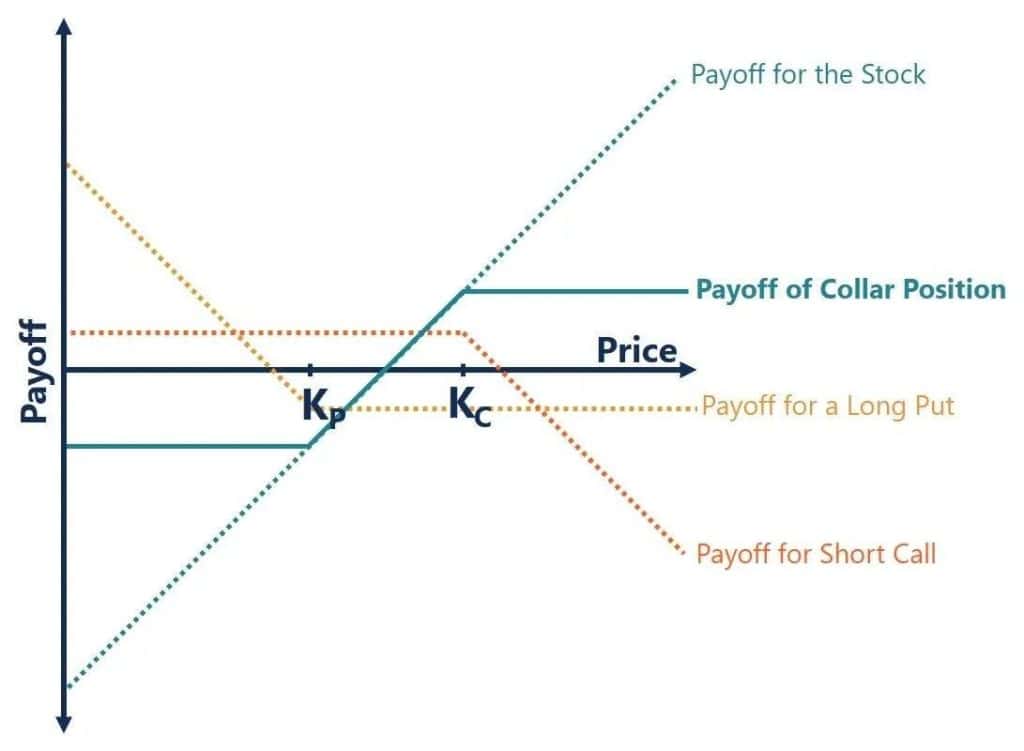
Understanding the payoff diagram helps traders visualise how the strategy behaves under different market conditions. It is an essential step before executing the trade.
Maximum Profit and Loss of a Collar Options Strategy
- Defined Risk-Reward Structure: A collar strategy offers a clearly defined payoff range with both profit and loss capped. This makes it easier for investors to plan and manage risk. It is particularly useful in volatile markets where uncertainty is high.
- Maximum Profit is Limited: The maximum profit occurs when the stock price rises above the call strike price (Kc). In this case, gains are capped because the stock may be called away at the call strike. The profit is calculated as the difference between the call strike and the purchase price of the stock, adjusted for net premium.
- Maximum Loss is Limited: The maximum loss occurs when the stock price falls below the put strike price (Kp). The protective put ensures that losses do not go beyond a certain level. The loss is calculated as the difference between the purchase price and the put strike, adjusted for premiums.
Uses of the Collar Option Strategy
- Tax and Long-Term Holding Strategy: Investors may use collars to avoid selling stocks and triggering capital gains tax. Instead of exiting the position, they hedge risk while continuing to hold the asset. This is particularly useful for long-term investors managing large portfolios.
- Portfolio Protection (Hedging): The collar strategy is widely used to protect existing stock positions from downside risk. Investors use it as a form of insurance, especially during uncertain or volatile market conditions. It allows them to stay invested while reducing potential losses.
- Income Generation Through Call Premium: By selling a call option, investors earn premium income that can offset the cost of buying the protective put. This makes the strategy cost-effective compared to buying a put alone. It enhances returns in sideways or mildly bullish markets.
Pros of the Collar Options Strategy
- Downside Protection: The protective put limits potential losses, making it a safer strategy compared to holding stocks without hedging. It provides peace of mind during market uncertainty. This makes it suitable for conservative investors.
- Cost Efficiency: The premium received from selling the call helps offset the cost of the put option. In some cases, the strategy can even be implemented at little to no cost. This improves overall capital efficiency.
- Defined Risk and Predictability: The strategy clearly defines both maximum profit and maximum loss. This makes it easier to plan trades and manage expectations. It reduces emotional decision-making during market volatility.
Cons of the Collar Options Strategy
- Active Monitoring Required: The position needs to be monitored regularly, especially near expiry or during volatile market conditions. Changes in price or volatility may require adjustments. Without proper management, the effectiveness of the strategy can reduce.
- Limited Upside Potential: The biggest drawback is that profits are capped due to the short call option. If the stock rallies strongly, gains beyond the call strike are not realised. This can lead to missed opportunities in bull markets.
- Complexity in Execution:The strategy involves multiple components, including stock holding and two option legs. It requires understanding of option pricing and market behaviour. Beginners may find it slightly complex to execute and manage.
Final Thoughts
The collar option strategy is a practical tool for managing risk while staying invested in the market. It balances protection and income, making it ideal for uncertain or volatile conditions.
However, it is not suitable for traders seeking unlimited upside. It requires a clear understanding of trade-offs and careful selection of strike prices.
For long-term investors, the collar strategy can be an effective way to preserve capital and manage risk, especially during market corrections.
FAQs
The purchase of protective puts provides a floor for potential losses by allowing the holder to sell the stock at a predetermined price, while the sale of covered calls generates income to offset the cost of the puts.
The collar strategy offers downside protection against market downturns while still allowing for some upside potential. It can also generate income through the sale of covered calls and helps to manage risk in volatile markets.
One drawback is the capped upside potential due to the obligation to sell the stock at the predetermined strike price of the covered call. Additionally, the cost of purchasing protective puts can reduce potential profits.
Depending on market conditions, traders can adjust their collar strategy by rolling options positions, modifying strike prices, or adjusting expirations to adapt to evolving market dynamics and risk tolerance.
While the collar strategy can be beneficial for traders seeking downside protection and income generation, it may not be suitable for those who prioritize unlimited upside potential or have a low-risk tolerance. It’s essential to consider individual investment objectives and risk preferences before implementing this strategy.
A collar strategy involves holding a stock, buying a protective put, and selling a call option to limit both downside risk and upside potential. It is commonly used for hedging existing positions.
The four basic options strategies are Long Call, Long Put, Covered Call, and Protective Put. These form the foundation for more advanced strategies like spreads, straddles, and collars.