
Why the Right Stock Selection Matters
In order to learn how to choose stocks for swing trading, there are certain tips you can follow, such as:
- Target high-momentum stocks: Stocks showing strong price moves or breaking key levels provide better opportunities for short-term profits and help traders enter trends early.
- Avoid weak or erratic stocks: Stocks with inconsistent patterns, low liquidity, or weak fundamentals can lead to unpredictable price swings, increasing the risk of losses or stagnation.
- Ensure smooth trade execution: Stocks with high daily trading volumes allow traders to enter and exit positions efficiently without significant slippage, ensuring trades execute close to intended prices.
- Follow reliable trend signals: Stocks that exhibit consistent chart patterns and momentum provide clear cues for timing entries, setting stop-losses, and identifying profit targets, enabling disciplined decision-making.
How to Choose Stocks for Swing Trading?
Picking the right stocks is the backbone of swing trading, with traits such as:
Look for High Liquidity Stocks
Liquidity shows how easily a stock can be bought or sold without affecting its price. Stocks with high daily trading volumes allow smooth entry and exit, minimizing slippage. For example, Reliance Industries trades millions of shares daily, making it easier for swing traders to take positions quickly and exit without large price impacts. Illiquid stocks may trap traders or cause losses when trying to close positions rapidly.
Focus on Volatility and Price Movement
Volatility measures the extent of price fluctuations over a period and is critical for swing trading. Moderate to high volatility creates the short-term swings necessary to capture profits. Low-volatility stocks tend to remain stagnant, reducing opportunities, while extremely volatile stocks can be risky if proper risk management is not applied.
Identify Strong Trends
A strong trend, either upward or downward, increases the probability of successful swing trades. Traders look for stocks showing higher highs in an uptrend or lower lows in a downtrend. Recognizing trends early allows traders to enter at the start of momentum, maximizing the potential for profitable swings.
Check Volume and Momentum
Volume confirms the strength of price movements, while momentum indicates the speed at which a stock is moving. Swing traders use volume spikes and momentum indicators to validate trade entries and exits. A strong trend supported by rising volume and momentum is more likely to sustain, improving the chances of capturing short-term gains effectively.
Technical Tools & Indicators
Swing traders analyse price trends using tools such as:
Moving Averages
Moving averages smooth out short-term price fluctuations to reveal the underlying trend. Swing traders monitor crossovers, such as when a 10-day moving average crosses above a 50-day moving average, which can signal a trend continuation or reversal. For example, a bullish crossover in Reliance Industries may indicate the start of a short-term uptrend suitable for a swing trade.
RSI and MACD
The Relative Strength Index (RSI) measures overbought or oversold conditions, helping traders anticipate potential short-term reversals. A reading below 30 may signal an oversold stock, while above 70 indicates overbought conditions. The MACD (Moving Average Convergence Divergence) tracks momentum and can confirm trend strength, making it a powerful tool when combined with price action for swing trades.
Support and Resistance Levels
Support and resistance are key price levels where stocks tend to pause or reverse. Swing traders use these levels to identify entry and exit points and set stop-loss orders. For instance, buying near a strong support level with confirmation from RSI or MACD increases the probability of a successful trade, while selling near resistance helps lock in profits.
Screening Process & Tools in Swing Trading
Successful swing trading requires a thorough grasp of screening methods that combine fundamentals, sector performance, market updates, and price action into one clear picture. Traditionally, traders juggle multiple platforms for these tasks, which often leads to scattered information and missed insights.
This is where Stoxo, StockGro’s AI-powered research engine, fits in. It brings all key elements together, from financial filters and sector mapping to corporate events and charting into a single platform. For retail investors, this means less noise, structured insights, and faster decision-making.
- Fundamental filters: Track earnings growth, debt ratios, and return on equity to measure financial stability.
- Sector mapping: Compare how industries are performing against the broader market using visual heatmaps.
- Event tracking: Keep up with results, board meetings, and announcements that may affect stock prices.
- Charting tools: Study support-resistance levels and candlestick formations to understand price behavior.
Strategy Examples & Approaches in Swing Trading
Swing trading strategy also makes use of specialized approaches designed around price behavior and market events:
- Episodic pivot strategy: This method focuses on sudden catalysts such as earnings reports, regulatory updates, or industry news that spark sharp price moves. Traders look for early entry points when such events create strong market attention, aiming to capture the resulting swings.
- Darvas box theory: Introduced by Nicolas Darvas, this strategy defines a “box” where price moves within a set high and low. A breakout above the box signals strength, while a drop below indicates weakness. It offers a structured way to identify entry and exit levels.
Risk Management & Trade Planning
Effective risk control is essential in swing trading and includes practices such as:
- Stop-loss strategy & trigger discipline: Always define a price point to exit automatically. During the Adani Group stock rout in early 2023, many investors without stop-loss levels faced double-digit losses after Hindenburg’s fraud report triggered panic selling.
- Trade size & capital exposure: Control how much capital goes into a single position. In general, risking 2–5% of portfolio value per trade may prevent a single loss from wiping out weeks of gains. Over-sized positions magnify volatility..
- Clear exit plan with profit targets: Define profit objectives before entering trades (e.g., exit at 10–12% upside). Without pre-set exits, traders often hold too long and see gains vanish. In 2021, many retail traders in Zomato exited too late after its post-IPO rally cooled, missing the chance to lock in profits before prices corrected.
- Risk-reward ratio & loss scenarios: Target trades where potential profit is at least twice the potential loss (2:1 ratio). Also prepare for tail risks like policy changes or global events. The Silicon Valley Bank collapse in March 2023 dragged banking and tech shares lower overnight, hurting traders who hadn’t sized risk properly.
Market Conditions & Catalysts for Swing Trading
Swing traders often benefit when certain market-wide triggers are active, such as:
- Interest rate policy shifts: When central banks cut rates, borrowing gets cheaper and rate-sensitive sectors rally. For example, on June 6, 2025, RBI cut the repo rate by 50 bps to 5.50% plus lowered CRR, triggering strong gains in realty, banking, auto stocks.
- Sector rotation trends: Investors moving money into sectors showing strength create opportunities. In late 2024, Realty, Pharma, Auto and PSU Bank sectors outperformed broadly, providing clearer swing setups for those aligned.
- News & corporate events: Earnings surprises, buybacks or regulatory changes tend to move stocks more sharply. Infosys recently surged on announcement of a buyback, giving short-term traders a quick gain opportunity.
- Government /regulatory catalysts: Actions like proposed import taxes or trade rules can sharply affect particular sectors. E.g. in March 2025, steel companies gained after India proposed a temporary import tax on certain steel products, triggering upside in JSW, Tata Steel, and SAIL.
Swing Trading in Indian Markets (if targeting India)
The major rules shaping swing trading in India in 2025 are as follows:
- Margin rule
Effective February 1, 2025, option buyers must pay the entire premium upfront at order entry. This eliminated short-term leverage and reduced speculative high-volume trades.
- No expiry-day spread benefits
SEBI removed expiry-day calendar spread benefits for F&O contracts in February 2025, making margin rules stricter for positions held till expiry.
- Intraday position monitoring
From April 1, 2025, NSE and BSE began monitoring open positions in equity derivatives at least four times daily, ensuring real-time oversight for swing traders.
- Pre-open session for F&O
Proposed to be introduced in December 2025, a pre-open session for derivatives improves price discovery and reduces shocks when entering or exiting large swing positions..
- Insider trading restrictions
Updated SEBI rules in 2025 extended trading window closures to swing trades, barring insiders from participating ahead of results or major announcements.
Step-by-Step Analysis Using Stoxo AI
To see how AI powered stock analysis works in real life, let’s look at Reliance Industries Ltd. (RELIANCE) through Stoxo AI by StockGro.
To perform this analysis, you simply:
- Open Stoxo by visiting StockGro: Navigate to the AI-powered research engine.
- Ask your question: Type in a simple query, such as “Swing trading analysis for Reliance Industries.”
- Review the insights: It will generate a comprehensive report as follows:
The tool first delivers a broad snapshot covering both technical and fundamentals. Reliance’s last close was ₹1,395.00, with the stock currently trading near ₹1,377.00. The overall technical score stands at 9/10, though the stock has slightly underperformed its industry benchmark across different timeframes. Here’s how the stock compares to its sector:
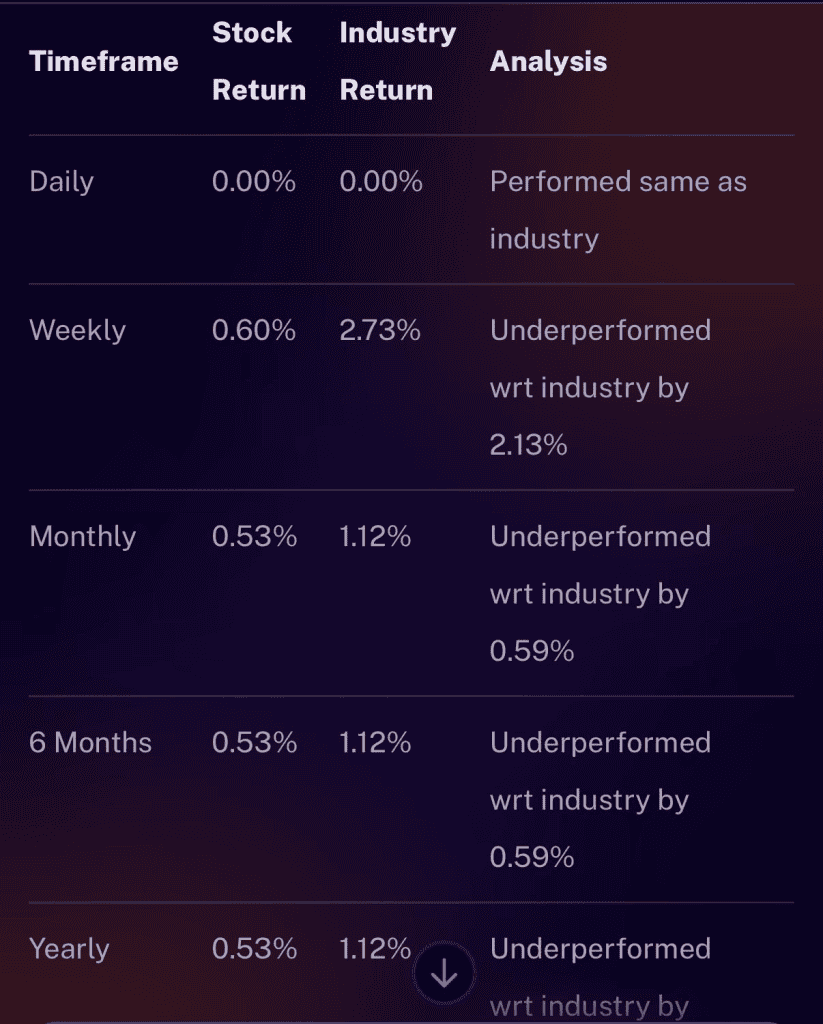
This data suggests that while the stock has strong underlying technicals, its momentum is lagging. It further breaks down the technicals:
- Trend direction: Sideways, with the 20-day Moving Average at ₹1,385.03.
- RSI (14): 52.13, pointing to a neutral zone (neither overbought nor oversold).
- Volume trend: Declining, suggesting caution before fresh entries.
- Overall outlook: Positive, driven by a 10/10 Risk Assessment score, but weighed down by a weaker 4/10 Momentum Score.
The stock is consolidating between ₹1,340 and ₹1,396. A breakout above ₹1,396.30 with strong volume could hint at a bullish swing, while a bounce near ₹1,340.60 might present a buying opportunity.
This is what predicting market direction is all about: using a multi-faceted approach to see the full picture. Instead of relying on a single indicator, Stoxo AI brings together performance benchmarks, technical scores, and key price levels to build a clear decision-making framework.
Conclusion
Swing trading is less about predicting the distant future and more about reading the market’s immediate rhythm. It blends patience with quick execution, allowing traders to capture meaningful moves without long waits. By treating each price swing as a short chapter in a bigger story, it turns volatility into opportunity. For anyone on the path to figure out how to choose stocks for swing trading, it starts with rhythm, clarity, and smart analysis of every move.
FAQ‘s
Yes. Choosing the right stocks with liquidity, volatility, and trend potential is crucial for capturing profitable swings.
Yes. High-volume stocks allow smooth entry and exit, minimizing slippage and enabling effective trade execution.
Yes. Moderate to high volatility provides the price swings necessary to generate profits in a short-term trading timeframe.
Yes. Indicators like RSI, MACD, and moving averages help confirm trends, momentum, and potential reversal points, improving trade accuracy.
Yes. Assessing potential risk relative to reward ensures positions are manageable and protects capital from adverse price movements.

Leave a Comment