Summary
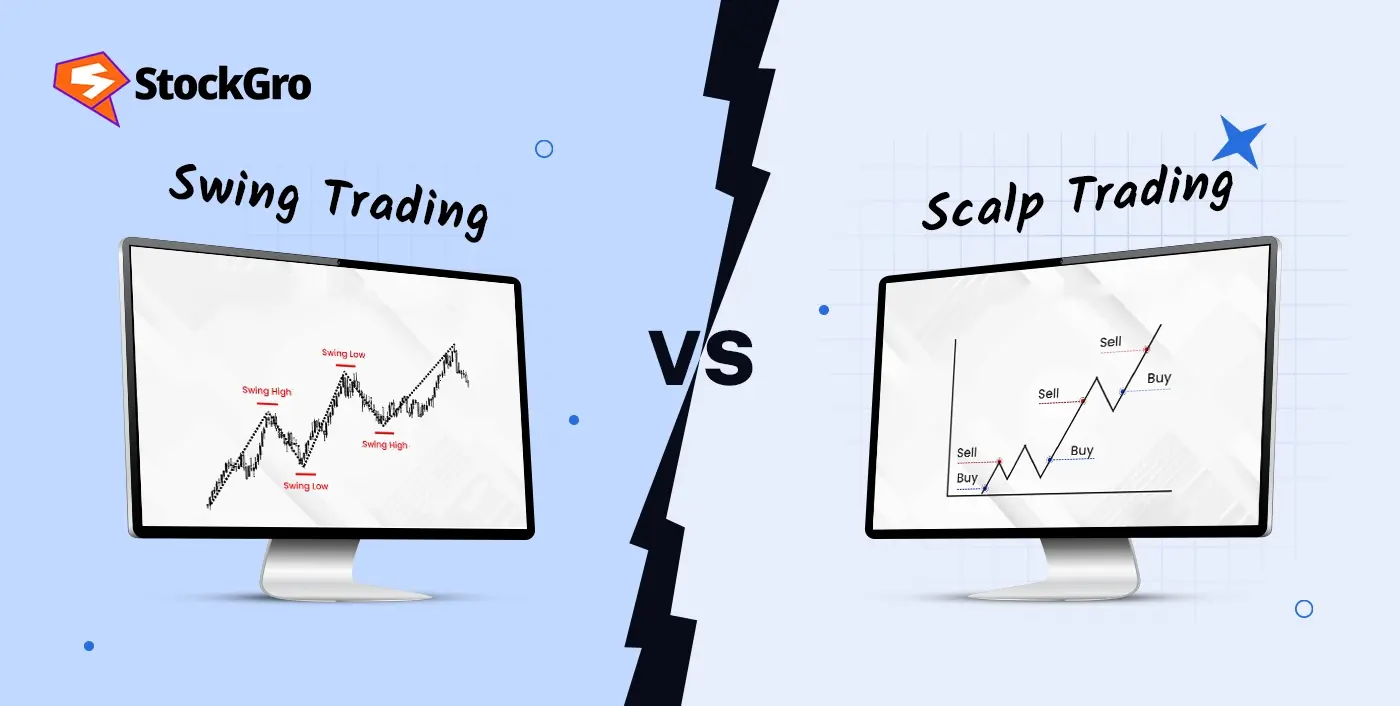
Scalping involves making multiple quick trades in a day to profit from small price movements, while swing trading targets larger price swings over several days or weeks.
Scalping requires high focus, fast execution, and real-time monitoring, whereas swing trading is less intensive and relies on technical and fundamental analysis.
Choosing between them depends on risk tolerance, time availability, and trading style preferences.
What is Scalping Trading?
Scalping is trading on fast-forward. You jump in, grab a tiny price movement — sometimes just a few paise — and jump right back out. A single trade might only net you ₹50 or ₹100, but the idea is you’re doing this dozens of times in a day. Those small wins pile up. On a good day, a disciplined scalper pulling ₹80 across 30 trades walks away with ₹2,400 before costs.
The catch? You need to be glued to your screen. There’s no “set it and forget it” here. If you want to dig deeper into the mechanics, our guide on scalping strategy covers the foundations. And depending on how aggressive you want to get, you can explore a 1 minute scalping strategy or a slightly calmer 5 minute scalping strategy.
What is Swing Trading?
Swing trading is the patient cousin. Instead of chasing every little blip, you’re looking at bigger price swings that play out over days, sometimes a couple of weeks. You spot a stock that looks like it’s about to move, enter your position, and then wait for the wave to crest before you exit.
The beauty of it is breathing room. You don’t need to stare at charts all day — checking in once or twice is usually enough. That makes it genuinely viable for people with day jobs, which is why it’s often the first “real” trading style beginners gravitate towards. Understanding the right swing trading time frames is what separates decent setups from great ones, so that’s worth reading up on early.
Scalping vs Swing Trading: Key Differences Compared
| Feature | Scalping | Swing Trading |
| Holding time | Seconds to minutes | Days to weeks |
| Trades per day | 20–100+ | 2–5 per week |
| Profit per trade | Small (₹20–₹150) | Larger (₹500–₹5,000+) |
| Screen time | Full market hours, no breaks | 30–60 minutes daily |
| Capital needed | Higher (volume-driven) | Moderate |
| Stop-loss range | Very tight (₹2–₹5) | Wider (₹20–₹50) |
| Stress level | High | Moderate |
| Best suited for | Full-time traders | Working professionals |
| Key charts | 1-min, 5-min | Daily, 4-hour |
| Brokerage impact | Significant (many trades) | Minimal (fewer trades) |
Pros and Cons of Scalping and Swing Trading
Scalping: Pros and Cons
Quick compounding: Those tiny profits add up surprisingly fast when you’re pulling 30–50 trades a day. A disciplined scalper can compound returns daily in a way that longer-term styles simply can’t replicate. It’s the closest thing to a daily paycheque the market offers.
No overnight risk: Every position is closed before the market shuts, so you never wake up to a gap-down disaster caused by overnight news. Your capital resets clean each morning, and you start fresh without worrying about what happened in global markets at 2 AM.
Brokerage eats into profits: This is the silent killer. If you’re paying ₹20 per order and making 40 round-trip trades a day, that’s ₹1,600 gone in brokerage alone — before taxes and exchange charges. Your gross profit needs to comfortably exceed that number, or you’re basically working for your broker.
Mentally exhausting: The focus required is intense, and burnout sneaks up fast. After a few hours of rapid-fire decisions, your sharpness drops and mistakes start creeping in. Most scalpers will tell you honestly — the last hour of their session is almost always their worst.
Swing Trading: Pros and Cons
Fits around real life: You can hold a full-time job and still swing trade effectively. The analysis happens after market hours, and once your orders are set, the market does its thing without needing you to babysit it. For a deeper look at approaches that work, check out best swing trading strategies.
Bigger per-trade gains: Each winning trade can deliver ₹1,000–₹5,000 or more, which means you don’t need a perfect strike rate to come out ahead. Even winning just 50–55% of your trades can be profitable if your average winner is larger than your average loser. That maths gives you real breathing room.
Overnight exposure: Holding positions overnight means you’re at the mercy of earnings surprises, global events, and gap-opens that can blow right past your stop-loss. One nasty overnight gap can erase several good trades in a heartbeat, and there’s nothing you can do about it until the market reopens.
Patience tax: Watching a trade sit flat for three or four days while your capital is tied up feels genuinely frustrating — especially when you see scalpers posting daily wins on social media. It takes real discipline to let a swing trade play out instead of panic-closing early.
Tools and Indicators for Scalping vs Swing Trading
Scalping Tools and Indicators
One-click execution platform: Speed is everything. You need a trading platform that lets you enter and exit positions in a single click — any delay of even a second or two can turn a winning scalp into a losing one. Look for platforms with Level 2 market depth and real-time tick data.
VWAP (volume weighted average price): This is your anchor indicator. It shows you where institutional money has been flowing during the session, and scalpers use it to decide whether to go long above the line or short below it. Most winning scalps happen in the direction of VWAP.
9-period EMA (exponential moving average): Slap this on a one-minute chart and you’ve got a quick read on immediate momentum. When the price stays above the 9 EMA, buyers are in control; when it dips below, sellers are stepping in. Simple, fast, effective.
RSI on short settings: Set your RSI (relative strength index) to 7 or 9 periods instead of the default 14. It reacts faster to price changes, helping you spot overbought and oversold conditions on those tiny time frames before slower traders catch on.
Swing Trading Tools and Indicators
Daily candlestick charts: Your primary workspace. Daily candles smooth out the intraday noise and let you see the bigger trend clearly — whether a stock is in an uptrend, pulling back, or breaking down. Everything else layers on top of this.
50-day and 200-day moving averages: These two lines tell you the medium and long-term trend at a glance. When the price is above both, the stock is healthy; when the 50-day crosses below the 200-day (a “death cross”), it’s usually a warning sign worth paying attention to.
MACD (moving average convergence divergence): Great for catching momentum shifts before they become obvious on price alone. When the MACD line crosses above the signal line, it hints at a bullish swing starting — and the opposite signals a bearish one. It pairs really well with moving average setups.
Stock screener: A solid screener that filters for volume spikes, breakout patterns, and sector trends will save you hours of manual chart-flipping every evening. Most Indian brokers — Zerodha’s Kite and Groww included — offer free screeners that are more than good enough to get started with.
Which Trading Strategy Is Better for Beginners?
Swing trading, and it’s not really close. The pace is manageable, the decision-making window is longer, and you can learn without the pressure of split-second execution. You’ve got time to research your setup, think through your risk, and review what happened after the trade — all of which accelerate learning.
Scalping demands skills that most beginners haven’t developed yet: reading price action in real time, managing emotions under rapid-fire pressure, and recovering mentally from a streak of losses within minutes. It’s not impossible to start there, but the learning curve is steep and the cost of mistakes (through accumulated brokerage and bad entries) adds up fast. Get comfortable with markets through swing trading first, then test scalping with small position sizes once your instincts sharpen.
Common Mistakes Traders Make and How to Avoid Them
Overtrading on slow days: When the market isn’t moving, scalpers force trades that aren’t there. If your setups aren’t appearing, the best trade is no trade. Walk away and come back tomorrow.
Ignoring brokerage maths: A scalper making ₹3,000 gross but paying ₹1,800 in brokerage and taxes isn’t really making ₹3,000. Always calculate your net return after all costs — it’s the only number that matters.
Moving stop-losses to avoid a loss: This is the fastest way to turn a small loss into a devastating one. Your stop exists for a reason. The moment you start shifting it, you’re trading on hope, not strategy.
Skipping trade journals: If you don’t record what worked and what didn’t, you’re relying on memory — and memory is generous with your wins and forgetful about your mistakes. Even a simple spreadsheet helps.
Switching strategies mid-trade: You entered as a swing trader, the stock dips, and suddenly you’re trying to scalp your way out. Mixing styles mid-trade almost always ends badly. Pick one approach per trade and stick with it.
Best Practices to Build Trading Confidence
Start with paper trading: Use a simulator or virtual trading account before risking real money. You get full market conditions with zero financial exposure — it’s the safest way to find out whether your strategy actually holds up under pressure. Most Indian brokers, including Zerodha and Groww, offer paper trading features that mirror live markets closely enough to learn from.
Keep position sizes tiny at first: Don’t scale up until you’ve logged at least 50 trades. The goal early on isn’t profit — it’s building pattern recognition and learning how you react emotionally when things go sideways. Small positions let you make mistakes cheaply while those instincts develop.
Maintain a trade journal: Write down every trade — entry reason, exit reason, what you felt during it, and what you’d do differently. It sounds tedious, but patterns in your own behaviour only become visible when they’re on paper. A month of journal entries will teach you more about yourself than a dozen YouTube tutorials.
Set daily loss limits: Decide before the session starts how much you’re willing to lose in a single day — say ₹1,000 or ₹2,000 — and walk away the moment you hit that number. This one rule alone prevents the spiral of revenge trading that wrecks most beginners. No exceptions, no “just one more trade.”
Connect with other traders: Join a Discord group, follow traders on Twitter, or find a friend who’s in the markets. Having someone to bounce ideas off — and someone who’ll call you out when you’re being reckless — keeps you grounded and accountable in a way that trading alone never does.
Final Thoughts
Neither scalping nor swing trading is objectively “better” — they solve different problems for different people. Scalping suits those who thrive on speed, have full days to dedicate, and don’t mind the mental grind. Swing trading works for people who want markets to be part of their life, not their entire life. The smartest thing you can do is try both on a paper account, track your results honestly, and let the data — not someone else’s opinion — tell you which one fits.
FAQs
Yes, because the rapid pace amplifies emotional mistakes and brokerage costs eat into slim margins. One lapse in concentration can trigger a chain of bad trades within minutes.
Yes. The slower pace gives you time to learn chart reading, risk management, and trade planning without the pressure of split-second decisions.
You’ll want at least ₹1,00,000–₹2,00,000 to scalp meaningfully in Indian markets, since profits per trade are small and you need enough volume for them to add up after brokerage.
Neither inherently. Profitability depends on your discipline, strategy, and how well you manage risk — not the style itself. Consistent scalpers and consistent swing traders both make money.
Yes. Most swing traders spend 30–60 minutes outside market hours on analysis and place orders before the market opens or after it closes. It’s one of the most job-friendly trading styles.
Paper-trading accounts (Zerodha’s Varsity simulator, for instance), basic charting platforms with free indicators, and trade-journalling spreadsheets. Start with free tools — you don’t need premium software until your strategy is proven.