India’s bond and debt landscape is sizeable, and participation is widening. You now see choices beyond fixed deposits, from government bonds to corporate bonds and NCDs (non-convertible debentures).
For many savers, the appeal is, steady interest and a clearer idea of cashflows than equities. But there is a catch. Interest rates move, business cycles change, and companies do not always want to stay locked into the same borrowing cost for 7 to 10 years. Investors, on the other hand, want higher coupons and predictable income.
Callable bonds address that mismatch by allowing early redemption after a pre set date and at a pre agreed price. This can create headroom for refinancing, while investors may receive a higher coupon for accepting the chance of early repayment. This blog explains how callable bonds work in India, what to look for in the terms, and how to judge whether the trade-off suits your holding period.
What Is a Callable Bond?
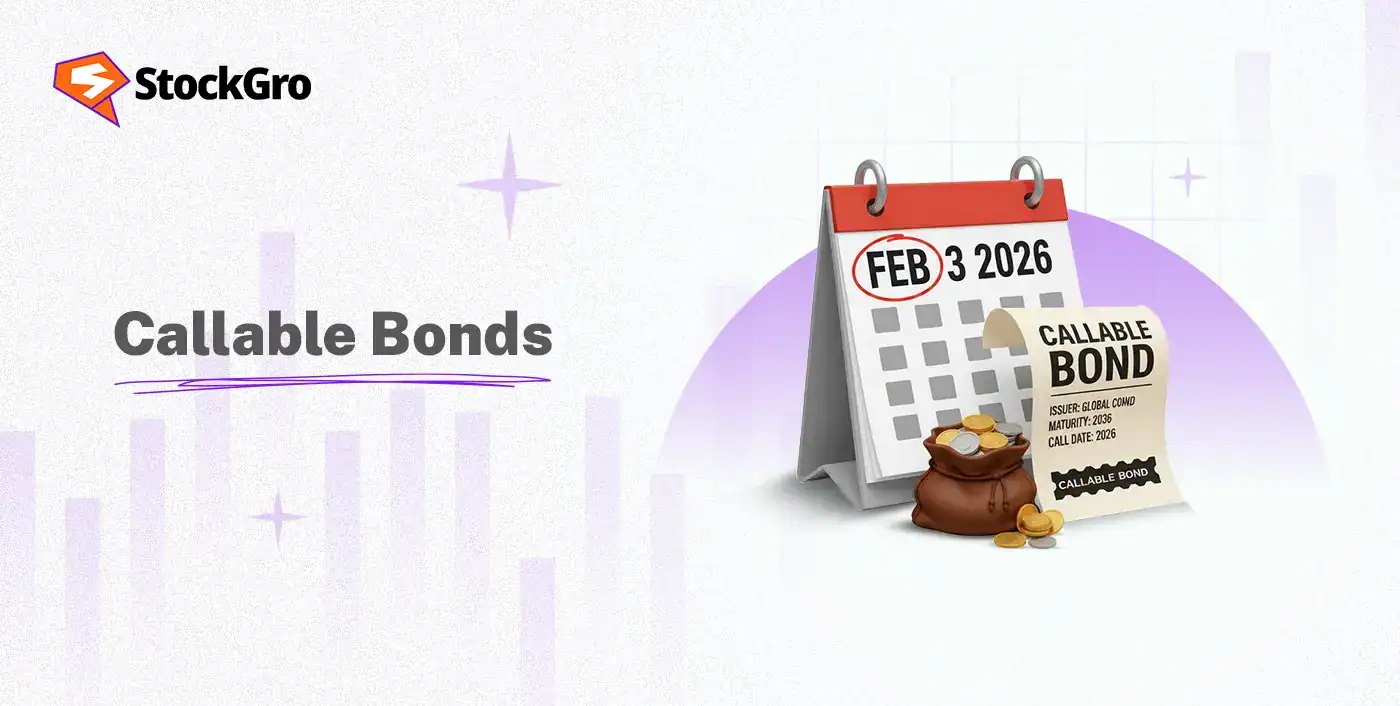
A callable bond is a bond that gives the issuer (the company or government borrowing the money) the right to pay you back early, before the bond’s stated maturity date.
If the issuer “calls” the bond, you get your money back at a set price (often a little above the bond’s face value). After that, the bond stops paying interest because it no longer exists.
For investors, the main drawback is that you might lose a good interest rate sooner than expected. Then you may have to reinvest your money at lower rates, which can reduce your future income. Therefore, callable bonds often pay a higher interest rate than similar non-callable bonds to make up for this extra risk.
Key terms:
- Call date: This is the first date from which the issuer is allowed to redeem the bond before maturity.
- Call price: The specified price the investor receives if the bond is called.
- Call protection: A period when the bond can’t be called.
How do Callable Bonds Works
A callable bond starts like a normal bond. You lend money to the issuer. You receive interest payments on set dates. The difference is an “early repayment” option. The issuer can choose to repay you before maturity. This can happen only on the call dates written in the bond terms.
Here is how it usually plays out
- You buy the bond. Coupons come in as scheduled.
- Call protection may apply. During this period, the issuer cannot call it.
- A call date arrives. The issuer checks market interest rates and funding needs.
- If they call it, they send a notice. The notice gives the call date and the price.
- You get paid out. You receive the call price plus accrued interest up to that date. Coupons stop after that.
What it means for you
- Your income stream can end earlier than planned.
- You may need to reinvest when rates are lower.
- The bond’s return depends on whether it gets called, so people also look at yield to call as well as yield to maturity.
How is a Callable Bond Valued?
Valuing a callable bond is a little different from valuing a regular bond. A normal bond has fixed cash flows up to maturity, so its value is based on the present value of future interest payments and the principal repayment. A callable bond, however, gives the issuer the right to repay the bond early. That means the investor may not receive all the coupon payments until the original maturity date.
Because of this extra feature, a callable bond is usually worth less than an otherwise similar non-callable bond. In simple terms, its value can be thought of as the value of a plain bond minus the value of the issuer’s call option. The call option benefits the issuer, not the investor, because it allows the issuer to refinance if interest rates fall.
A few key factors affect the value of a callable bond:
- The coupon rate
- The time left to maturity
- The call date and call price
- Current market interest rates
- The issuer’s credit quality
- Interest rate volatility
Investors also look at measures such as yield to call and yield to maturity to understand possible returns under different scenarios.
Different Types of Callable Bonds
These securities can vary by issuer and by the way the call feature is designed. Some are grouped by who issues them. Others are defined by how and when early redemption can happen.
- Corporate callable bonds are issued by companies. They are commonly used to support business needs or to refinance existing borrowings.
- Municipal callable bonds are issued by local authorities such as cities, counties and states. They are often linked to public projects and may be called if funding can be replaced on better terms.
- Government callable bonds are issued by government entities. They are used to raise money for public service projects.
- Fixed rate callable bonds pay the same interest rate through their life. Even so, the issuer still retains the right to redeem them before maturity.
- Freely callable bonds can be redeemed at any time after issue. This gives the borrower greater flexibility.
- Deferred callable bonds include a call protection period. During that time, early redemption is not allowed.
- Step up callable bonds have coupons or call prices that rise over time according to the schedule. The issuer can still call them at set intervals before final maturity.
- Sinking fund callable bonds involve money being set aside over time to retire part of the debt. The call feature may be used alongside this to manage the outstanding amount.
Pros and Cons of Callable Bonds
| Pros | Cons |
| Often pays a higher coupon than a similar non-callable bond | The issuer may redeem early when rates fall, so you may have to reinvest at lower rates |
| Predictable coupon income until the call or maturity date | Price upside can be capped because the bond may be called before maturity |
| Wider availability in corporate bonds and NCDs, so more options to choose from | Your realised return may be closer to yield-to-call, not yield-to-maturity |
| Can suit shorter holding periods if the first call date is not too far | Comparing becomes harder because you must check call dates, call price, and yield to worst |
| May work for income-focused investors who can handle early redemption | Cashflow planning can get disrupted if redemption happens earlier than expected |
Interest Rates on Callable Bonds
Interest rates have a direct effect on how callable bonds behave. They do not just influence returns in general. They can also affect whether the bond stays in place until maturity or is repaid early.
When market interest rates fall, issuers may find it cheaper to borrow again at lower rates. In that situation, they may choose to call existing bonds that carry higher coupons. For investors, this can interrupt the income they expected to receive over a longer period.
In a falling rate environment, a few things may happen:
- The likelihood of early redemption may rise
- The investment tenure may become shorter than expected
- Reinvestment risk may increase if newer options offer lower yields
When interest rates rise, the incentive usually weakens. Replacing the borrowing may cost more, so issuers may be less likely to call the bond. As a result, the bond may continue until maturity, and investors may keep receiving the original coupon.
In a rising rate environment, the main effects may include:
- A lower probability of early redemption
- Continued receipt of the agreed coupon
- Changes in the bond’s market value as interest rates move
So, the link between callable bonds and interest rates is important for two reasons. It can shape both the bond’s cash flow pattern and its market valuation over time.
Example of a Callable Bond
| Item | Assumed Value |
| Face value | ₹1000 |
| Coupon rate | 9% per year |
| Coupon payment | ₹90 each year |
| Final maturity | 10 years |
| Call option | Issuer can redeem after Year 5 |
| Call price | ₹1010 (par + small premium) |
| Issue price | ₹1000 |
Outcome A: Issuer calls the bond in Year 5
| Year | Coupon you receive | Redemption you receive | Total that year |
| 1 | ₹90 | ₹0 | ₹90 |
| 2 | ₹90 | ₹0 | ₹90 |
| 3 | ₹90 | ₹0 | ₹90 |
| 4 | ₹90 | ₹0 | ₹90 |
| 5 | ₹90 | ₹1,010 | ₹1,100 |
Total cash received over 5 years: ₹90 * 5 = ₹450 in coupons, plus ₹101 redemption.
Grand total: ₹1460.
Outcome B: Issuer does not call, you hold till Year 10
| Year | Coupon you receive | Redemption you receive | Total that year |
| 1 to 9 | ₹90 each year | ₹0 | ₹90 each year |
| 10 | ₹90 | ₹1,000 | ₹1,090 |
Total cash received over 10 years: ₹90 * 10 = ₹900 in coupons, plus ₹1000 principal.
Grand total: ₹1900.
If rates fall, the issuer may choose to call in Year 5 and refinance cheaper rate. Your bond can end early, so you may need to reinvest at the new, lower rates.
FAQ‘s
It gives the issuer the option to redeem early if market rates move lower. This flexibility can reduce interest costs through refinancing. It can also help with balance-sheet planning when cash flows, regulations, or capital needs change.
One has an early redemption option for the issuer, so the bond may end before the final maturity date. The other runs for the full term unless you sell it in the market or the issuer defaults.
They can get redeemed just when the coupon starts to look attractive, usually after interest rates fall. That can leave you reinvesting sooner than planned, often at lower yields.
It can be fine if the coupon is meaningfully higher and you are comfortable with the bond ending early. It is less convenient when you need long, predictable cash flows or you do not want reinvestment risk.
You may get a higher coupon than a similar bond without this feature. It also gives you a clear call date and call price to plan around, instead of relying only on market selling.