Markets always whisper patterns that only an attentive listener can hear, while others keep chasing the noise. In that conversation, an instrument speaks in the language of interest rates, liquidity, and capital flow, which is a bond.
To understand ‘what are bonds’, you must step above the surface of fixed income and recognise them as debt agreements, where capital is lent in exchange for defined cash flows and principal repayment.
The further sections break down bonds, their meaning, components, types, and much more.
What are Bonds?
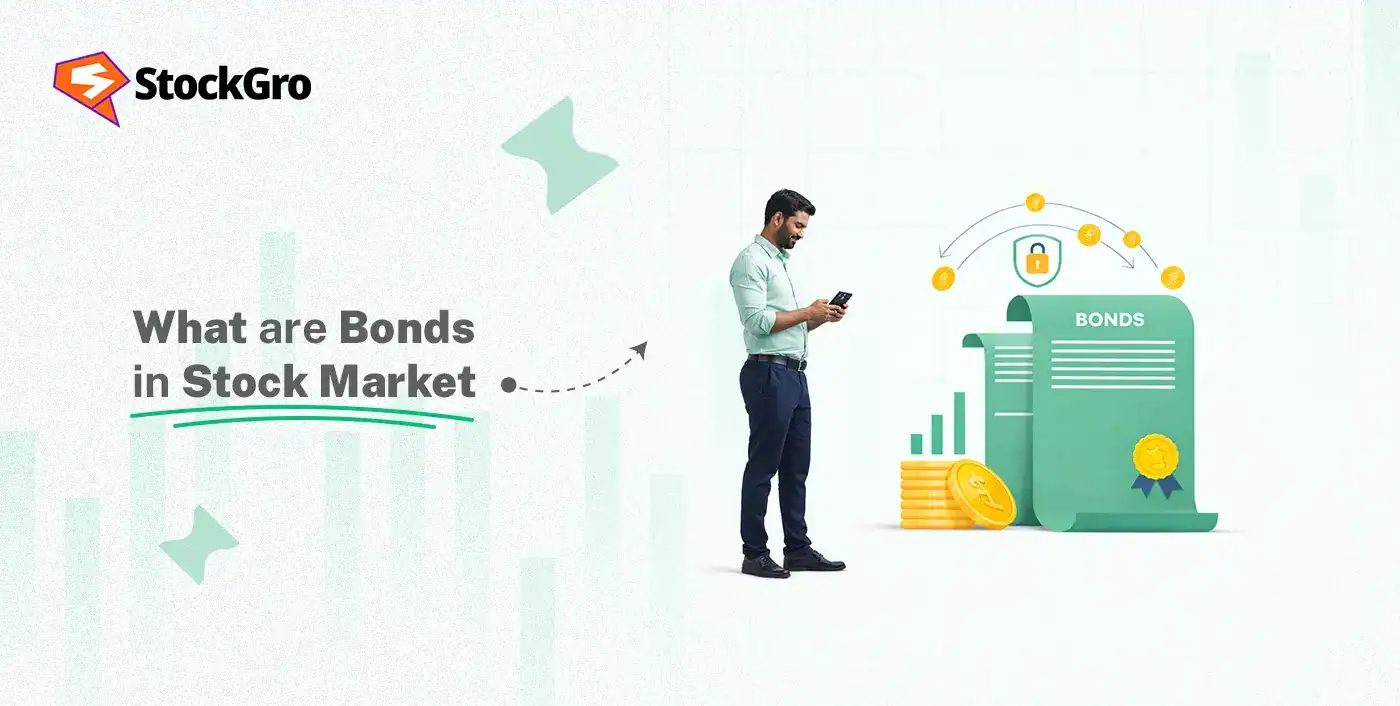
Bonds are debt instruments through which an investor lends or invests their capital into a government or corporation for a fixed period that earns periodic interest and receives the principal at maturity. They represent a contractual obligation with pre-defined income and timelines.
How Bonds Work?
Bonds are like loan agreements between the issuer and the investor. The investor provides capital, and in return, the issuer commits to paying periodic interest, known as the coupon, along with repaying the principal on a fixed maturity date.
The price of the bonds can fluctuate in the market depending on interest rate movements, credit quality, and time remaining to maturity, which in turn affects their yield.
Key Components of a Bond
To understand these movements, you must break the bond into its key elements that drive pricing, returns, and risk.
Face Value / Par Value
The face value, also known as par value or principal, is the nominal amount that is repaid by the issuer at maturity, for instance, ₹1,000 or ₹10,000 in standard issues. Let’s say, a bond issued at ₹1,000 will return that exact amount at maturity of 5 years, regardless of interim price fluctuations in the market.
Coupon Rate
The coupon rate defines the annual interest rate paid by a bond issuer to the holder, as a percentage of the face value. For example, a 7% coupon on a ₹10,000 bond delivers ₹700 annually. This payment remains unchanged, even as market interest rates shift, which is why older bonds become more or less attractive as the rate cycles evolve.
Maturity Date
This marks the day of redemption or repayment, on which the bond issuer repays the principal to the investor. The short-term bonds may mature within a year, while long-term bonds can extend up to 10, 20, or even 30 years.
Yield
Yield reflects the actual return an investor earns from a bond, and it moves inversely to price.
For example, a bond with a ₹1,000 face value pays ₹70 annually, which is a 7% coupon. However, if its market price falls to ₹900, the same ₹70 is now earned on a lower investment. This pushes the effective return, or yield, higher than 7%, reflecting the price decline.
This shifting relationship is where bonds begin to signal market expectations and sentiment.
Types of Bonds
The following are the types of bonds:
Government Bonds
Government bonds involve minimal credit risk and set a standard for the entire interest rate market. As of 6 April 2026, 10-year government bond categories show 1.85% (1-year), 6.61% (3-year), and 5.24% (5-year) average returns, reflecting stability across cycles.
Corporate Bonds
Companies can raise capital either through issuing shares or bonds. The corporate bonds offer higher returns to compensate for credit risk. The corporate bond category has delivered 4.64% in 1-year, 6.80% in 3-year, and 5.90% in 5-year, showing relatively stable performance with moderate risk.
Municipal Bonds
Municipal bonds are debt securities, which are issued by the local governments, states, or agencies to fund public infrastructures, such as schools, roads, or water systems. While India’s market remains limited, its behaviour tends to align closer to government bonds, with lower risk and stable but modest returns over time.
Zero-Coupon Bonds
Zero-coupon bonds are securities, which are issued at a discount and do not pay regular interest. These can be bought at a discount to the face value and redeemed at full upon maturity. Their sensitivity to interest rates is high, which makes their price movements significant, especially in changing rate environments.
Convertible Bonds
Convertible bonds have an option of conversion into equity shares. Their performance blends debt stability with equity upside, while reacting to both interest rates and stock price movements.
Tax-Saving Bonds
These bonds prioritise post-tax returns. While fresh issuances are limited, existing bonds continue to offer predictable income with tax advantages, which makes them relevant for conservative investors.
Features of Bonds
As seen through their components and types, bonds reveal how money moves across time, interest rates, and risk.
- Defined cash flows: Bonds pay fixed interest at regular intervals, which creates an income stream.
- Interest rate sensitivity: The bond prices and interest rates have an inverse relationship, which means when the interest rates rise, existing bond prices fall, and when rates decline, prices rise.
- Credit quality: The bonds carry credit risk. In this case, government bonds stand stronger, while corporate bonds vary based on financial strength, which is why yields differ across issuers.
- Fixed maturity: Bonds come with a defined end date, when the principal is returned, which allows investors to align cash flows with specific financial goals.
Advantages of Investing in Bonds
The following are a few advantages of investing in bonds:
- Steady income stream: A fixed coupon ensures income continues regardless of short-term market swings, making it reliable for income-focused investors.
- Lower volatility: Compared to equities, bonds tend to move within narrower ranges and hold value better, which helps reduce overall portfolio fluctuations.
- Capital preservation: High-quality bonds, especially government-backed ones, prioritise return of principal at maturity. This makes them suitable for investors focused on protecting capital over aggressive growth.
Disadvantages of Bonds
However, bonds react to interest rates, inflation, and credit risk, which can reduce returns or purchasing power over time.
- Interest rate risk: The long-duration bonds feel the impact of interest rate changes more significantly, which leads to potential capital losses if sold before maturity.
- Limited return potential: Bond returns are limited to their coupon. Unlike equities, there is no participation in business growth, which limits upside during strong market cycles.
- Inflation impact: Fixed interest payments may lose real value if inflation rises. Over time, this can reduce the power of purchasing of the income generated from bonds.
How to Invest in Bonds in India
Understanding bonds is one thing, and allocating money into them is another step. Here is how you can proceed:
Direct Bond Purchase
You can purchase bonds through brokers or exchanges, selecting specific issuers, maturities, and yields. This route offers control over cash flows and credit choice, but also requires close tracking of interest rates, pricing, and issuer strength.
Bond Mutual Funds
These funds invest capital across bonds, and are professionally managed. to provide balanced credit quality and time period. This makes them suitable for investors who prefer allocation without tracking individual securities.
Government Platforms
Platforms such as Reserve Bank of India Retail Direct offer investment directly into government securities. This route offers access to sovereign bonds with lower credit risk, along with a structured and transparent investment process.
Who Should Invest in Bonds?
Bonds are more suitable for investors who prioritise stability over aggressive growth, particularly those expecting predictable income and defined timelines.
They fit well for retirees, conservative investors, or those who want to balance their portfolios against equity volatility. In periods of rising uncertainty or shifting interest rates, bonds also attract those who watch macro signals closely, using them as a guide to market direction.
Bonds vs Stocks
Two markets, one capital flow! Here is how bonds and stocks differ from each other:
| Aspect | Bonds | Stocks |
| Nature | Bond is a debt-oriented asset, through which the investor becomes a lender. | Stocks are equities or shares, here the investor becomes an owner. |
| Return Structure | It offers fixed interest payments with principal repayment. | It offers varied returns through price appreciation and dividends. |
| Risk Level | It has lower risk, especially in government bonds. | It involves higher risk, driven by business performance and market sentiment. |
| Income Stability | It has predictable and defined cash flows. | It is uncertain and dependent on company earnings. |
| Market Behaviour | Bonds move with interest rates and credit conditions. | It moves with earnings, growth expectations, and sentiment. |
| Role in Portfolio | It offers stability, income, and capital preservation | It offers growth, wealth creation, and inflation beating returns. |
Conclusion
In the financial markets, bonds are an important component of how the system functions. They define the cost of money, reflect interest rate changes, and shape the movement of capital across asset classes.
From this aspect, understanding bonds is about reading the signals they send on inflation, policy, and risk. In every market cycle, those signals quietly guide disciplined investors toward balance, timing, and control.
FAQs
Bond returns come from two sources. First, the coupon, which provides regular interest income. Second, price movement in the secondary market. When interest rates fall, bond prices rise, allowing investors to book gains beyond the fixed income stream.
Yes, certain government securities and platforms allow investments starting from ₹1,000. In recent years, retail participation has increased through direct platforms and bond funds, making bonds more accessible without requiring large capital commitments.
It depends on the coupon rate and prevailing interest rates. A $100 bond will return its face value at maturity, but total returns depend on interest earned over time and reinvestment of those payments.
A bond works as a loan. The investor lends money to the issuer, receives fixed interest at regular intervals, and gets the principal back at maturity. Its price moves in the market based on interest rates, credit quality, and time remaining.