Summary
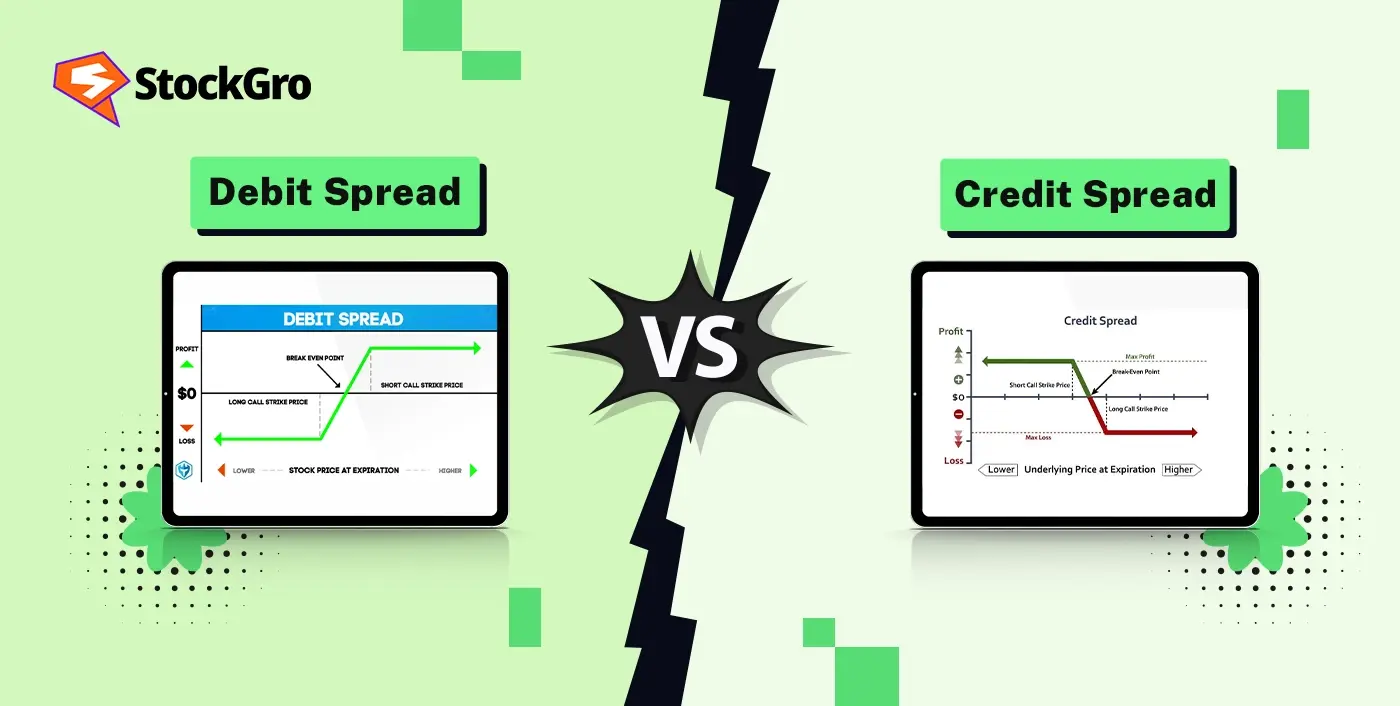
A debit spread involves paying a net premium to open an options position, typically to limit risk and potential loss.
A credit spread generates a net premium upfront, providing immediate income but with capped profits and defined risk.
Traders choose debit or credit spreads based on market direction, volatility expectations, and risk tolerance to implement strategic options trades.
What is a Debit Spread?
A debit spread is an options strategy where a trader pays a net premium to enter the position. It is widely used in spread trading because it limits both risk and reward, making it suitable for controlled trading environments.
In a debit spread option strategy, traders buy one option (higher premium) and sell another option (lower premium) with the same expiry but different strike prices. The net cost of the trade becomes the maximum possible loss.
Debit spreads are commonly used when traders expect a moderate move in the market, rather than a large breakout. They are preferred in directional trades where risk control is more important than unlimited profit potential.
What is a Credit Spread?
A credit spread is an options strategy where the trader receives a net premium upfront. It is widely used in credit spread option strategy setups where the goal is to profit from time decay and limited price movement.
In this strategy, one option is sold (higher premium) and another option is bought (lower premium) to reduce risk exposure. The premium received at entry becomes the maximum profit if the trade expires successfully.
Credit spreads are typically used in range-bound or low-volatility markets, where the trader expects the underlying asset to stay within a specific price range.
Debit vs Credit Spread: Key Differences Explained
| Feature | Debit Spread | Credit Spread |
| Cash Flow | Pay premium upfront | Receive premium upfront |
| Market Outlook | Directional (bullish/bearish) | Neutral or mildly directional |
| Risk Level | Limited to premium paid | Limited but higher margin requirement |
| Profit Potential | Limited but defined | Limited to premium received |
| Time Decay Impact | Negative (hurts position) | Positive (benefits position) |
| Best Market Condition | Trending markets | Sideways markets |
| Example Strategy Type | Bull call spread / bear put spread | Bear call spread / bull put spread |
A bear spread option strategy is often a form of credit spread used when traders expect moderate downside movement or range-bound bearish conditions.
Debit Spread Example
Let’s take an example to understand how a debit spread works. As of August 19, 2025, Tata Motors is priced at ₹697.20.
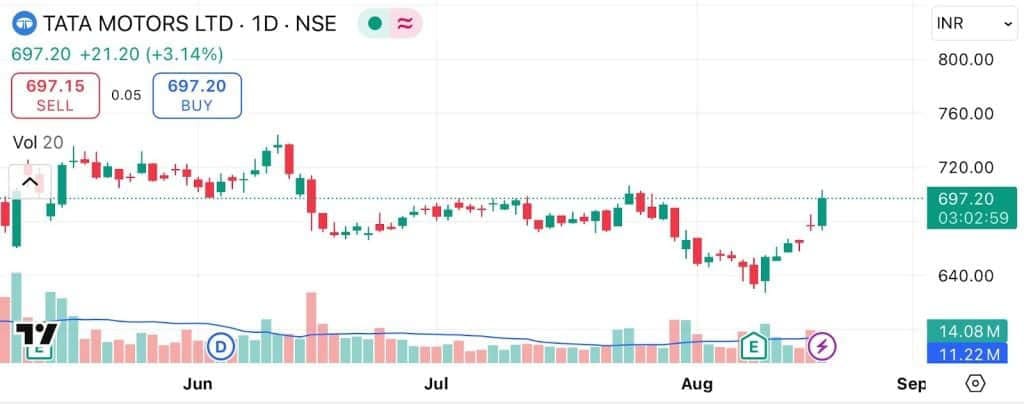
A bull call spread can be built by:
- Purchasing a ₹700 call option for ₹12
- Selling a ₹710 call option for ₹7
This results in a net debit of ₹5 per share. The maximum loss is restricted to 5, while the profit is also 5, being the strike gap subtracting the debit. Such a setup reflects a moderately bullish view with both risk and reward clearly defined.
Credit Spread Example
Now, we will also consider a credit spread example. On August 19, 2025, Zodiac Ventures was trading at ₹7.28.
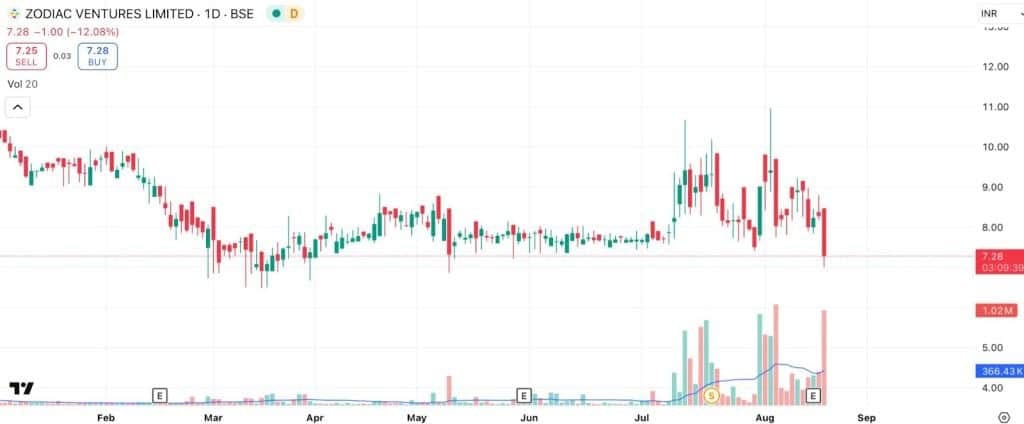
A bear call spread can be structured by:
- Selling a ₹7.50 call option for ₹0.50
- Buying a ₹8.00 call option for ₹0.25
This generates a net credit of ₹0.25 per share. The maximum gain is ₹0.25 if the price stays below ₹7.50, while the maximum loss is capped at ₹0.25 (spread width minus credit). This approach suits a mildly bearish or neutral outlook, where the aim is for the sold option to expire worthless.
Which Strategy is Better for Beginners?
For beginners, both strategies can be useful, but their suitability depends on risk preference and market understanding.
Debit Spreads for Beginners:
- Easier to understand due to defined risk (premium paid)
- Better for learning directional trading
- Suitable when market trend is clear
Credit Spreads for Beginners:
- Requires understanding of margin and probability
- Works well in stable markets
- More consistent income generation but needs discipline
Overall, beginners often start with debit spreads due to simpler risk structure.
When to Use Debit Spreads vs Credit Spreads
Each spread suits a different type of market situation. Here’s when each is generally used:
- A debit spread is chosen when seeking to participate in a directional move without committing the full premium of a single option. It allows controlled exposure at a lower upfront cost.
- Debit spreads are useful when risk needs to be defined in advance, since the maximum possible loss is capped at the debit paid.
- They can be preferred when looking for a limited but focused payoff, as the profit potential is linked directly to the distance between strikes.
- A debit spread makes more sense when paying a known cost is acceptable in exchange for potential upside, even if the maximum reward is capped.
- They are often applied in cases where a moderate move is more likely than a large one, as a strong swing could be better captured by buying a single option instead.
- A credit spread is suitable when the underlying is expected to stay within a range or move gradually, since the objective is for both options to expire worthless.
- Credit spreads offer upfront income in the form of net credit, which is fully retained if the market stays within the expected boundaries.
- They can work well when time decay is expected to erode option value quickly, helping the sold leg lose value faster than the bought one.
- Credit spreads may be preferred when the focus is on collecting premiums consistently rather than waiting for a directional payoff.
- They are also considered in cases where the move against the position is expected to be limited, since losses are capped at the difference between strikes minus the credit.
The decision between a debit spread vs credit spread therefore comes down to whether the objective is to pay for potential movement or get paid for accepting controlled obligations if stability holds.
Taxes: Debit Spread vs Credit Spread
Both debit and credit spreads are treated as derivative trades under Indian tax rules, but the way they are recorded and reported creates some key differences. Here’s how they differ:
- Tax Classification: Profits from both debit and credit spreads are taxed as business income, not capital gains. These are added to overall income and taxed as per the applicable slab rate, while losses are treated as business losses.
- Loss Set-Off and Carry Forward: Spread-related losses are permitted to be offset against business income, though not allowed against salary. Unused losses may be carried ahead for up to eight years to offset against future business income.
- Turnover Calculation: For all option strategies, including debit and credit spreads, turnover is calculated as the sum of two components: the absolute profit or loss on closed positions, and the premium received on shorting/writing options. The calculation process remains the same for both spread types.
- Filing ITR: Income from both debit and credit spreads is reported under ITR-3 as business income.
- Tax Audit Requirement: If turnover from spread trades crosses the threshold set under Section 44AB, a tax audit is required. This rule applies equally to debit as well as credit spreads.
- Expense Deduction: Brokerage, internet costs, advisory tools, and related expenses can be claimed as business expenses, provided records and invoices are maintained.
- Advance Tax: If the overall tax liability from spread trading and other income exceeds ₹10,000 in a year, advance tax must be paid in quarterly installments. Non-payment can attract interest under Sections 234B and 234C.
Risk Management in Spread Trading
- Defined Risk Structure: Both spreads limit maximum loss, making them safer than naked options
- Position Sizing: Traders should avoid over-leveraging even in defined-risk trades
- Stop-Loss Discipline: Although spreads have built-in risk limits, early exit can preserve capital
- Volatility Awareness: Credit spreads perform poorly in high volatility environments
- Greeks Monitoring: Delta, Theta, and Vega help understand position behavior
Effective risk management ensures long-term sustainability in options trading strategies for beginners.
Final Thoughts
Options spread trading offers a balanced approach between risk and reward. Debit spreads provide directional exposure with limited loss, while credit spreads generate income in stable markets.
Understanding when to use each strategy based on volatility, trend direction, and market conditions is key to consistent performance. With disciplined execution and proper risk management, spread trading can become a powerful tool in an options trader’s toolkit.
FAQs
Neither is inherently more profitable. Profit depends on market conditions and correct strategy selection.
Yes. Beginners can use spreads as they offer defined risk and structured payoff.
Yes. Credit spreads require margin since they involve selling options, though risk is limited.