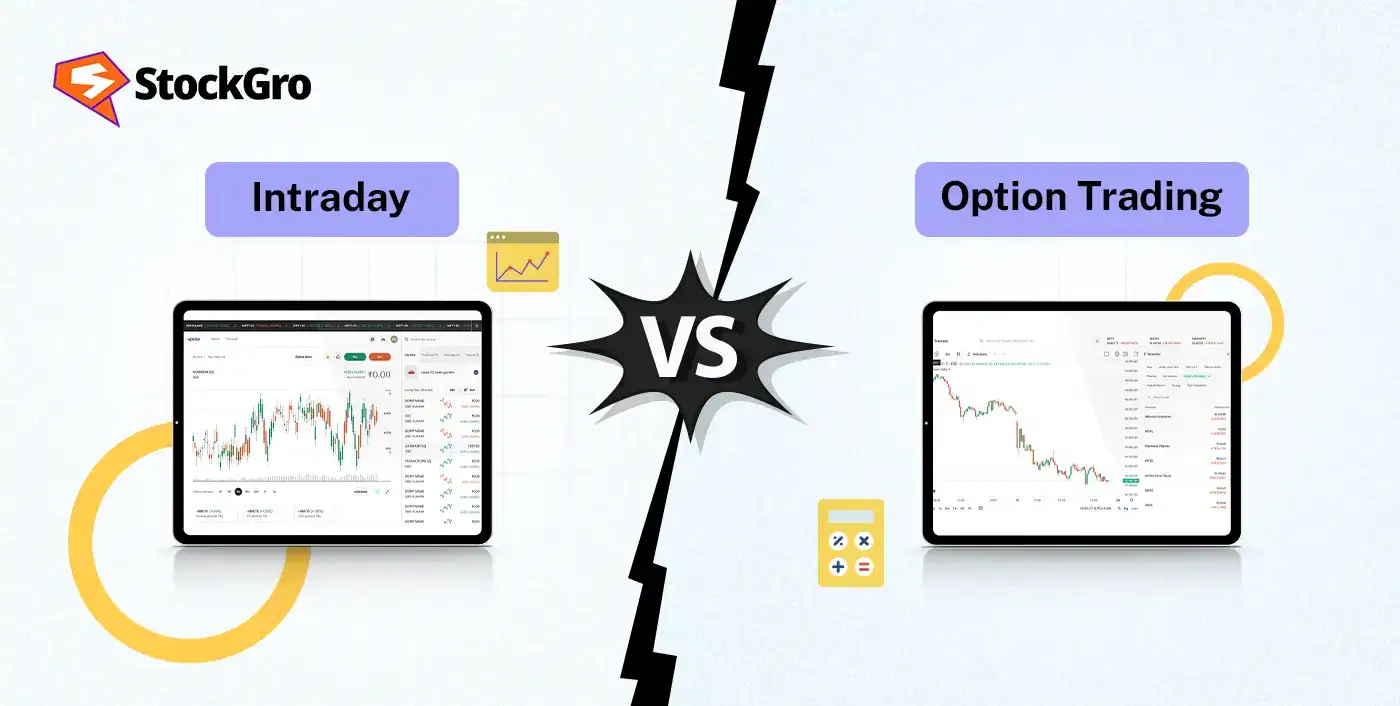
With data showing that nearly 93% of individual traders in F&O lost money between FY22–FY24, jumping into the wrong trading style can easily wipe out capital. Thinking about trading seriously? A head-to-head look at option trading vs intraday helps unpack the demands, risks, and typical outcomes before you commit to one. Let’s begin then!
What Is Intraday Trading?
Intraday trading, often called day trading, involves buying and selling financial assets, such as stocks, within the same trading day. Traders aim to capitalise on small price movements and must square off all positions before the market closes. This approach does not result in ownership of shares, as no delivery occurs, and it eliminates overnight risk by settling all trades by the end of the session.
What Is Options Trading?
Options trading deals in derivative contracts that grant the buyer the right, but not the obligation, to buy or sell an underlying asset at a predetermined price by a specific expiry date. These contracts, known as calls and puts, derive their value from the underlying asset. Traders use options for hedging against losses, income generation, or speculation on market direction with leverage.
Key Differences Between Intraday and Options Trading
A detailed comparison of the fundamental differences between option trading vs intraday includes the following:
- Comparison Table: Intraday vs Options
The table below displays how both methods function differently in terms of structure, execution, and risk, helping you see their contrasts at a glance:
| Feature | Intraday trading | Options trading |
| Time period | Strictly single session (Ends daily). | Multi-day to monthly (positional allowed). |
| Capital & leverage | Relies on margin | Buyers: premium (natural leverage). Sellers: high capital |
| Profit factors | Directional price movement | Underlying price, time decay, and volatility. |
| Risk | Linear (Losses match price drop). | Asymmetric (Buyers: capped loss. Sellers: unlimited risk). |
| Complexity | Moderate (chart & volume based). | High (requires understanding Greeks). |
| Tools | Technical indicators, VWAP. | Option chain, delta, theta, open interest. |
| Tax treatment | Treated as speculative business income: profits are taxed as business income at slab rates, and speculative losses can be carried forward for 4 assessment years and set off only against speculative business income | Equity/index options (and futures) are treated as non‑speculative business income: profits are taxed as business income at slab/corporate rates, and non‑speculative losses can be carried forward for 8 assessment years and set off against other non‑speculative business income. |
Time Horizon, Capital & Leverage
The time commitment and financial structure differ significantly. Intraday traders operate strictly between market open and close (9:15 AM to 3:30 PM). As of 2025, SEBI’s “Peak Margin” rules mandate that brokers collect 100% of the VaR + ELM margin upfront for intraday equity trades, effectively capping leverage at approximately 5x (requires 20% of trade value).
Options trading allows for holding positions over weeks or months. For option buying, SEBI mandates 100% of the premium be paid upfront (no broker leverage), though the contract itself offers natural leverage. For option selling, traders must maintain the full SPAN + Exposure margin, similar to holding futures, with no additional intraday leverage allowed.
- Risk-Reward and Profit Potential
In intraday trading, the risk is generally limited to that day’s movement, and stop-losses are essential to protect capital. Options trading carries a unique risk called time decay, where the value of a bought contract erodes as the expiration date nears, potentially leading to a total loss of the premium paid. However, options also offer non-linear profit potential, allowing gains even in stagnant markets if complex strategies like selling are used.
- Complexity, Skills & Tools Required
Intraday trading demands rapid decision-making, proficiency in reading charts, and a disciplined mindset to handle stress. Options trading requires a more strategic approach, necessitating an understanding of “The Greeks”, mathematical calculations that assess risk sensitivity and the ability to construct multi-leg strategies to hedge against possible losses.
Advantages and Disadvantages of Intraday Trading
The specific drawbacks as well as benefits of intraday trading include:
Advantages
- Zero overnight exposure: Since positions are not carried forward, the trader’s capital is immune to gap-down openings caused by overnight global events or earnings reports.
- Margin-based buying power: Traders can utilise leverage facilities to take positions that are significantly larger than their actual account balance, amplifying potential returns on small price moves.
- Bear market opportunities: It enables traders to profit from falling prices through short selling, a mechanism generally unavailable for standard delivery-based equity trades.
Disadvantages
- Screen-time intensity: Success depends on capturing fleeting moves, requiring the trader to remain fixated on the terminal throughout the session, which limits other activities.
- Auto-square off risks: If a position is not closed by the cutoff time, the broker’s system automatically liquidates(auto square off) it at the prevailing market price, which may be unfavourable.
Advantages and Disadvantages of Option Trading
The primary weaknesses and benefits of option trading include factors such as:
Advantages
- Capital efficiency via premiums: Buying options allows for exposure to a large volume of shares (a lot) for a fraction of the cost required to purchase the stocks directly.
- Portfolio insurance mechanisms: Investors can purchase put options to hedge their long-term equity holdings, effectively neutralising losses during short-term market corrections.
- Multi-directional strategy deployment: Unlike equities, options allow for strategies (like straddles) that generate profit in sideways markets or purely from volatility changes, regardless of direction.
Disadvantages
- Erosion of premium value: Time decay (Theta) works against the buyer, meaning the asset must move significantly and actively to offset the daily loss of the contract’s value.
- Steep learning curve: Interpreting the Greeks (Delta, Gamma, Vega) is essential; without this knowledge, price behaviour can appear irrational and lead to unexpected losses.
When Intraday Trading Might Be Better
This style is generally suited for individuals who prefer closing their books daily and have the time to monitor markets closely. Intraday trading may be the superior choice in scenarios such as:
- Desire for immediate results: It is ideal for those who prefer to see the outcome of their trades, profit or loss, by the end of the day, ensuring a peaceful night’s sleep without worry.
- Focus on technicals: If a trader is proficient in reading chart patterns, volume analysis, and price action but lacks interest in complex mathematical derivatives, intraday is a better fit.
- Small initial capital: For traders who want to trade expensive stocks but lack the funds for delivery or high-value option selling, the margin facilities in intraday trading provide a viable entry point.
- Avoiding “gap” risk: It protects against the risk of the market opening significantly lower or higher the next day due to overnight global events.
When Option Trading Might Be Better
Options trading is often the better route for those looking to implement sophisticated strategies, manage risk in a portfolio, or gain exposure to high-value assets with limited funds. This method typically fits best in market situations which include:
- High market volatility: During major events like budget announcements or earnings results, options can capture rapid price swings more effectively than simple stock trading.
- Portfolio protection: If an investor holds a significant amount of equity and fears a short-term correction, buying put options serves as an insurance policy to offset losses in the cash market.
- Income generation in flat markets: When the market is range-bound and not moving much, traders can sell options to collect premiums, a strategy that is not possible with simple intraday equity trading.
- Leverage with capped risk: For option buyers, the maximum loss is limited to the premium paid, offering a defined risk profile that appeals to cautious, aggressive traders.
Decision Criteria: Which One Fits Your Profile?
Selecting the appropriate method between option trading vs intraday trading depends on individual financial capacity, psychological resilience, and analytical preferences. The pivotal factors to consider when aligning a strategy with your profile are:
- Tolerance for volatility types: Intraday involves handling rapid price ticks and linear P&L swings. Option buying involves managing the risk of the premium going to zero, while selling involves unlimited theoretical risk.
- Screen time vs. analysis time: Intraday requires active execution during market hours. Options allow for positional plays where the analysis is done pre-market, requiring less active monitoring during the day.
- Liquidity requirements per strategy: If capital is low, option buying or leveraged intraday are the only accessible routes. High capital opens the door to option selling and safer, non-leveraged trading.
- Mathematical vs. visual aptitude: Visual thinkers often prefer the chart-based nature of intraday. Analytical thinkers who understand probability and decay rates tend to favour options.
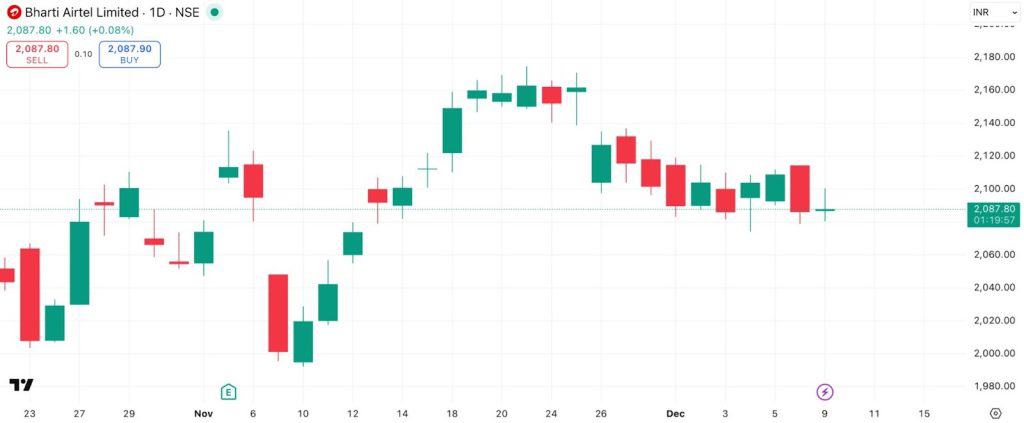
Now, let’s look at a real-world example using a daily chart of Bharti Airtel to compare the visual versus analytical approach and understand the practical difference between intraday and options trading strategies.
The stock has corrected from higher levels and is currently trading around ₹2,087, trying to find support.
- The intraday trader: Sees that the stock is holding the ₹2,080 support level and forming a green candle. They view this as a buying opportunity for a quick bounce. They might buy at ₹2,087 with a target of ₹2,105 for the same day, placing a stop-loss just below ₹2,075 to manage risk.
- The options trader: Observes the same chart but notices the stock is moving sideways (consolidating). Instead of betting on a jump, they might sell a Put Option with a strike price of ₹2,060. As long as Bharti Airtel stays above ₹2,060 by expiry, they keep the entire premium as profit, earning from the stock’s stability rather than just its rise.
Practical Tips Before You Trade
Entering the stock market without a solid plan is risky, regardless of the instrument, and requires adherence to strict operational rules. Some essential best practices to ensure longevity in the markets are as follows:
- Initial capital allocation limit: Do not deploy your entire savings immediately; allocate only a specific portion of disposable income that you can afford to lose during the learning phase.
- Mandatory exit protocols: Establish a hard stop-loss level before entering any trade to prevent a single adverse market move from depleting a significant portion of your trading capital.
- Discipline in trade frequency: Resist the urge to be in the market constantly; waiting for high-probability setups is more profitable than “overtrading” to chase minor fluctuations.
- Instrument-specific knowledge is important: Ensure you fully comprehend the mechanics of the specific instrument, whether it’s margin calls in intraday or Theta decay in options, before executing live trades.
- Simulation before live execution: Consider using paper trading platforms to validate your strategies and understand platform mechanics in real-time conditions without financial exposure.
Conclusion
Choosing between option trading vs intraday ultimately narrows down to your appetite for complexity and risk. If you prefer quick, daily settlements based purely on price action, intraday is your arena. However, if you are comfortable with multidimensional strategies involving time decay and sharp market swings, options offer greater adaptability. Assess your capital, get complete knowledge of one trading style at a time, and never trade without a defined exit plan.
FAQs
Intraday trading carries linear risk tied to price movements with high leverage amplifying losses, while options trading offers capped risk for buyers (premium only) but unlimited risk for sellers. Intraday demands constant monitoring; options allow strategic hedging. Both high-risk; suitability depends on experience.
Intraday requires margin (5-20x leverage), starting ₹25,000-50,000 for NSE stocks. Options buying needs only premium (₹5,000-20,000 per lot), but selling demands high margins (₹1-2 lakh+). Intraday suits moderate capital; options buying are ideal for small accounts.
No. Options require understanding Greeks, time decay, volatility, far more difficult than intraday’s price action reading. Beginners should master the cash market first, then intraday technicals before options. Paper trade options strategies extensively to avoid premium erosion losses.
Option buying is better for small capital as premium provides high leverage with capped risk. Intraday margin requirements and volatility can wipe small accounts quickly. Avoid option selling with limited funds.
Both treated as business income, taxed at slab rates (no STT distinction). Intraday: turnover = sale value. Options: futures-like turnover + premium adjustments. Expenses (brokerage) deductible. Maintain records; opt for presumptive taxation if turnover < ₹2 Cr.
Yes. Use options for directional bias (buy calls/puts) while intraday trading underlying for quick profits. Hedge intraday positions with protective puts. Straddles during earnings + intraday scalps work well. Requires advanced risk management across instruments.