Money has always had a direction. What shifted, quietly then all at once, is who gets to set it. Investors today are asking a question that didn’t exist in most portfolios a decade ago. Where does this capital actually go?
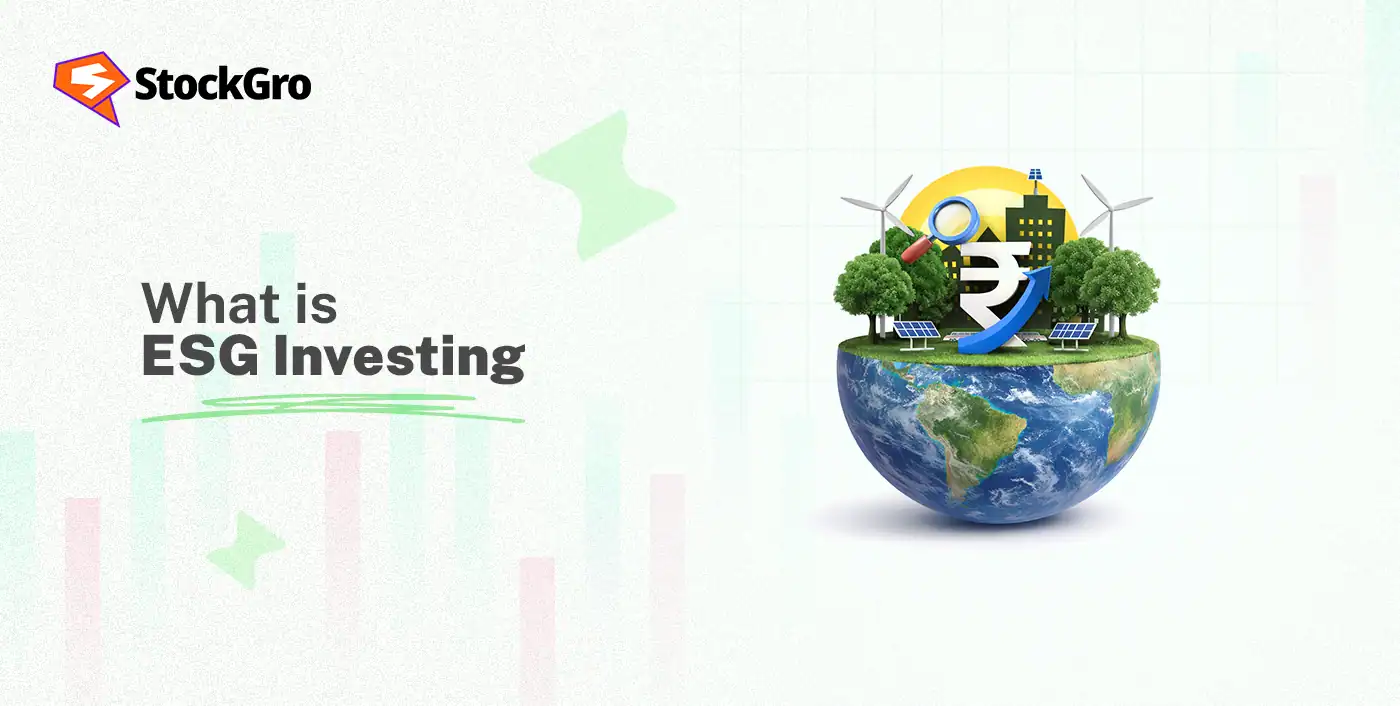
That is ESG. Not a buzzword. Not a feel-good filter. A different way of measuring whether a company is worth owning. Here is what you need to know before diving in.
What Is Environmental, Social, and Governance (ESG) Investing?
ESG investing evaluates companies on three dimensions, Environmental, Social, and Governance, alongside the usual financial metrics. It is less about virtue signalling and more about spotting risks that a balance sheet won’t tell you.
Think about it this way. A company bleeding regulatory fines, dealing with a workforce scandal, or run by a board that answers to no one is a financial risk dressed up in corporate language. ESG filters exist to catch exactly that, before it becomes your problem as an investor.
How Environmental, Social, and Governance (ESG) Investing Works
- Fund managers embed these three criteria into their analysis before a single rupee moves. Each pillar is examining something specific.
- Environmental: It looks at sustainability in hard terms. Are emissions being reduced? What is the energy mix? Companies that treat the environment like a free resource tend to carry hidden costs that eventually surface.
- Social: This examines the human layer. Workplace conditions, hiring equity, and community impact. These are not soft metrics. Firms that treat workers well tend to hold together better under pressure.
- Governance: The boardroom test, and it’s brutal. Are directors actually independent, or just friendly faces? Is executive pay defensible? Promoter pledging, related party transactions, murky financials. All of it drags a company’s score down, as it should.
Examples of ESG Investing
ESG is not abstract; it shows up in several real Indian companies and their choices.
Infosys has held a carbon-neutral status since 2020, with a significant portion of its energy coming from renewable sources. It shows up consistently in ESG fund holdings.
TCS makes the cut largely on governance and social grounds. Workforce diversity, employee welfare programmes, and board accountability have made it a near default pick for ESG-focused portfolios.
Mahindra & Mahindra took an early bet on electric vehicles and sustainable agriculture. That pivot earned it a place as something of a benchmark for environmentally conscious automotive investment, and the ESG score to match.
Why is ESG investing important?
ESG investing carries real economic and social weight. It has the following impact:
Long-term risk reduction. Companies with weak ESG practices attract regulatory penalties, reputational damage, and operational disruptions at a far higher rate. ESG filters help investors step around these before they detonate.
Governance and earnings stability. Transparent boards consistently correlate with fewer corporate scandals and more predictable earnings over time.
Capital shapes behaviour. When money flows toward responsible companies, the rest of the sector notices. ESG investing creates competitive pressure for better conduct across entire industries, not just within individual funds.
Values are not separate from returns. Younger investors, especially, are unwilling to treat these as two different conversations. Where their money sits is part of the calculation.
Regulatory tailwinds. SEBI’s framework mandates ESG disclosures for listed companies. Better data means sharper investment decisions.
What Does Environmental, Social, and Governance (ESG) Mean for a Business?
From a company’s perspective, ESG is no longer optional. It starts as reporting. Over time, it becomes a strategy.
On the environment side, watching your footprint often ends up cutting costs too. Social pressure pushes businesses toward treating people better, from the shop floor to the community outside. Governance is simpler to say than to do. Be clear, be accountable.
Companies that get all three right tend to draw patient capital and sidestep nasty surprises. It does not show overnight, but given time, the gap gets hard to ignore.
How Is ESG Investing Different From Sustainable Investing?
The terms are related and can lead to confused investment decisions. Here’s how they differ:
| Parameter | ESG Investing | Sustainable Investing |
| Definition | Screens companies on Environmental, Social, and Governance criteria to assess risk and return | Broader category covering any investment strategy aimed at long-term environmental and social impact |
| Approach | Quantitative and qualitative scoring on specific ESG metrics | Includes ESG, impact investing, green bonds, SRI, and thematic funds |
| Scope | Company-level analysis tool used in fund selection | Multiple strategies, asset classes, and global frameworks |
Topics fall under ESG and how they are rated
Each ESG pillar includes a wide range of factors.
Environmental Topics
- Emissions and reduction targets
- Energy sources and efficiency
- Water usage and conservation
- Waste management
- Impact on biodiversity
Social Topics
- Employee safety and well-being
- Diversity and inclusion
- Labour standards
- Customer privacy
- Community initiatives
Governance Topics
- Board structure and independence
- Executive compensation
- Transparency in reporting
- Shareholder rights
- Anti-corruption policies
These factors are assessed by rating agencies, including MSCI, Sustainalytics, and India’s own ESGRisk.ai, which assign ESG scores. Investors use these scores as a reference, not as the only deciding factor, but as a guide.
How ESG investing Evolved Globally?
Ideas about responsible investing did not arrive with a press release. They accumulated slowly, pushed forward by crises, regulation, and investors questioning what their money was actually funding.
The global story begins in the early 1960s, when investors began refusing to hold stocks in tobacco companies, arms manufacturers, and businesses propping up apartheid. In 2004, the United Nations Global Compact coined the term ESG in its “Who Cares Wins” report. It was a call for financial institutions to embed these factors into their decision-making.
The UN-backed Principles for Responsible Investment (PRI) were launched in 2006 and attracted many institutional signatories.
India followed its own track. SEBI mandated Business Responsibility Reports from the top 100 listed companies in 2012. It eventually evolved into the BRSR standard, now mandatory for India’s top 1,000 listed companies from FY 2022-23.
The total assets of ESG funds in India have grown to ₹9,986 crore as of February 2026, reflecting the holistic investor approach.
Pros of ESG Investing
The case for ESG investing is still being written. That said, ESG does carry certain structural advantages worth knowing.
- Catches Hidden Risks: A company’s financials tell you what happened. ESG analysis tells you what is building underneath, before it becomes a portfolio problem.
- Steadier Returns: Fewer scandals, fewer regulatory disruptions, more predictable operations. Companies running clean tend to compound more consistently over time.
- Ahead of Regulation: Governments are tightening sustainability requirements everywhere. ESG-compliant companies face fewer compliance costs when new rules arrive, and that advantage quietly compounds.
- Less Sector Volatility: ESG funds tend to underweight industries prone to cyclical shocks and regulatory crackdowns, which smooths return profiles when markets turn difficult.
- Invest With Intention: For investors who care where their money goes, ESG offers a measurable framework backed by actual screening criteria, not just a feeling.
List of ESG Funds in India
The top ESG funds by their Assets Under Management (AUM) as of April 15, 2026, are:
| Fund Name | AUM (in ₹ crore) | NAV (in ₹) | 3-Year Return (%) | Expense Ratio |
| SBI ESG Exclusionary Strategy Fund | 4,810 | 252.62 | 13.15 | 1.37 |
| ICICI Prudential ESG Exclusionary Strategy Fund | 1,246 | 17.13 | 17.13 | 1.06 |
| Axis ESG Integration Strategy Fund | 1,006 | 21.70 | 11.83 | 1.40 |
| Kotak ESG Exclusionary Strategy Fund | 709 | 17.88 | 13.73 | 0.93 |
| Baroda BNP Paribas ESG Best-in-class strategy Fund | 635 | 10.23 | 2.88 (1-month) | 0.61 |
- SBI ESG Exclusionary Strategy Fund: The largest ESG fund in India by AUM, by a significant margin. Its 13.15% three-year CAGR reflects a conservative, exclusion-first approach anchored to large caps, which suits investors who prioritise stability over aggressive alpha.
- ICICI Prudential ESG Exclusionary Strategy Fund: Smaller corpus, but the 17.13% three year return is hard to ignore. Active stock selection within the ESG screen is clearly doing meaningful work here.
- Axis ESG Integration Strategy Fund: Integrates ESG factors rather than eliminating sectors entirely, which produces broader portfolio exposure and a 11.83% return tracking close to the category average.
- Kotak ESG Exclusionary Strategy Fund: A disciplined mid-sized fund with significant weight in financial services and consumer cyclicals, two of India’s fastest growing sectors, wrapped inside an ESG framework.
- Quantum ESG Best In Class Strategy Fund: The smallest on this list. It picks the highest ESG scorers within each sector rather than cutting sectors altogether, making it a useful satellite holding for values-focused portfolios.
Who Should Choose ESG Funds?
ESG funds are not for everyone, but for the right investor, they offer a compelling mix of values alignment and long-term wealth creation.
- Long-horizon investors, who want to participate in India’s growth story without compromising on who they back.
- People who think good corporate behaviour will eventually show up in stock prices, and would rather not wait on the sidelines when it does.
- Those running a core-satellite portfolio who need a thematic sleeve with some conviction behind it.
- Millennials and young earners for whom putting money where values are is not idealism, but a strategy.
- Institutions and HNIs with ESG mandates to honour, whether for governance, regulatory, or reputational reasons.
Conclusion
ESG investing has moved from niche to necessary. Across India and globally, the argument is no longer about whether these factors matter. It’s about how fast markets will price them in. Whether you approach ESG as a values-driven choice or simply as a smarter way to manage long-term risk, the direction of travel is clear.
FAQ‘s
ESG stands for Environmental, Social, and Governance. It is a way to assess companies beyond financials by considering sustainability, people practices, and corporate conduct.
The term ESG was coined in 2004 through the United Nations Global Compact report Who Cares Wins, which encouraged financial institutions to include these factors.
ESG in India began taking formal shape in 2012, when SEBI introduced Business Responsibility Reports for the top 100 listed companies.
ESG investing can be a good option for long-term investors because it helps identify hidden risks, supports responsible businesses, and aligns money with broader values.