

Saving taxes and growing wealth can really work together if you make the investment choices. In India, there are lots of investment options that are tax-free or help you save on taxes and each one has its own set of benefits rules to follow and returns.
Understanding how these investments work is really important because it helps you make financial decisions and pay less in taxes.
Let us look at the tax-free investment options that are available in India and figure out how to pick the one that is best for what you want to achieve with your money.
What Are Tax-Free Investments?
Tax-free investments are investment options where the returns, interest, maturity amount, or any other gains/income are exempt from income tax under the provisions of the ITA. However, the tax treatment differs across various investments.
For instance, investment options, such as PPF and SGBs, provide tax-free income, while others, such as NPS and ELSS, primarily offer tax deductions on contributions.
Therefore, understanding the distinctions between each option will help you in choosing the right investment for your financial goals and tax planning.
Various Types of Tax-Free Investments
The following are some investment options that provide tax-free income, tax-saving benefits, or exemptions on maturity proceeds, depending on the applicable tax rules.
Public Provident Fund (PPF)
The public provident fund, also known as PPF, is a long-term investment option introduced by the government and accessible through select banks and post offices.
The tenure ranges from 15 years with optional 5-year extensions, or continue until retirement or age 60, depending on the scheme. Investors can deposit between ₹500 and ₹1,50,000 during a single financial year.
These deposits fall within the tax deduction limits prescribed under Section 80C. Crucially, the interest earned and the maturity amount are completely free from income tax, making it an exempt-exempt-exempt (EEE) investment.
Sukanya Samriddhi Yojana (SSY)
The SSY account is a scheme focused on the welfare of the girl child. A legal guardian can initiate the account for a girl child before she turns 10. The deposits can begin at ₹250, with an annual contribution ceiling of ₹1,50,000.
The scheme completes its tenure after 21 years, or earlier if the girl marries after turning 18. SSY, like PPF, qualifies under the EEE regime, offering tax exemption at investment, growth, and withdrawal stages.
Employee Provident Fund (EPF) & VPF
The EPF is a retirement savings scheme, supported by the government, in which employees and employers contribute a portion of employees’ salary on a monthly basis to build a retirement corpus.
The Voluntary Provident Fund, or VPF, allows the employees to contribute an additional amount from their salary to the same EPF account.
The employee contributions to the EPF qualify for deductions under Section 80C, which is up to ₹1.5 lakh under the old tax regime. Additionally, EPF and VPF generally follow the EEE, which is Exempt-Exempt-Exempt tax regime, although interest on employee contributions exceeding ₹2.5 lakh in a financial year is taxable under the applicable rules.
National Pension System (NPS) Tier 1
The NPS Tier 1 is a government retirement savings scheme administered by the Pension Fund Regulatory and Development Authority (PFRDA). The minimum contribution to open a Tier 1 account is ₹500, while subscribers must contribute at least ₹1,000 per financial year to keep the account active.
NPS Tier 1 offers tax deductions under Section 80CCD(1) up to 10% of salary for salaried individuals or 20% of gross income for self-employed individuals, subject to the overall ₹1.5 lakh limit under Section 80CCE.
An additional deduction of ₹50,000 is also available under Section 80CCD(1B). While the withdrawals receive tax benefits, the annuity income received after retirement is taxable according to the applicable income tax slab.
Equity Linked Savings Scheme (ELSS)
An ELSS is a diversified equity mutual fund that qualifies for tax deductions of ₹1.5 lakhs under Section 80C. It has a mandatory lock-in period of 3 years, which is the shortest lock-in among the tax-saving investment options under Section 80C.
Although investments qualify for tax deductions, ELSS does not provide completely tax-free returns. The capital gains from ELSS are subject to taxation as per applicable taxation rules for equity mutual funds.
Sovereign Gold Bonds (SGB)
Sovereign Gold Bonds (SGBs) are Government of India securities denominated in grams of gold and issued by the Reserve Bank of India (RBI). They offer a fixed interest of 2.50% per annum, paid semi-annually, along with returns linked to the market price of gold.
The bonds have an 8-year maturity, with an early redemption option from the fifth year on interest payment dates.
If you purchase SGB directly from the RBI during the original issue and hold it for 8 years, that is maturity, and your capital gains are completely exempt from taxation.
However, if you purchase the bond from the secondary market, you are subject to taxation at the rate of 12.5% LTCG upon maturity, with additional charges and no indexation.
Tax-Free PSU Bonds (NHAI, IRFC, PFC, REC, HUDCO, NHB)
Tax-Free PSU Bonds are debt securities issued by public sector undertakings such as NHAI, IRFC, PFC, REC, HUDCO, and NHB.
The interest earned on these bonds is 100% exempt from income tax under Section 10(15)(iv)(h) of the Income-tax Act, and no Tax Deducted at Source (TDS) is applicable on interest payments.
Although no fresh bonds have been issued since FY 2015-16, existing bonds continue to trade on the NSE and BSE. However, capital gains arising from selling these bonds before maturity are taxable according to the applicable capital gains provisions.
Section 54EC Capital Gains Bonds
Section 54EC Capital Gains Bonds help taxpayers save tax on long-term capital gains arising from the sale of land or buildings.
To claim the exemption, the capital gains must be invested in notified 54EC bonds within six months from the date of transfer, subject to a maximum investment of ₹50 lakh in a financial year.
If the bonds are transferred, converted into money, or pledged for a loan before the prescribed lock-in period, the tax exemption is withdrawn.
ULIP under Section 10(10D)
A Unit Linked Insurance Plan, or ULIP, is a life insurance product that also invests a portion of the premium in market-linked funds. Under Section 10(10D) of the Income-tax Act, the maturity amount is tax-exempt if the policy meets the prescribed eligibility conditions.
For ULIPs issued on or after 1 February 2021, the combined annual premium across ULIPs must not exceed ₹2.5 lakh to claim this exemption. If the premium crosses this limit, the maturity proceeds become taxable.
Traditional Endowment / Money-back Insurance under 10(10D)
Traditional Endowment and Money-back Insurance plans combine life insurance with guaranteed savings or periodic payouts. Under Section 10(10D) of the Income-tax Act, the maturity amount, including any bonus, is generally exempt from tax if the policy satisfies the prescribed conditions.
For policies issued on or after 1 April 2023, this exemption applies only if the aggregate annual premium across non-ULIP life insurance policies does not exceed ₹5 lakh.
If this limit is exceeded, the maturity proceeds become taxable. However, the death benefit paid to the nominee continues to remain exempt from tax.
National Savings Certificate (NSC)
The NSC is a fixed-income savings scheme offered by the Government of India through post offices. It has a 5-year maturity period and allows individuals to invest any amount starting from ₹1,000 in multiples thereof.
The investments in NSC qualify for a tax deduction of up to ₹1.5 lakh under Section 80C of the Income-tax Act. While the interest is taxable, the interest accrued during the first 4 years is treated as reinvested and also qualifies for deduction under Section 80C, subject to the overall limit.
Which Investments Are NOT Tax-Free? (Myth-Busting)
Many investors assume that every tax-saving investment is also tax-free, which can be a mistake. Some investments provide deductions on the amount invested, while others tax the interest, maturity proceeds, or capital gains. Understanding the difference can help you make better investment decisions.
| Investment | Why is it not fully tax-free? |
| National Pension System (NPS) Tier 1 | It offers tax deductions on contributions, but annuity income after retirement is taxable. |
| Equity Linked Savings Scheme (ELSS) | ELSS qualifies for Section 80C deductions, but capital gains are taxed according to applicable equity taxation rules. |
| National Savings Certificate (NSC) | The investment qualifies for Section 80C deductions, but the interest earned is taxable. |
| Unit Linked Insurance Plan (ULIP) | The maturity proceeds become taxable if the aggregate annual premium exceeds ₹2.5 lakh for policies issued on or after 1 February 2021. |
| Traditional Endowment and Money-back Insurance | The maturity proceeds may become taxable if the aggregate annual premium exceeds ₹5 lakh for policies issued on or after 1 April 2023. |
| Sovereign Gold Bonds (SGBs) | The annual interest is taxable, and bonds sold before maturity through the secondary market may attract capital gains tax. |
| Tax-Free PSU Bonds | The interest here is tax-free, but capital gains arising from selling the bonds before maturity are taxable. |
Tax-Free Options by Investor Segment
Since different investors have their own financial needs, choosing suitable investment options accordingly can improve returns while reducing tax liability.
For Salaried Employees
The salaried employees might combine EPF, VPF, PPF, and NPS Tier 1 to build long-term wealth while claiming tax deductions. PPF, SSY, EPF, and VPF generally follow the EEE tax regime, while NPS offers additional deductions under Section 80CCD(1B), making them suitable retirement-focused investments.
For Senior Citizens
Senior citizens looking for tax-efficient retirement planning may consider PPF, if eligible to continue an existing account, Tax-Free PSU Bonds available through the secondary market, and Sovereign Gold Bonds held until maturity. These investments can provide tax-efficient returns while helping preserve capital over the long term.
For NRIs
Investment options for NRIs are more limited because many tax-saving schemes have residency-based eligibility. NRIs cannot open new PPF accounts, although accounts opened while they were residents may continue until maturity, as the government’s earlier closure notification has been kept in abeyance.
They also cannot purchase new Sovereign Gold Bonds, but existing holdings acquired before becoming an NRI may be retained until redemption or maturity.
NRIs may invest in NPS, life insurance plans, and ULIPs, subject to scheme conditions.
For Girl Child (SSY deep dive)
The Sukanya Samriddhi Yojana is designed exclusively for the financial future of a girl child. With its tax deductions under Section 80C, tax-free interest, and tax-free maturity proceeds under the EEE regime, it is one of the most tax-efficient long-term savings schemes for education and marriage expenses.
For High-Income Earners (HNI)
The high-income earners can diversify across PPF, NPS, Tax-Free PSU Bonds, and Section 54EC Capital Gains Bonds, depending on their financial objectives. Combining tax-efficient investments with capital gains planning can help reduce overall tax liability while creating a balanced long-term investment portfolio.
How Much Can You Invest Tax-Free Each Year? (Limits)
The amount you can invest tax-efficiently each year depends on the investment option and the applicable provisions of the Income-tax Act.
While some schemes have annual investment limits, others restrict only the tax deduction that can be claimed. The table below summarises the key limits for popular tax-free and tax-saving investments.
| Investment | Maximum investment / deduction limit |
| Public Provident Fund (PPF) | ₹1.5 lakh investment per financial year |
| Sukanya Samriddhi Yojana (SSY) | ₹1.5 lakh investment per financial year |
| EPF / VPF | No statutory contribution limit, but Section 80C deduction is capped at ₹1.5 lakh |
| NPS Tier 1 | Section 80CCD(1): Within the overall ₹1.5 lakh limit. Additional ₹50,000 under Section 80CCD(1B). |
| ELSS | Investment has no upper limit, but deduction is limited to ₹1.5 lakh under Section 80C |
| NSC | No maximum investment limit, but deduction is capped at ₹1.5 lakh under Section 80C |
| Section 54EC Bonds | ₹50 lakh investment in a financial year |
How to Choose the Right Tax-Free Investment? (Decision Tree)
Choosing the best tax-free investment depends on your financial goals, investment horizon, and tax requirements. Before investing, compare the following factors to find an option that matches your needs:
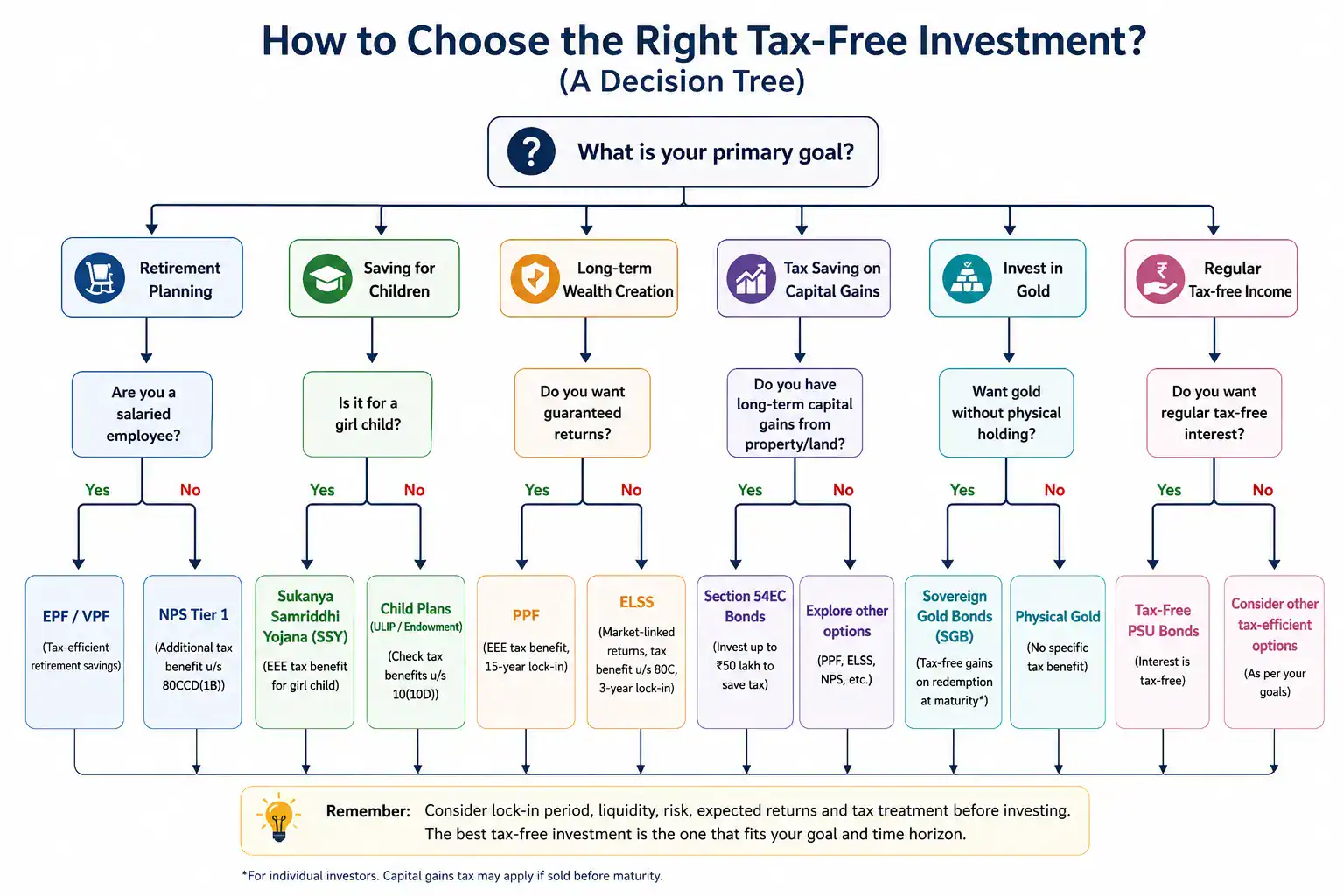
Tax-Free Investment vs Regular Investment
Tax-free and regular investments differ in their tax treatment, returns, and overall post-tax earnings.
| Feature | Tax-Free Investment | Regular Investment |
| Tax on returns | Interest, maturity amount, or specified gains may be exempt from tax, subject to scheme conditions. | Interest, dividends, or capital gains are generally taxable as per the applicable tax rules. |
| Tax deduction on investment | Many options, such as PPF, SSY, and NPS, offer tax deductions under sections of the Income-tax Act. | Tax deductions are generally not available unless specifically provided by law. |
| Post-tax returns | Usually higher because part or all of the returns may not be taxed. | Net returns may reduce after paying applicable taxes. |
| Investment objective | Suitable for tax planning, long-term savings, retirement, and specific financial goals. | Suitable for wealth creation, income generation, or portfolio diversification without tax benefits being the primary objective. |
| Examples | PPF, SSY, Tax-Free PSU Bonds, original SGB maturity proceeds, and Section 54EC Bonds. | Fixed Deposits, Corporate Bonds, Non-tax-saving Mutual Funds, and Regular Savings Accounts. |
| Best suited for | Investors looking to reduce tax liability while meeting long-term financial goals. | Investors prioritise returns, liquidity, or diversification over tax benefits. |
Benefits of Tax-Free Investments
Tax-free investments can help you reduce your tax burden while supporting long-term financial goals through tax-efficient returns and disciplined investing.
- Lower tax liability: Eligible investments can reduce your taxable income or provide tax-free returns, which helps you save more each financial year.
- Higher post-tax returns: When interest, maturity proceeds, or capital gains are exempt from tax, you retain a larger share of your investment earnings.
- Supports long-term financial goals: Most tax-free investments are designed for retirement planning, children’s education, wealth creation, or capital preservation.
- Encourages disciplined investing: The lock-in periods and regular contribution requirements help in building consistent saving and investment habits.
How to Start Investing? (Step-by-Step)
The investment process involves standard procedures such as:
- Documentation and KYC:
The first step for any investment is ensuring Know Your Customer (KYC) compliance. Investors need to provide identity proof (Aadhaar, Voter ID), address proof, and PAN card details. A valid birth certificate is compulsory when opening an SSY account.
- Choosing the intermediary:
Most government schemes like PPF, NSC, and SSY can be opened at designated post offices or authorised branches of public and private sector banks. Tax-free bonds require a demat account and are purchased through stock exchanges or during public issues. ELSS funds are purchased through mutual fund distributors or online platforms.
- Opening the account:
For post office schemes, a specific application form (e.g., Form-1 for PPF) must be filled out and submitted along with the initial deposit amount via cheque or cash. Online banking platforms now allow existing customers to open PPF and SSY accounts instantly without visiting a branch.
- Making deposits:
Once the account is active, subsequent deposits can be made via online transfer, standing instructions, or physical visits. It is important to adhere to the minimum and maximum deposit limits each financial year to keep the account active and eligible for interest.
Conclusion
Tax-free investments can help you build long-term wealth while reducing your tax liability, but each option follows different rules for deductions, returns, and maturity benefits. Choosing the right investment depends on your financial goals, investment horizon, and risk appetite.
Before investing, compare the tax treatment, lock-in period, and expected returns of each option to build a portfolio that supports both your wealth creation and tax planning objectives.
FAQs
The most benefitting tax‑efficient options include PPF, Sukanya Samriddhi Yojana (SSY), tax‑free PSU bonds, NSC (with Section 80C benefit), and ELSS funds. PPF and SSY are fully EEE, while ELSS combines equity growth with 80C deduction but taxable LTCG.
Tax‑free investments reduce tax either by allowing 80C deductions on contributions (PPF, NSC, SSY, ELSS) or by making interest/maturity exempt (PPF, SSY, notified tax‑free bonds). This improves effective post‑tax returns, especially for investors in higher tax slabs.
Tax‑free bonds issued by government‑backed PSUs like NHAI or IRFC are generally considered safe because of sovereign support and fixed coupons. They suit conservative, long‑term investors seeking predictable, tax‑exempt interest, though liquidity in secondary markets can be limited.
You can invest up to ₹1,50,000 per financial year in PPF. Investing close to this upper limit annually for the full 15‑year tenure maximises both compounded, tax‑free growth and Section 80C tax benefits under the EEE structure.
Premature access depends on the product. ELSS units can be redeemed after three years. PPF allows partial withdrawals and loans after specific years, but full withdrawal only at maturity. SSY and many tax‑free schemes permit early exit only under limited, defined conditions.