
Summary
Business-cycle mutual funds allocate and adjust their funds in different market sectors depending on the economic phase.
Since they do not focus solely on a single sector, they are different from sector funds.
Business-Cycle Mutual Funds
A business-cycle mutual fund is an actively managed equity mutual fund that adjusts its investments according to different phases of the economy. Instead of following a fixed sector allocation, the fund manager shifts exposure to industries that are expected to benefit from current or upcoming economic conditions. However, they are not a separate SEBI mutual fund category. In India, they are generally classified as thematic equity funds.
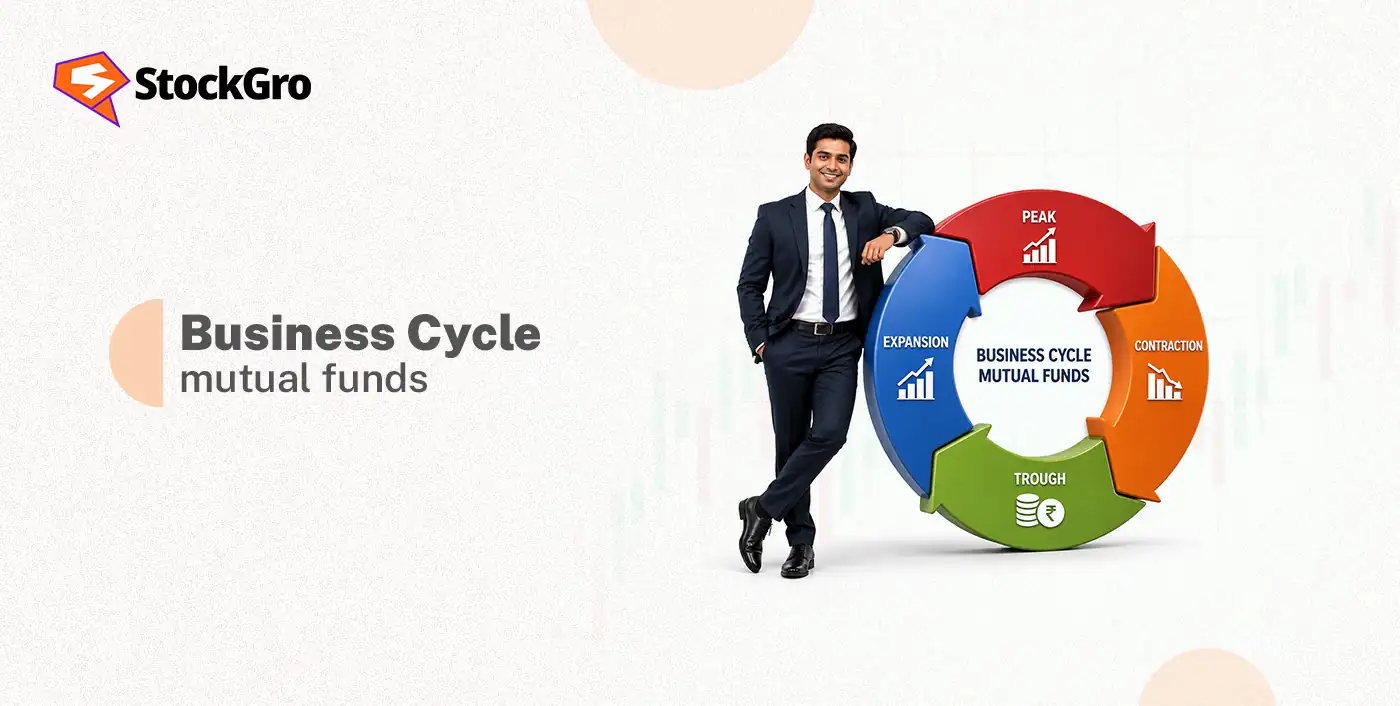
Different sectors typically experience four economic stages, i.e., recovery, expansion, contraction, and peak. Business cycle mutual funds attempt to capitalise on the changing trends by reallocating investments before market leadership shifts.
How Business-Cycle Mutual Funds Work
The business-cycle fund highly depends on the fund manager’s expertise and ability to interpret economic indicators and position the portfolio accordingly.
Rather than investing equally across multiple sectors, the mutual fund manager constantly evaluates factors such as GDP growth, inflation trends, interest rates, government spending, corporate earnings, credit growth, consumer demand, commodity prices, and global economic developments. Based on these aspects, investment allocations are adjusted across multiple sectors over time.
The strategy rests on constant macroeconomic tracking. Fund managers watch both leading and lagging indicators to judge where the economy stands.
The four broad stages that an economy encounters are listed below. Let us understand the concept using JPMorgan Chase as an example.
- Recovery: In this stage, demand starts to escalate, and rates are often low. Early-cycle sectors like banking and autos rejuvenate in this economic stage.
As the economy recovers, investors and businesses tend to borrow more money, ultimately increasing demand for car and business loans. This results in JPMorgan’s business of allowing credit.
- Expansion: In this stage, the business accelerates, companies begin to experience more demand, and the industrials, capital goods, and metals sectors tend to grow.
A rise in income comes with the privilege to spend confidently.
Strong economic growth increases demand for loans, investment banking, and asset management activities. This helps with the company’s revenue and profits.
- Peak: The economic condition may escalate, and inflation may rise in this stage. Central banks may raise their rates, and commodity and energy stocks may outperform the market.
Rising inflation and interest rates may temporarily increase the interest income. But gradually it may lead to a decrease in demand for loans and borrowings.
- Recession: The growth of this sector slows down in this stage. Investors shift their focus to defensive sectors such as healthcare and consumer staples that are less sensitive to economic fluctuations.
When the economy suffers a recession, businesses and individuals tend to borrow less, and more defaults start occurring. These lead to a main focus on managing the credit risk.
Key Benefits of Investing in Business-Cycle Mutual Funds
Business-cycle funds can be balanced by adapting to the economic cycle.
- Opportunity to Gain from Different Market Phases: Business-cycle funds are different from sector funds, which remain focused on a particular sector. Business-cycle funds have the flexibility to allocate investments across multiple sectors based on the economic conditions. This allows investors to participate in changing market opportunities without switching the entire fund.
Suppose, when the economy recovers, fund managers may decide to invest more in the banking and automobile sectors. When growth potential increases, they may shift towards infrastructure and capital goods. And when the economy faces a recession, it may shift towards more defensive investments such as healthcare and FMCG. This is how the funds rotate, according to different stages of the economy.
- Diversification across sectors: These funds generally allocate their investment across different sectors over time. This diversified allocation helps reduce concentration in specific sectors and separates it from funds that particularly focus on a single sector.
- Expert portfolio Management: Experienced fund managers manage the business-cycle funds and continuously track changing economic conditions, understand market cycles, and evolving industry trends. This makes them suitable for investors who prefer active management alongside broad diversification.
- Potential to Capture Long-term Growth: As economies move through repeated cycles, different sectors become market leaders at different times. A well-managed business cycle fund seeks to identify these shifts early, potentially improving long-term returns compared to maintaining fixed sector exposure.
Risks and Limitations Investors Should Know
Although business-cycle funds offer various growth opportunities, it also carries certain risks and limitations.
- Timing Errors: Predicting the economic changes is not an easy task. If fund managers fail to predict economic conditions, asset allocation in multiple sectors may underperform in the broader market.
- Highly Volatile: During different economic phases, some portfolios may carry an overweight in certain sectors, leading to more frequent changes in returns than a diversified portfolio. For periods of underperformance, investors should be prepared.
- Not suitable for Short-term Traders: Economic cycles generally take several years, not just a few months. Investors seeking short-term gains may become disappointed if returns are unstable.
- Active Management Risk: Business-cycle funds are different from index funds because they heavily depend on the fund manager’s decision. The performance of business cycle funds may vary due to the quality of research and the investment decisions made by fund managers.
Who Should Invest in Business-Cycle Mutual Funds?
Business-cycle funds are not suitable for all types of investors.
- Investors comfortable with equity: This is an equity fund with active sector rotation, so it involves market fluctuations alongside added variability from sector bets.
- Investors with a long-term goal: Since full cycles can take several years, this fund suits goals at least five years away, giving the strategy time to play out.
- Investors seeking professionally guided exposure to macro sectors: Investors who find it hard to track interest rates or sector rotations themselves can let a professional handle the analysis.
- Investors seeking portfolio diversification: Investors who already hold large-cap or flexi-cap funds might add this for a differentiated, cycle-aware strategy.
However, a business-cycle fund is not suitable for conservative investors seeking low volatility, investors with short-term goals, or investors uncomfortable with a manager’s discretionary sector calls.
Business-Cycle Mutual Funds vs Sector Funds vs Flexi Cap Funds
Although all the funds invest in equities, they have other features that differentiate them from each other.
| Basis | Business-Cycle Fund | Sector Fund | Flexi-Cap Fund |
| Investment Strategy | Rotate across sectors based on the economic phase | Focus on one specific sector | Invest across market caps without sector restriction |
| Diversification | Moderate, a handful of cycle-relevant sectors | Low, specifically one sector | High, across caps and sectors |
| Risk | Moderate-to-high, depends on timing accuracy | High, entirely depends on a single sector’s performance | Moderate, cushioned by broad diversification |
| Suitable for | Long-term investors seeking dynamic allocation | Investors with strong sector conviction | Investors seeking diversified equity exposure |
Common Mistakes Investors Make and How to Avoid Them
There are certain mistakes made by investors when investing in business-cycle funds.
- Expecting quick profits: Economic cycles take time to develop. Exiting the fund due to unsatisfactory short-term performance may not be effective for an investor.
- Ignoring the fund manager’s record: Since a lot depends on the manager’s calls, it is important to check how the fund house has performed in the past, rather than picking a fund on name alone.
- Reacting to short-term fluctuations: A few temporary fluctuations do not necessarily mean the fund is failing. The anticipated shift may simply not have played out yet.
- Not matching the fund to personal risk appetite: Investing without identifying your risk tolerance and goals may lead to quick exits or selling during market drops.
Conclusion
Business-cycle mutual funds provide a distinctive approach to equity investing by adjusting portfolios during different economic phases. Instead of focusing on a specific sector, the business-cycle fund allows investors to allocate their investment across sectors based on their economic performance. These funds are suitable for investors seeking long-term goals and professional guidance.
However, they also include various limitations, such as management risk, volatility risk, and the possibility of unstable economic conditions. Therefore, these funds should be viewed as long-term investments rather than short-term trading opportunities.
FAQs
Business-cycle mutual funds are market-linked investments and do not guarantee returns. Their risk depends on market conditions and the fund manager’s investment decisions.
Yes, beginners can invest if they have a long-term investment horizon and understand the risks associated with equity mutual funds.
Business-cycle funds shift investments across multiple sectors based on economic conditions, whereas sector funds invest only in a single industry or sector.
An investment horizon of at least five years is generally recommended, as economic cycles take time to unfold.
Yes. Investing through a Systematic Investment Plan (SIP) helps average purchase costs and encourages disciplined investing over the long term.
These funds are primarily designed for long-term investors rather than short-term traders. However, they can complement a diversified equity portfolio if they align with the investor’s risk profile and financial goals.