In modern days, the stock market offers more investment routes than ever before, yet the abundance of choice shifts the focus from opportunity to selection.
Now, you must have heard of ETFs, index funds, and mutual funds. Each presents a distinct approach to participating in the market.
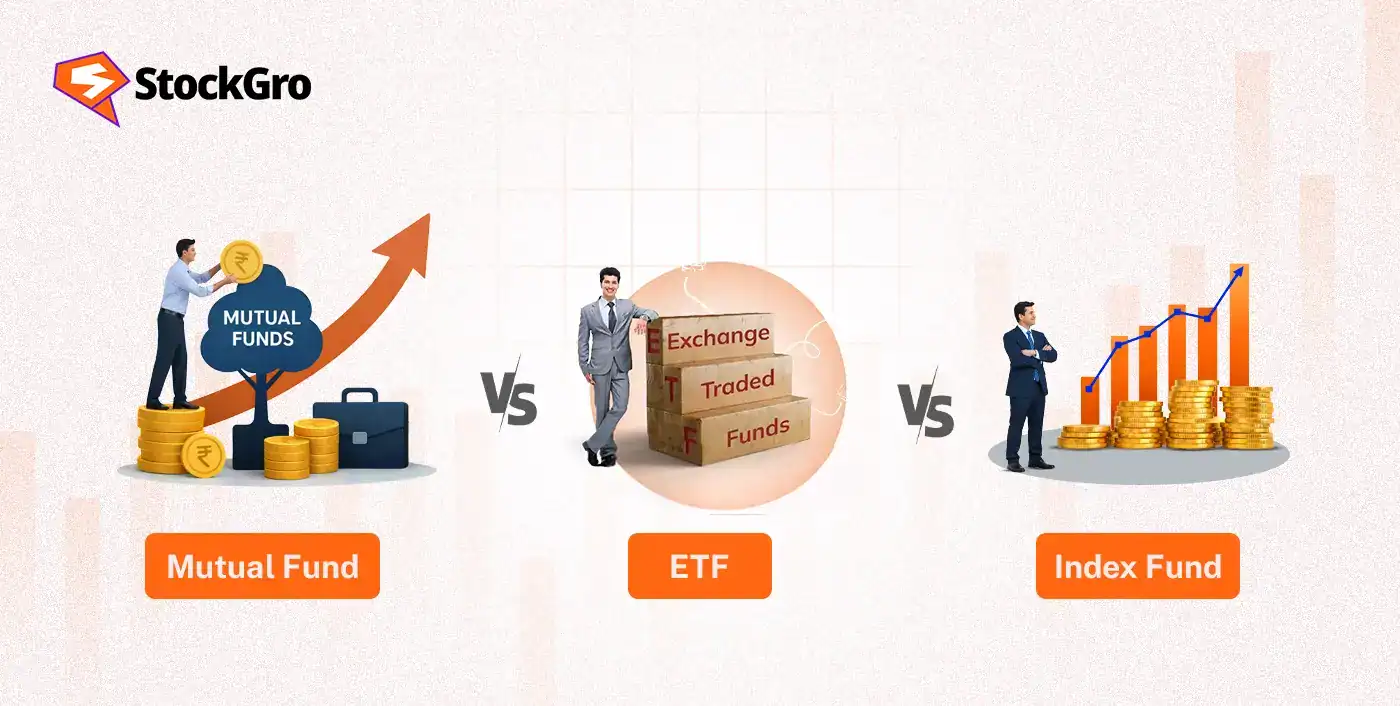
Then, when the conversation angles as ETFs vs Index Funds vs Mutual Funds, the differences are based on their structure, cost, trading flexibility, and management style. Investors/traders usually weigh these instruments based on cost efficiency, control, and long-term return expectations.
To know more about ETFs vs Index Funds vs Mutual Funds and when to choose each, keep reading!
What Are ETFs?
Exchange-traded funds (ETFs) are market-linked instruments that follow a market index, such as the Nifty 50, and are traded like regular stocks on the stock exchanges during trading hours.
While ETF trading requires a demat account, it provides high tax efficiency and liquidity to the investors. Additionally, most ETFs follow a passive approach, aiming to track the market, which keeps the costs relatively lower.
Top ETFs in India based on market capitalisation, as of 25 March 2026 (latest updated 06:30 AM) are:
| Name | Category | Market Capitalisation | 1-year Return (%) |
| CPSE ETF | Equity | 60,188.96 | 13.45 |
| UTI Nifty 50 ETF | Equity | 38,989.16 | –2.10 |
| Nippon India ETF Nifty IT | Equity | 23,086.70 | –18.61 |
| Nippon India Silver ETF | Silver | 21,841.86 | 125.43 |
| Bharat 22 ETF | Equity | 21,692.47 | 8.44 |
What Are Index Funds?
Index funds are a particular type of mutual fund scheme designed to mirror a market index, such as Nifty 50 or Sensex, with a passive approach, as the name suggests. These funds invest in the same securities that make up the selected index in the same proportion, rather than individually selecting stocks.
Top Index Funds in India based on their asset under management (AUM), as of 25 March 2026 (latest updates 08:00 AM):
| Name | Category | AUM | Absolute Return 1-year (%) |
| UTI Nifty 50 Index Fund | Growth | 26,517.42 | –2.26 |
| HDFC Nifty 50 Index Fund | Growth | 22,260.25 | –2.31 |
| ICICI Pru Nifty 50 Index Fund | Growth | 15,390.61 | –2.30 |
| SBI Nifty Index Fund | Growth | 11,879.12 | –2.34 |
| HDFC BSE Sensex Index Fund | Growth | 8,869.18 | –4.19 |
What Are Mutual Funds?
Mutual funds are hardly new to us Indians. From familiar campaign lines like Mutual Funds Sahi Hai to the rise of SIP culture, they have already found a place in our everyday financial conversations.
Mutual funds collect the money from investors and allocate it across equities, debt, or a mix of assets, guided by the fund manager’s strategy. If we compare it to ETFs or index funds that largely follow a preset path, many mutual funds take on an active approach to stock selection, sector allocation, and timing, aiming to deliver returns above the market.
Top mutual funds in India based on asset under management (AUM), as of 25 March 2026 (latest updated 08:00 AM):
| Name | Category | AUM | Absolute Return 1-year (%) |
| ICICI Pru Silver ETF FOF | FoFs (Domestic) – Silver | 7,058.51 | 122.54 |
| HDFC Silver ETF FoF | FoFs (Domestic) – Silver | 4,734.74 | 123.57 |
| Nippon India Silver ETF FOF | FoFs (Domestic) – Silver | 4,719.87 | 123.02 |
| Edelweiss Gold and Silver ETF FoF | FoFs – Gold | 2,964.79 | 80.21 |
| Motilal Oswal Gold and Silver Passive FoF | FoFs – Gold | 2,730.16 | 74.62 |
Differences Between ETFs, Index Funds, and Mutual Funds
At first glance, ETFs, index funds, and mutual funds appear to serve the same purpose: market participation through diversification. However, their structure, pricing, and management approach set them apart in meaningful ways. Let’s check how!
| Basis | ETFs | Index Funds | Mutual Funds |
| How do they function? | Market-traded funds tracking an index or asset | Mutual fund that mirrors an index | A fund category investing across assets |
| Decision approach | Passive, tracks an index | Passive, tracks an index | Mostly active, fund manager driven |
| How do investors transact? | Bought and sold on exchange like stocks | Bought directly from fund houses | Bought directly from fund houses |
| Pricing method | Real-time market price | End-of-day NAV | End-of-day NAV |
| Liquidity | High, intraday transactions allowed | Moderate, processed once daily | Moderate, processed once daily |
| Expense ratio trend | Lower due to passive nature | Low due to passive strategy | Higher due to active management |
| Investors’ control | High control over timing and price | Limited to day-end execution | Limited to day-end execution |
| Accessibility | Requires demat and trading account | No demat required | No demat required |
| Investment approach | Matches index performance | Matches index performance | Aims to outperform market |
| Who does it suit? | Traders and cost-conscious investors | Long-term passive investors | Investors preferring professional management |
When to Choose an ETF?
An ETF can be your better fit if you like being in control of timing and pricing.
- You pay attention to market movements: If you’re into tracking prices during the day or follow market trends closely, ETFs give you the flexibility to act instantly.
- You want lower ongoing costs: Since most ETFs simply follow an index, they tend to stay light on expenses, which suits investors who care about long-term cost efficiency.
- You are already comfortable with stock investing: If buying shares through a demat account feels like a routine to you, ETFs might blend right in.
When to Choose an Index Fund?
This could work if you prefer consistency without constant involvement.
- You believe in staying invested rather than timing entries: If your approach is to let compounding play out over years, index funds keep things simple, with no pressure to react to daily ups and downs.
- You like the discipline of regular investing: Index funds make the investing process smooth, allowing you to build your portfolio without thinking about market timing at all.
- You want a clean setup: Investing in index funds requires no trading account or constant tracking. You invest, review occasionally, and let the fund mirror the market in the background.
When to Choose a Mutual Fund?
Mutual funds could be relevant if you want an active approach without doing much by yourself.
- Fund manager does the work: If you don’t want to pick sectors or stocks yourself, mutual funds place that responsibility in experienced hands.
- Your investments are tied to different goals: Whether it is long-term growth, income stability, or a balanced mix, mutual funds offer categories that can be aligned with what you are working towards.
- You are fine paying for active management: The higher cost only makes sense if you value the possibility of better positioning and active shifts. For many investors, that trade-off feels worth it.
Conclusion
ETFs, index funds, and mutual funds each serve a distinct role in an investor’s portfolio. The choice does not rest on which is superior, but on how well each aligns with your approach to investing.
ETFs offer flexibility and control, index funds bring simplicity and discipline, while mutual funds provide active management. A well-thought-out allocation may even include a mix of all three, depending on your goals, cost preference, and comfort with market involvement.
FAQs
The right choice between the three depends on how you invest. If you prefer active decision-making, mutual funds might suit you. If you want low-cost passive investing, index funds or ETFs work better. ETFs add trading flexibility, while index funds offer simplicity through SIPs and long-term holding.
An ETF is not necessarily better than a mutual fund. It depends on what you value more. ETFs offer lower costs and real-time trading, while mutual funds provide active management and goal-based options. If you want control and lower expenses, ETFs may suit you. If you prefer expert handling, mutual funds may be more relevant.
SIPs are not directly available in ETFs, unlike in mutual funds. Since ETFs are traded on stock exchanges, you need to buy units manually through a demat account. However, some brokers allow setting up automated purchases at regular intervals, which can work similarly to an SIP, though not in the traditional format.