Summary
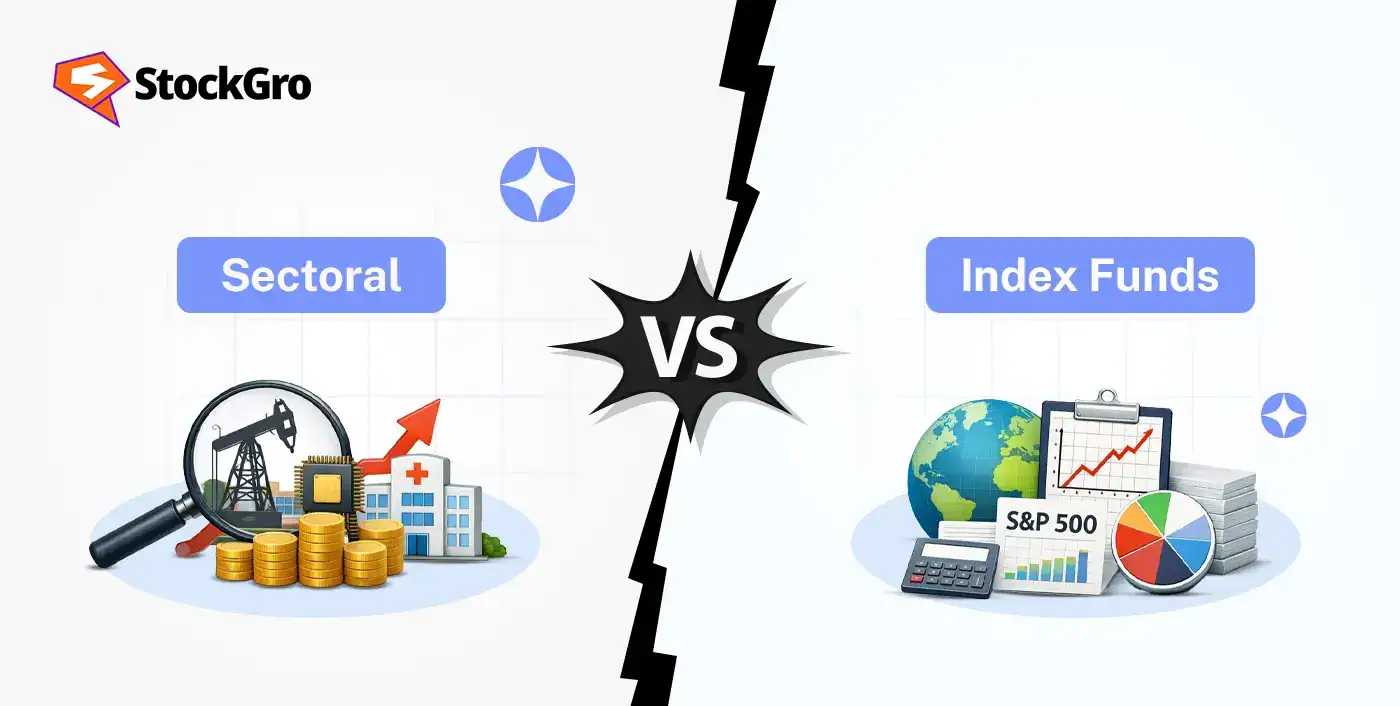
This article compares index funds and sector funds, highlighting their unique advantages. Index funds track the overall market, offering low-cost, broad exposure, while sector funds focus on specific industries with higher growth potential but increased risk. Learn how to pick the right fund based on your goals and risk tolerance. Choose a strategy that aligns with your investment style.
What Are Index Funds?
An index fund is a mutual fund designed to replicate the returns of a particular market index. They mirror the benchmark index by holding the same set of stocks in identical proportions.
Index funds follow a passive strategy, meaning there is minimal buying and selling based on predictions. This makes them cost-efficient and relatively easy to manage.
The key features of index funds are listed below:
- Diversification: Index funds are spread across multiple companies in an index, which reduces the risk.
- Low Expense Ratio: As the funds run on a passive investment approach, their operational costs are lower.
- Market-linked returns: Their performance closely mirrors the market movement, and thus, the returns depend on how the market is doing.
- Transparency: These funds follow the listed companies on an index, which makes tracking them convenient.
- Long-Term Focus: Index funds are suitable for investors who are aiming for steady wealth creation over time.
If you’re interested in investor funds, you can consider these options listed by their asset size as of March 24, 2026:
| Fund Name | AUM (₹ Cr) | NAV (₹) | Expense Ratio | 3-Year Returns (%) |
| UTI Nifty 50 Index Fund | 26,681 | 160.18 | 0.20 | 11.61 |
| HDFC NIFTY 50 Index Fund | 22,324 | 222.76 | 0.20 | 11.57 |
| ICICI Prudential Nifty 50 Index Fund | 15,391 | 240.83 | 0.19 | 11.57 |
| SBI Nifty Index Fund | 11,879 | 212.91 | 0.19 | 11.58 |
| ICICI Prudential Nifty Next 50 | 8,396 | 54.79 | 0.70 | 18.34 |
What Are Sector Funds?
Sector funds that invest in a specific sector or industry, like defence, banking, or technology. Their focus is not on diversification as they concentrate their investments within a single segment of the market.
This approach enables investors to gain from growth within a specific sector. However, it also increases exposure to sector-specific risks, making these funds more volatile compared to diversified options.
The following characteristics are associated with sector funds:
- Targeted Approach: Sector funds allow you to invest your capital only in industries or themes that you expect to grow.
- Active Management: Fund managers pick the top-performing stocks as per the targeted sector and adjust their allocation as per the market conditions.
- High Return Potential: Strong sector performance can generate significant returns.
- Elevated Risk: As the performance is dependent on specific sectors, it introduces more risk and makes investments volatile.
- Cyclical Nature: Similar to the sectors they invest in, these funds have cycles of high growth followed by little to no movement phases.
Let’s take a look at the top sector funds by the size of their total assets as of March 23, 2026:
| Fund Name | Sector | AUM (₹ Cr) | NAV (₹) | Expense Ratio | 3-Year Returns (%) |
| ICICI Prudential Technology Fund | IT | 13,572 | 181.27 | 1.01 | 8.67 |
| ICICI Prudential Banking and Financial Services Fund | Banking | 10,886 | 136.81 | 1.02 | 13.76 |
| SBI Banking & Financial Services Fund | Banking | 10,725 | 45.87 | 0.72 | 20.47 |
| Tata Digital India Fund | IT | 9,896 | 44.97 | 0.54 | 9.01 |
| Nippon India Pharma Fund | Pharmaceuticals | 8,306 | 552.02 | 0.91 | 23.86 |
Index Funds vs Sector Funds: What’s the Difference?
While both index funds and sector funds are popular investment choices, they serve very different purposes in a portfolio. A comparison table below highlights the key differences between them.
| Aspect | Index Funds | Sector Funds |
| Investment Focus | Tracks broad market index | Focuses on specific industry |
| Diversification | High across sectors and companies | Low, limited to one sector |
| Risk Level | Lower due to diversification | Higher due to concentration |
| Return Potential | Stable, market-linked returns | Higher potential, more volatile |
| Management Style | Passive, index-based investing | Active, sector-driven strategy |
| Cost | Lower expense ratios | Higher management costs |
| Volatility | Moderate market-linked fluctuations | High sector-driven fluctuations |
| Investment Horizon | Long-term wealth creation focus | Short to medium-term opportunities |
| Suitability | Beginners and conservative investors | Experienced, risk-tolerant investors |
| Objective | Match overall market performance | Outperform via sector bets |
How Index Funds Work in Stock Market Investing
What is an index mutual fund? An index fund is a type of mutual fund designed to track the performance of a market index, such as the Nifty 50 or Sensex. Instead of trying to beat the market, index funds aim to replicate the index by holding all (or a representative sample) of the stocks in the index.
Index funds work on the principle of passive investing, which reduces management costs and minimizes human errors in stock selection. The fund’s returns are directly tied to the performance of the underlying index.
Formula for approximate returns:
Index Fund Return≈Index Performance−Expense Ratio
Investing in index funds allows beginners and long-term investors to participate in market growth with minimal effort, lower costs, and lower risk compared to actively managed funds.
Understanding Sector Funds and Their Risk-Reward Potential
Sector funds are mutual funds that focus on a particular industry or sector, such as technology, healthcare, banking, or energy. By concentrating investments in one sector, these funds provide higher potential returns if that sector performs well.
Investing in sector funds requires careful analysis because the performance of a fund is heavily influenced by sector-specific trends, economic cycles, and government policies. Investors should understand that while sector funds can outperform the broader market during a growth phase, they can also underperform when the sector faces challenges.
Risk-Reward Potential of Sector Funds
- Higher Returns Potential:
Sector funds can deliver exceptional returns when the sector they focus on experiences strong growth. For example, a technology sector fund can outperform a general market index if the tech industry is booming. - Higher Volatility:
Because sector funds are concentrated in one industry, they are more susceptible to sharp price swings. A bad quarter for the sector can significantly impact the fund’s NAV, making it riskier than diversified index funds. - Economic and Policy Sensitivity:
Returns are heavily dependent on the sector’s economic cycle, government regulations, and market demand. For instance, banking sector funds may be impacted by RBI policy changes or credit growth slowdown. - Risk-Reward Formula (Simplified):
This ratio helps investors gauge whether the potential gains justify the risk they are taking.
- Ideal for High-Risk Tolerance:
Sector funds are best suited for investors willing to tolerate short-term losses for the chance of higher long-term gains. They are less suitable for conservative or beginners without sector knowledge.
Which Is Better for Beginners, Traders, and Young Investors?
| Investor Type | Recommended Fund | Why It Works Best |
| Beginners | Index Funds | Simple, diversified, low-cost, and less risky; ideal for learning how to invest in mutual funds. |
| Traders | Sector Funds | Sensitive to short-term sector trends, offering potential high returns for tactical moves. |
| Young Investors | Mix of Index and Sector Funds | Majority in index funds for steady long-term growth; smaller allocation to sector funds for higher risk-reward opportunities. |
Common Mistakes to Avoid While Investing in Sector or Index Funds
- Overconcentration in a single sector: Investing too heavily in one sector fund can increase risk if that sector underperforms. Diversification across funds reduces exposure to sector-specific shocks.
- Ignoring expense ratios: High expense ratios reduce net returns, especially in sector funds where active management costs are higher than index funds. Always compare fund charges before investing.
- Chasing past performance: Past returns of a sector fund or index fund do not guarantee future results. Investors should evaluate fund strategy and market conditions rather than just historic gains.
- Short-term mindset: Sector funds are prone to volatility; treating them like short-term investments can lead to panic selling. Index funds work better when held for long-term wealth creation.
- Neglecting market cycles: Sector funds are highly sensitive to economic cycles. Investing without understanding the sector’s growth phase can result in losses.
- Skipping systematic investments: Not using SIPs (Systematic Investment Plans) can make investors miss out on rupee-cost averaging benefits, especially in volatile sectors.
Final Verdict
Index funds are ideal for beginners and long-term investors, offering broad market exposure, lower risk, and steady growth. Sector funds provide higher risk-reward potential and are suitable for experienced investors or traders who can handle volatility. Young investors can benefit from a balanced approach, using index funds for stability and sector funds for high-growth opportunities. Understanding your goals, risk tolerance, and time horizon is key to optimizing your mutual fund investments.
FAQs
Yes. Index funds are diversified across many companies, reducing risk compared to concentrated sector funds.
Yes, but they should start small and understand sector trends, as these funds are more volatile.
Sector funds can offer higher returns in strong-performing sectors, but they carry higher risk. Index funds provide steady, long-term growth.nt.
Yes. Combining both allows diversification, balancing steady returns with potential high-reward opportunities.
Typically 3–5 years or more. Sector funds can be volatile in the short term but offer growth over a medium-to-long horizon.
You can use virtual trading platforms or paper trading apps to simulate investments in index and sector funds before committing real capital.