Summary
High return mutual funds can build long-term wealth but require patience, discipline and a long investment horizon.
Choose funds based on long-term performance, costs, fund management and your financial goals, not recent returns alone.
Diversify your investments, stay invested through market cycles and review your portfolio periodically to improve investment outcomes.
What Are High Return Mutual Funds?
High return mutual funds refer to mutual fund schemes designed for maximum capital appreciation. Fund managers direct capital toward businesses on a growth trajectory or sectors picking up momentum, which is what separates their return potential from more stable options like fixed investments.
Professional teams sit behind these decisions, studying company fundamentals and reading market cycles before committing capital. That growth orientation cuts both ways, though. Higher upside comes paired with sharper drawdowns, so patience matters as much as the fund selection.
Can Mutual Funds Really Deliver High Returns?
Yes, mutual funds can and often do deliver strong returns, though nothing is guaranteed. Categories like small cap, mid cap and flexi cap have shown double-digit compound annual growth rate (CAGR) over five-year periods.
The catch is these returns rarely arrive in a straight line. A fund might climb 30% one year and give back 5% the next. The investors who actually capture the long-term gain are the ones who stay committed through the full market cycles.
Types of Mutual Funds That Have Historically Delivered High Returns
Here is a list of mutual funds that have delivered strong returns in the past. The list summarises their latest metrics as of 22 July 2026.
| Fund | Category | AUM (₹ crore) | Expense Ratio (%) | 3-Year Return (%) | 5-Year Return (%) |
| Parag Parikh Flexi Cap Fund | Flexi Cap | 1,43,388 | 0.53 | 14.46 | 13.92 |
| HDFC Flexi Cap Fund | Flexi Cap | 1,06,496 | 0.58 | 16.94 | 18.35 |
| HDFC Mid Cap Fund | Mid Cap | 1,00,858 | 0.61 | 19.78 | 20.23 |
| Nippon India Small Cap Fund | Small Cap | 78,407 | 0.54 | 17.32 | 19.58 |
| Kotak Midcap Fund | Mid Cap | 67,611 | 0.33 | 20.48 | 18.38 |
| HDFC Small Cap Fund | Small Cap | 40,417 | 0.62 | 13.17 | 15.82 |
| ICICI Prudential India Opportunities Fund | Sectoral / Thematic | 37,257 | 0.60 | 17.05 | 20.08 |
| HDFC Defence Fund | Sectoral / Thematic | 10,529 | 0.69 | 41.49 |
Note: The funds are listed for information purposes only. They are not investment recommendations.
Key Factors That Influence Mutual Fund Returns
The following elements shape how a fund performs over time:
- Fund manager skill: Stock picks and timing decisions directly affect how a scheme performs against its benchmark.
- Expense ratio: A lower ratio leaves more of the fund’s actual gains with the investors each year.
- Market cycles: Returns often depend on which phase of the market cycle an investor enters or exits in.
- Portfolio concentration and size: Diversified funds tend to be steadier, while concentrated or very large funds by Asset Under Management (AUM) can swing more sharply or move less nimbly.
Who Should Invest in High Return Mutual Funds?
These mutual funds generally suit those who fall into one or more of the following groups:
- Investors working with a five-year horizon or longer
- People who can stay steady through market corrections without panicking
- Those already holding fixed income instruments who want a growth layer added
- Investors who prefer experts to handle stock selection
Advantages of Investing in High Return Mutual Funds
High return mutual funds offer a few clear advantages worth weighing.
- Professional management: The funds are managed by professionals with market experience. The depth of their research can not be replicated by most individual investors.
- Diversification: The capital is spread across multiple companies. One weak performer does not drag the whole fund with it.
- Compounding potential: Money left untouched over long stretches allows compounding to take place. The earlier gains generate further gains and add to the corpus size.
- Easy accessibility: The entry points are modest. Investors get meaningful exposure to market growth without needing a large sum upfront.
Risks and Limitations of High Return Mutual Funds
These funds also bring risks that deserve careful consideration.
- Market risk: The funds are heavily oriented toward equity. Their value tracks the broader market and can fall sharply whenever the market turns down.
- Concentration risk: These funds are concentrated in specific companies, sectors or themes. They are more vulnerable to underperformance of these particular shares or market segments.
- No guaranteed returns: Past performance offers no assurance of what lies ahead. A strong growth phase does not mean the same returns will follow in the years to come.
- Lock-in periods: Certain schemes have restrictions on early withdrawals. It can catch investors off guard if liquidity is needed sooner than planned.
How to Identify High Return Mutual Funds Before Investing
A few checks can help investors spot funds with genuine investment potential.
- Look past the headline return and see how the fund actually performed across a complete market cycle.
- Compare that performance against both the benchmark index and the category average, not in isolation.
- Study the expense ratio closely. A lower figure means more gains go to the investor.
- Review the fund manager’s track record across previous market cycles. This reveals the fund’s stability during downturns.
- Match the risk level and category to your personal financial goals and time horizon before committing any capital.
High Return Mutual Funds vs Other Investment Options
Here is how high-return mutual funds compare with direct equity, fixed income options and commodities.
| Parameter | High Return Mutual Funds | Direct Equity | Fixed Income Options | Commodities |
| Return Potential | High | Very high | Low to moderate | Moderate to high |
| Risk | Moderate to high | High | Low | High |
| Diversification | High | Low | Moderate | Low |
| Management | Professional | Self-managed | Minimal | Self-managed |
| Liquidity | High | High | Varies | High |
- Return potential: Direct equity and high-return mutual funds sit at the top for return potential, while fixed-income options prioritise stability and commodity returns swing with market cycles.
- Risk: Direct equity and commodities are generally more volatile than mutual funds. Fixed-income investments involve the lowest risk.
- Diversification: Mutual funds provide built-in diversification, while direct equity and commodities require investors to diversify on their own.
- Management: Mutual funds are professionally managed. Direct equity, fixed income options and commodity investing require investors to research and monitor their own investments.
- Liquidity: Direct equity, commodities and most mutual funds offer relatively easy access to funds, whereas some fixed income products may have lock-in periods.
SIP vs Lump Sum: Which Approach Works Better for High Return Funds?
There is not one right answer here. It comes down to your financial situation and what you’re aiming for.
An SIP works better for most investors since it spreads investments over time, softens market timing risk and builds a disciplined habit. A lump sum investment can suit someone with a large amount on hand, say a bonus or maturity proceeds, who is comfortable putting it in at current levels. The tradeoff is timing risk, since the full amount goes in at once.
Real-World Examples: How Investors Use High Return Mutual Funds
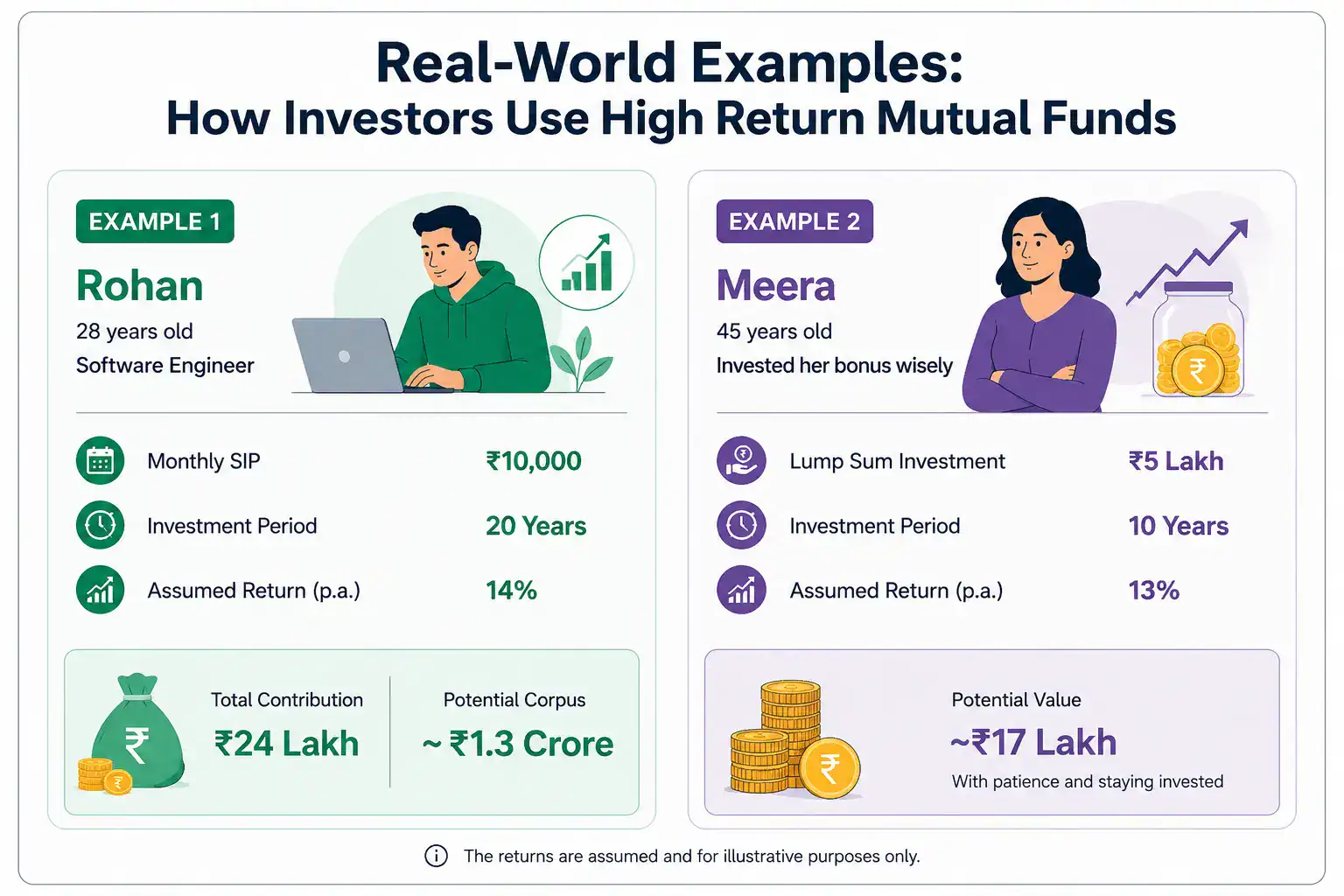
Example 1
Rohan is a 28-year-old software engineer. He puts ₹10,000 every month into a flexi cap fund through a SIP. He continues with it for the next 20 years, investing a total of ₹24 lakh. At a 14% yearly return, that could turn into around ₹1.3 crore.
Example 2
Meera is 45. Her company gave her a ₹5 lakh bonus. She invested the entire amount into a mid-cap fund in one go. If she holds onto her investment, it can grow to roughly ₹17 lakh after 10 years, assuming a 13% return per annum.
Common Mistakes Investors Make When Chasing High Returns
Investors commit these mistakes in pursuit of higher returns:
- Picking winners: Choosing a fund because it topped return charts recently might end in disappointment. Category leadership is not a reliable indicator of sustainable performance.
- Ignoring risk appetite: Investing heavily in volatile funds without the tolerance for large swings triggers panic selling right when patience matters most.
- Stopping SIPs during corrections: Pausing contributions the moment markets fall works against the averaging benefit that SIPs are meant to deliver. SEBI-registered analyst Saksham Sharma highlights that investors often earn less than their funds because they stop SIPs or switch schemes during market corrections.
- Overlooking the expense ratio: Fees can seem like a small detail, but ignored long enough, they eat away at years of compounding, even when a fund’s performance looks impressive on paper.
Best Practices for Choosing and Managing High Return Mutual Funds
Picking the right fund is just the start. What happens after that and how it is managed over the years is what actually protects the returns.
- Diversify across categories
Combining different types of funds like flexi cap with a small cap balances growth ambitions with a measure of stability. - Review periodically
A portfolio needs to be reviewed once or twice a year. Switching funds more frequently can work against the investor rather than for them. - Stay invested through cycles
Compounding allows the generated returns to create additional gains over time. Patient investors are rewarded better than those who react to every market movement. - Rebalance when allocations drift
A strong run can make a portfolio drift away from its intended balance. Restoring that original allocation helps keep the overall risk profile aligned with what was planned at the outset.
Final Thoughts
High return mutual funds can support long-term wealth creation, provided the choice reflects an investor’s actual risk appetite and time horizon. Returns will never come guaranteed, which is exactly why research, patience and periodic review carry more weight than chasing whatever performed best last year.
FAQs
Yes, if beginners have a long investment horizon and understand the risks. Starting with an SIP in a diversified equity fund can be a practical approach.
An SIP suits regular investors by reducing market timing risk, while a lump sum may suit those with surplus funds and a higher risk tolerance.
Check the fund category, portfolio allocation, volatility, drawdown history, benchmark performance, expense ratio and whether it matches your investment goals and risk appetite.
No. Mutual fund returns depend on market performance and investment strategy. Past performance is not a guarantee of future returns.