

Summary
The article discusses how mutual funds can support retirement planning, including investment strategies, suitable fund options, and common mistakes to avoid.
It also explores tools that can help investors better understand retirement investing.
How to Plan for Retirement Using Mutual Funds?
Retirement planning with mutual funds involves creating a long-term investment strategy that can support your financial needs after your working years. The goal is to build a corpus that can help maintain your lifestyle despite rising costs and inflation.
In this regard, mutual funds offer access to equity, hybrid, and debt investments, allowing investors to align their portfolios with their retirement timeline and risk tolerance.
Through regular investing and periodic portfolio adjustments, mutual funds can serve as a flexible tool for both wealth creation and post-retirement income planning.
A successful retirement plan is based on starting early, investing consistently, and staying focused on long-term goals. A longer holding period provides additional time for returns to generate further returns.
Best Mutual Funds for Retirement Planning(list)
The following table lists the best mutual funds for retirement planning based on 3Y CAGR as of 8 June 2026 (latest updated 08:00 AM IST), along with other significant parameters such as AUM and SEBI risk category.
| Name | AUM | 3Y CAGR | 5Y CAGR | Volatility | SEBI Risk Category |
| ICICI Pru Retirement Fund-Pure Equity Plan | 1,868.90 | 23.89 | 22.46 | 14.44 | Very High |
| ICICI Pru Retirement Fund-Hybrid Aggressive Plan | 1,156.55 | 21.22 | 17.10 | 12.55 | Very High |
| Aditya Birla SL Retirement Fund-30 | 433.33 | 18.01 | 12.47 | 13.85 | Very High |
| Union Retirement Fund | 195.84 | 16.06 | – | 13.96 | Very High |
| Tata Retirement Sav Fund – Prog Plan | 2,086.41 | 15.50 | 12.52 | 13.76 | Very High |
| Nippon India Retirement Fund-Wealth Creation | 3,055.82 | 14.65 | 13.40 | 13.89 | Very High |
| Tata Retirement Sav Fund – Mod Plan | 2,113.71 | 14.27 | 12.05 | 11.93 | Very High |
| Aditya Birla SL Retirement Fund-40 | 112.93 | 13.57 | 9.74 | 10.27 | Very High |
| Axis Retirement Fund-Dynamic Plan | 283.00 | 12.56 | 9.81 | 11.86 | Very High |
| HDFC Retirement Savings Fund-Equity Plan | 6,733.06 | 12.25 | 14.37 | 11.95 | Very High |
Step-by-Step Retirement Investment Strategy (Practical Guide)
The following steps can help investors use mutual funds systematically to build a retirement corpus:
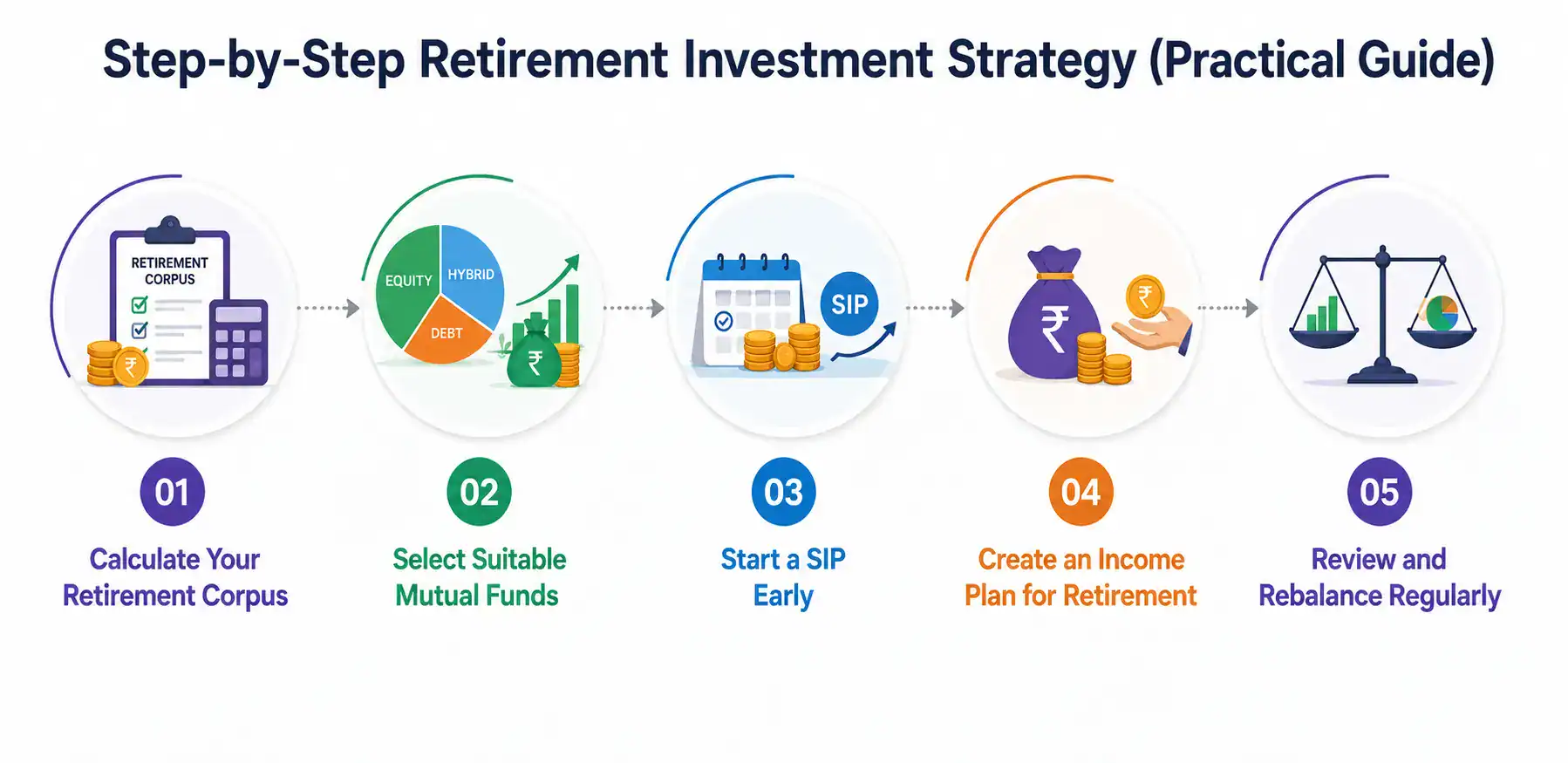
- Step 1: Calculate Your Retirement Corpus
Estimate the amount you may need after retirement by considering future expenses, inflation, healthcare costs, and life expectancy. This becomes the financial target your investments should aim to achieve.
- Step 2: Select Suitable Mutual Funds
Select mutual funds that match your retirement timeline. Investors with a longer horizon may allocate more towards equity funds, while those closer to retirement may gradually increase allocations to hybrid and debt funds.
- Step 3: Start a SIP Early
Systematic Investment Plan (SIP) allows investors to contribute a fixed amount at regular intervals, helping maintain investment discipline over long periods. When started early, it allows a longer compounding period and can make it easier to accumulate the required retirement corpus.
- Step 4: Create an Income Plan for Retirement
As retirement approaches, investors may start to focus on converting accumulated wealth into a reliable income stream. In this case, options such as Systematic Withdrawal Plans (SWPs) can help in providing regular cash flow from your mutual fund investments.
- Step 5: Review and Rebalance Regularly
Finally, it is essential to review and rebalance your portfolio periodically to ensure that the asset allocation continues to match your retirement timeline, financial objectives, and changing risk profile.
Over time, gradually increasing the allocation towards relatively stable investments can help preserve capital and reduce the impact of market fluctuations.
Real-World Example: How a ₹10,000 Monthly SIP Builds Retirement Wealth
To understand the impact of long-term investing, consider an investor, Ramesh, who starts a ₹10,000 monthly SIP at the age of 30 and continues investing until age 60.
Assuming an annualised return of 12%, the investment has 30 years to benefit from compounding.
| Particulars | Value |
| Monthly SIP | ₹10,000 |
| Investment Period | 30 Years |
| Total Amount Invested | ₹36 lakhs |
| Assumed Annual Return | 12% |
| Estimated Corpus at Retirement | ₹3.53 crore |
In this example, the investor contributes only ₹36.00 lakh over 30 years. However, the power of compounding helps the portfolio grow into a corpus of ₹3.53 crore.
The example shows that a longer investment horizon can have a substantial impact on retirement corpus accumulation. Even a modest SIP can create substantial retirement wealth when given sufficient time to grow.
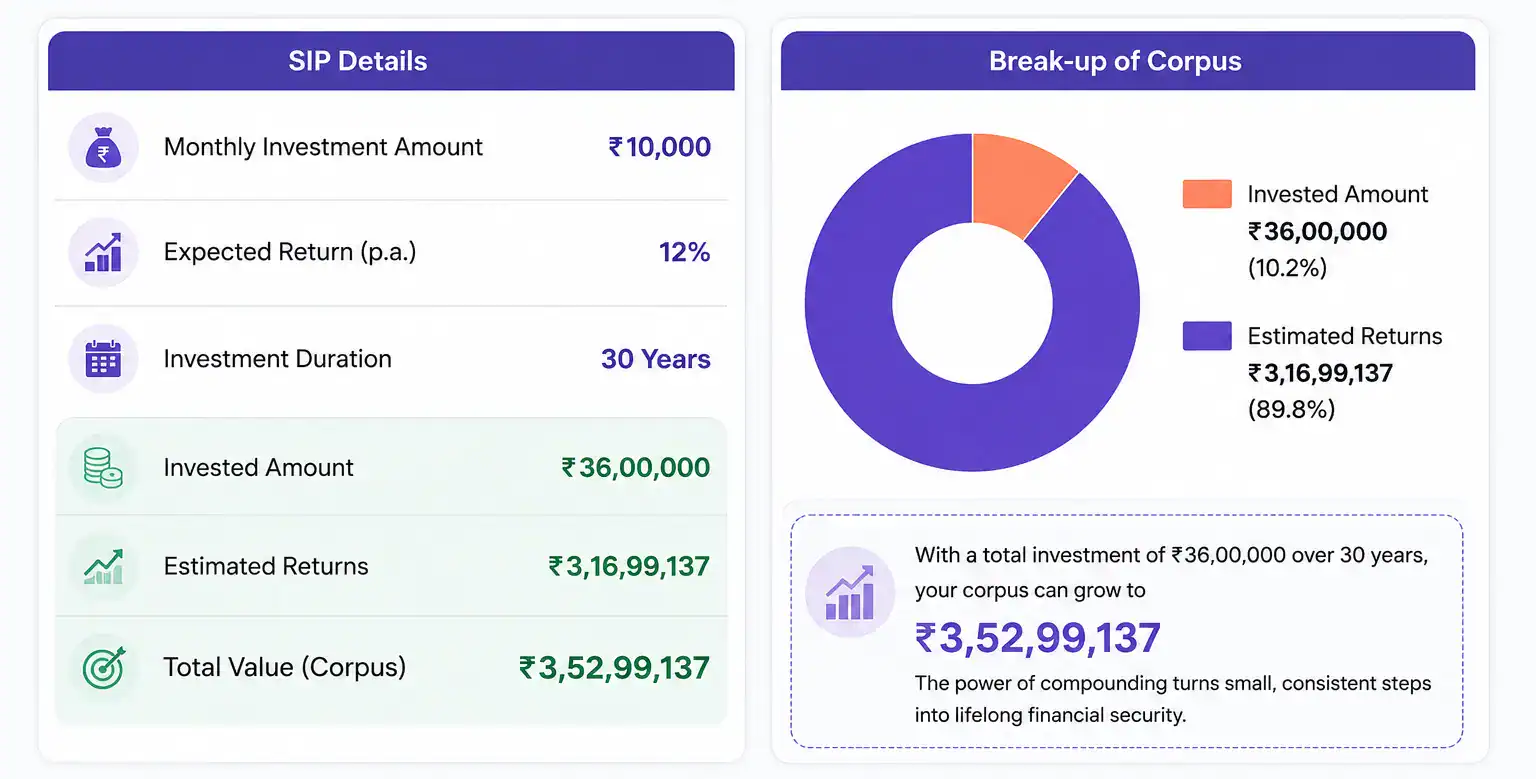
You can also use an SIP calculator that can help you project the potential value of your retirement corpus by considering the contribution amount, expected growth rate, and planned investment horizon.
Common Retirement Planning Mistakes and Their Solutions
Most investors make certain avoidable mistakes that can affect their retirement goals. Understanding these issues early can help improve long-term financial outcomes:
| Mistake | How to Avoid It? |
| Starting too late | Begin investing early so your money has more time to compound and grow. |
| Ignoring inflation | Estimate future expenses after accounting for inflation instead of relying on the current costs. |
| Investing conservatively in the early years | Investors might consider allocating a larger portion to equity funds when retirement is still several years away. |
| Failing to increase investments over time | Increase in SIP contributions periodically as income grows to stay aligned with retirement goals. |
| Not reviewing the portfolio | Review and rebalance investments regularly to ensure the asset allocation remains suitable. |
| Depending on a single investment option | Diversifying across suitable mutual fund categories instead of relying on one scheme or asset class. |
| Withdrawing investments during market volatility | Follow your investment plan and evaluate decisions based on long-term objectives rather than temporary market fluctuations. |
How StockGro Helps You Learn Retirement Investing Risk-Free?
StockGro offers educational resources, market insights, research tools, and calculators that can help users understand retirement investing concepts.
- Paper Trading Platform: Practise investment strategies with paper trading and understand how different portfolio allocations react to market movements.
- StockGro Academy: Access educational programmes covering concepts such as compounding, fundamental analysis, technical analysis, and risk management.
- Stoxo AI Assistant: Explore market trends, sectors, and investment-related questions through AI-powered research tools.
- Retirement Planning Tools: Use calculators such as the SIP Calculator to estimate retirement goals and long-term investment requirements.
Final Thoughts
Retirement planning is a long-term financial commitment that benefits from consistency rather than complexity.
Establishing retirement targets and reviewing investments periodically can help ensure that financial plans continue to reflect changing needs and circumstances.
While market conditions may change over time, maintaining a structured investment approach can make the journey towards financial independence more predictable and manageable.
FAQs
When it comes to retirement planning, there is no fixed timeline to start. However, starting early generally provides a longer investment horizon, which allows investors to benefit more from compounding and potentially build a larger corpus with lower monthly contributions.
The required monthly investment depends on factors such as retirement age, target corpus, expected returns, and current savings. Investors often use SIP calculators to estimate the monthly amount needed to achieve their retirement goals.
Mutual funds are subject to market risks, and returns are not guaranteed. However, they offer diversification, professional management, and access to different asset classes, making them a commonly used option for long-term retirement planning.
Many investors use mutual funds as a major part of their retirement strategy, but they are often combined with other instruments such as EPF, NPS, pension plans, fixed-income investments, and emergency savings to create a balanced financial plan.
Starting late may require higher monthly investments to achieve the same retirement corpus. Investors with shorter time horizons may also have fewer opportunities to benefit from long-term compounding.
Equity-oriented mutual funds have historically delivered returns that may exceed inflation over long periods. This growth potential can help preserve purchasing power and support rising expenses during retirement.