

Summary
Select a mutual fund that matches your financial goals, investment horizon and risk appetite before starting an SIP.
Compare funds using long-term performance, risk metrics, costs and fund management instead of recent returns alone.
Stay invested consistently and review your portfolio regularly to keep your SIP on track.
How to Select the Best Mutual Fund for SIP
The choice of investing in a mutual fund depends on your goal, your temperament and the years you have on hand. Finding that fit is the actual skill involved in picking a Systematic Investment Plan (SIP). The scale of SIP investing in India makes this worth getting right. Data from the Association of Mutual Funds in India (AMFI) shows monthly SIP contributions touched ₹31,781 crore in June 2026. Investors today are quietly building wealth this way, which is exactly why the fund you choose deserves more thought than a quick glance at last year’s chart toppers.
If you are still building this foundation, it helps to first understand how to select mutual funds for investment as a broader concept before narrowing down to specific funds.
Set Your Financial Goals and Investment Horizon First
Ask yourself a simple question before opening any fund page. What is this money actually for and when will it be needed? Skipping this step is how investors end up holding a fund that never really matched what they were saving for in the first place.
Once the goal and the timeline are written down, most of the guesswork disappears. Money needed soon does not need to chase high growth at the cost of stability. Money that can stay invested for many years can ride out the downturn phases that come with chasing stronger returns. This decision saves investors from second-guessing themselves later.
Choose the Right Mutual Fund Category for Your Risk Profile
Equity, debt and hybrid are the three broad buckets most SIP investors choose from and each responds to market fluctuations in its own way.
- Equity funds allocate a high portion of their investment into company shares. They work best for someone who can watch the value dip without panicking.
- Debt funds lean toward stability, investing in bonds and money market instruments. They offer steadier, more predictable movement for investors who value calmness over speed.
- Hybrid funds sit somewhere between the two, cushioning your investment journey while still leaving room for growth.
Inside equity funds, large-cap schemes stick to well-established companies and tend to move less erratically. Mid-cap and small-cap schemes chase smaller, faster-growing businesses and the extra growth potential comes with sharper swings. Flexi cap funds move across all three depending on where the manager currently sees value.
Matching this category choice to how much volatility you can genuinely sit through, not just what you think you can handle, is what keeps an SIP running through a full market cycle.
Evaluate Fund Performance Beyond Returns
A mutual fund that delivered strong returns last year is not automatically a good choice for your SIP. Returns need to be viewed over multiple market cycles and compared against how the fund’s benchmark index performed during the same stretch. A fund that consistently beats its benchmark across both rising and falling markets is considered ideal.
It also helps to look at how the fund performed during market corrections, since that reveals how much downside protection the fund offers. A scheme that stays relatively stable to its peers during a crash or sharp correction often recovers investor wealth faster once markets turn around.
Key Metrics to Compare Before Starting an SIP
A few measurable numbers reveal far more about a fund than its returns chart alone. Here is what to look at before committing your money:
| Metric | What It Tells You |
| Expense Ratio | The annual fee the fund house charges for managing your money. A lower expense ratio leaves more of the returns with investors. |
| Compound Annual Growth Rate (CAGR) | Reflects the fund’s average yearly growth over a chosen period, useful when comparing consistency across schemes |
| Standard Deviation | Shows how much a fund’s returns swing away from its average. A lower number usually means a smoother journey. |
| Sharpe Ratio | Measures how much return a fund delivered for every unit of risk it took on. A higher ratio generally signals better risk-adjusted performance |
| Fund Manager Tenure | A manager who has stayed with a fund for years often brings more stable, coherent decision-making and strategy continuity |
| Assets Under Management (AUM) | Refers to the total value of assets held by the fund. Extremely small or large AUM can each create their own operational challenges depending on the category |
Common Mistakes Investors Make When Selecting SIP Funds
Certain habits can quietly chip away at SIP returns for years before an investor even notices. A few of them show up repeatedly:
- Chasing last year’s top performer: A scheme topping the charts might have been the result of a favourable market phase. That momentum rarely continues in the following year.
- Overlapping investment: Holding several schemes from the same category only adds paperwork without any real diversification. As SEBI-registered analyst Saksham Sharma explains, owning more mutual funds does not always mean better diversification.
- Ignoring the expense ratio: Opting for a costlier fund eats into your gains every single year even if the difference appears small on paper.
- Overlooking your risk appetite: Buying an aggressive small cap fund without the tolerance to handle its volatility usually ends with panic selling at the wrong moment.
- Pausing SIPs during corrections: Stopping your SIP when markets decline goes against the idea of rupee cost averaging. Investing continuously allows you to benefit from buying at different price levels.
- Skipping portfolio reviews: A fund’s investment strategy or performance may change over time. Review the portfolio once a year to ensure the fund matches your financial goals.
Real-World Examples: Choosing the Right SIP Fund Based on Goals
Let’s take a look at examples to see the principles play out with real numbers. This makes the decision easier to apply to your own situation.
Example 1
Ritik is planning for his retirement, still twenty years away. With that much runway ahead of him, he leans into an equity-oriented flexi-cap fund and commits ₹8,000 every month without fail. Assuming the fund grows at roughly 12% annually over that stretch, standard SIP growth math suggests his corpus could edge close to ₹79.14 lakh by the time he retires.
As his units will have been held well past twelve months, the eventual gains would fall under long-term capital gains treatment (LTCG). LTCG on equity-oriented schemes held for more than twelve months is taxed at 12.5%, with the first ₹1.25 lakh of gains in a financial year exempt altogether. This works in his favour compared to pulling money out on a shorter, more frequent cycle.
Example 2
Aman is saving for a home down payment and he needs the money in just four years. An aggressive equity fund feels too risky for a goal this close, since a poorly timed dip right before he needs the money could set him back. He picks a conservative hybrid fund instead and puts away ₹15,000 a month. At a more modest assumed return of around 8%, his savings could grow to roughly ₹8.45 lakh by the end of four years, arriving there with far less volatility than a pure equity fund would have put him through.
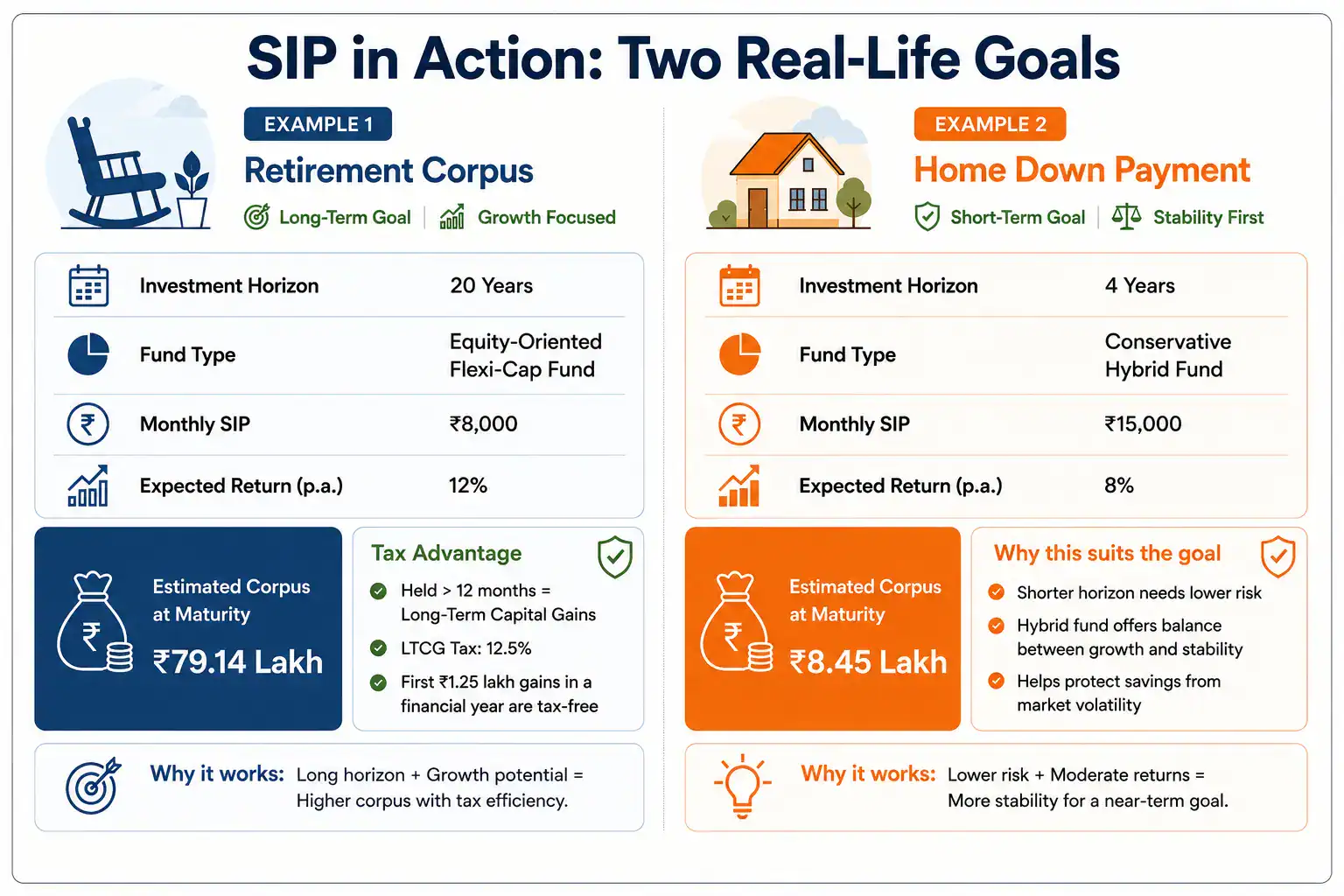
Note: These examples are intended for illustration only. The estimated corpus is based on assumed returns and should not be considered a guarantee of future returns.
Final Thoughts
When choosing a mutual fund for an SIP, do not think about the highest returns. Start with a clear understanding of what you are saving for, when you will need the money and how much market volatility you can withstand. From there, the right set of metrics turns an uncertain choice into a properly informed one.
Once a suitable fund has been identified, the real task is simply staying committed to it. Continue the SIP without interruption and review the portfolio at regular intervals. A steady combination of discipline and patience tends to serve SIP investors well over the long run.
FAQs
Start with your goal and how many years you have. Pick a category that matches your risk tolerance and lean toward funds with a steady long-term performance.
Your financial goal, your investment horizon, how much risk you can genuinely tolerate, the fund’s expense ratio and its performance across full market cycles, all deserve a look before you invest.
No. Past performance provides useful context but does not guarantee future returns. Assess long-term consistency, risk measures and benchmark performance alongside historical returns.
No single mutual fund category is best for every investor. For long-term SIPs, equity funds such as large-cap and flexi-cap schemes are generally preferred because they offer higher growth potential over extended periods.
Most investors can build a well-diversified portfolio with three to five mutual funds. Holding too many similar funds may reduce diversification benefits.
Yes. You can stop your existing SIP and start another one if your goals, risk profile or the fund’s performance changes over time.