Summary
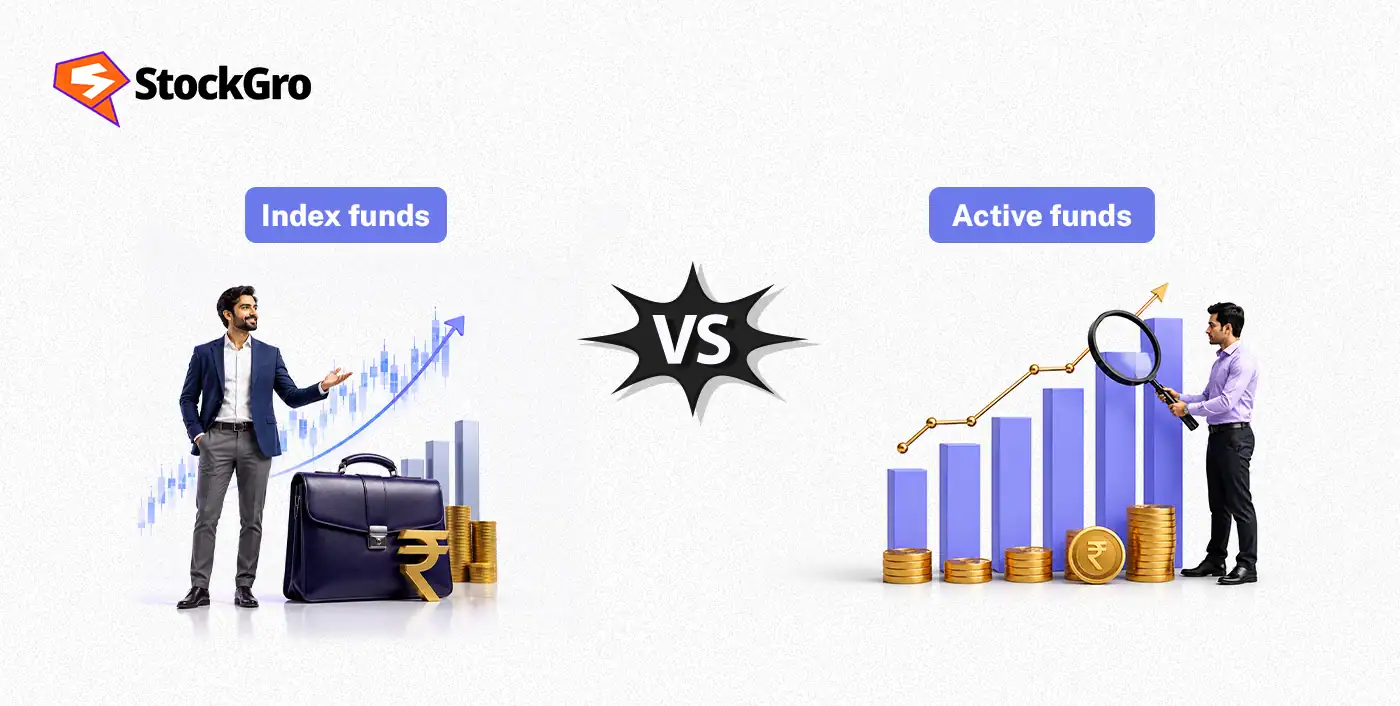
This blog explains the difference between index funds and active funds; index funds mimic a specific benchmark index, while active funds focus on exceeding the market index.
The index funds include low management costs and do not aim to beat the market, whereas the active funds include a high expense ratio and aim to earn more than the market.
What are Index Funds?
An index mutual fund is a mutual fund that tracks the performance of a particular index. It tracks a specific index, such as the Nifty 50 or the S&P 500, and invests in a similar proportion of investments.
What are Active Funds?
Active mutual funds are instruments that focus on performing better than the market and are managed by professional fund managers. The fund managers choose investments and decide when to buy, hold, or sell the securities.
How do Index Funds and Active Funds Work?
Index funds replicate the performance of a benchmark index by investing in similar investments at similar proportions. It does not aim to outperform the market; instead, it just matches an index. Index funds still have fund managers, but their role is passive. The fund manager replicates the index and manages tracking error. Any change in the index results in the funds changing accordingly.
Active mutual funds are investment funds that seek to outperform their benchmark index through active portfolio management and security selection. The fund manager actively analyses and evaluates the markets and makes decisions accordingly. The portfolio composition may change frequently as fund managers adjust investments according to market conditions, economic trends, and investment opportunities. The expense ratio for these mutual funds is high because it involves skilled management teams.
Key Differences Between Index Funds and Active Funds
Index funds and active mutual funds differ in several important aspects. Some of the key differences are highlighted below.
| Basis | Index Funds | Active Funds |
| Expense Ratio | The expense ratio is low because it does not include high skilled management | The expense ratio is high because it includes several operating costs such as investment management fees, administrative expenses, registrar fees, custodian fees, audit fees, and sales and marketing expenses. |
| Risk | The risks are equal to overall market | It includes market risk alongside fund managers’ risk |
| Returns | The returns are market-linked | The return depends on the manager’s skill |
Cost and Expense Ratio Comparison
A skilled fund manager seeks to identify undervalued or high-growth investment opportunities through rigorous research and analysis. Index funds usually have a low expense ratio because they do not require management expertise. On the other hand, the active funds include managerial fees, research expenses, etc, which increase the overall cost and ultimately result in a high expense ratio.
Returns and Performance Potential
The return on an investment depends on its performance, guided by the managers. The index fund generates returns based on the market performance of a specific index. Whereas, active funds aim to outperform, but returns also depend on market conditions, strategy, costs and execution. Outperformance is not guaranteed. It aims to generate alpha, while risk and return depend on the adopted strategy.
Risk and Volatility Levels
The risk and volatility of investments are directly related. Index funds usually carry the market risk because they depend entirely on the performance of the market index. The active funds carry market risks along with additional risks, as the manager makes necessary investment decisions to balance the portfolio.
Advantages of Index Funds
The following are the advantages of index mutual funds.
Low Costs and Simplicity
Index funds replicate the performance of a specific benchmark index, reducing the management cost. Investors are not required to pay additional expenses for broad research activities. Since the funds mirror an index, the investments are transparent to investors and do not change often. This makes it easier for them to track their investments.
Consistent Market Returns
Since index funds only focus on mirroring a standard index, the returns closely replicate the market returns. It gets exposure to a broader market consisting of a combination of multiple companies. It does not depend on a fund manager because the funds are easy to track.
Advantages of Active Funds
The following are the disadvantages of active mutual funds.
Potential to Outperform the Market
The primary advantage of active funds is their potential to outperform the market and generate returns above the benchmark index. Fund managers evaluate investment opportunities and select securities that appear undervalued and have the potential to grow. The return on active funds heavily depends on the the fund manager’s skills.
Flexibility in Changing Markets
Active funds offer the flexibility to adapt to changing market conditions and investment opportunities. This allows fund managers to allocate the investments strategically based on the evolving economic and market conditions.
Risks and Limitations of Each Approach
Both the index funds and active funds have their disadvantages. They are mentioned below.
Risks of Index Funds
- No downside protection: Since index funds are designed to track a benchmark index, they generally decline along with the broader market during a bear market.
- Less control: Since the funds mirror the market, investments are made based on the market index. Therefore, investors cannot remove any poor-performing investment if it is included in the index composition.
- Exposure to high-risk investments: The index fund includes a broad range of markets, mostly large market capitalisations. Investing in large-cap companies provides exposure to relatively stable and established businesses, although market risks still exist.
- Limited return: Since the index fund does not aim to exceed the market, the returns generated are limited to usual market returns.
Risks of Active Funds
- High expense ratio: Active funds usually charge high fees for management and research costs. These costs ultimately increase the overall expense ratio.
- Failure to beat the market: The excess return over the market in active funds is not guaranteed. Many investors often make mistakes while reading the market and fail to beat the market index.
- High dependence on fund managers: In active funds, the fund managers are responsible for the evaluation and allocation of investments. Therefore, investors are heavily dependent on the managers’ decisions.
- Portfolio concentration risk: Fund managers may invest a large amount in specific sectors or stocks to earn an amplified return. But these increase the concentration risks if the investments underperform.
Real-World Example: Index vs Active Fund Returns
Let us understand the difference with a simple example. Assume two investors invest ₹1,00,000 each for 10 years. One chooses an index fund, while the other chooses an active mutual fund.
| Particulars | Index fund | Active fund |
| Initial investment | ₹1,00,000 | ₹1,00,000 |
| Gross annual return | 12% | 13% |
| Expense ratio | 0.20% | 1.50% |
| Approx net annual return | 11.80% | 11.50% |
| Value after 10 years | ₹3,05,083 | ₹2,96,995 |
In this example, the active fund earns a higher gross return. However, its higher expense ratio reduces the final return. The index fund, despite earning a lower gross return, ends up with a slightly higher value after 10 years.
This shows why investors should not look only at headline returns. Costs, consistency and the fund’s ability to beat the benchmark after expenses are equally important.
What Investors Can Learn from This?
The following are the observations from the above example.
- A high return may not be effective if the expense ratio is also high. Even a small difference in cost can affect the final value over the long term.
- Consistently beating the market is difficult. Strong performance in one period does not guarantee similar returns in every market cycle.
- Low-cost investments may help investors improve long-term outcomes, especially when the return difference between two funds is narrow.
Common Mistakes Investors Make
The following are the common mistakes made by investors while investing in index and active funds.
Chasing Past Performance
Selecting a fund solely depending on its historical performance is one of the most common mistakes made by investors while investing. An investment that performed exceptionally last year may not perform very well in the present year. Due to various changes in the economy and market, the performance may fluctuate.
Investors must consider other fundamentals before choosing an investment and evaluate whether the investment objectives and risk profile align with their financial goals and risk appetite.
Ignoring Costs and Fees
The fees and costs included in an investment directly impact the overall returns on the investment. Even a minor change in the ratio might cause a huge deviation in the returns and reduce the overall value of the portfolio.
Investors must learn the various costs and fees included, such as exit load, tax implications, expense ratio, etc., before making an investment.
Final Thoughts
It is essential for investors to evaluate and identify their objectives and risk tolerance before choosing an investment. An index fund focuses on mirroring the performance of a particular market index, while an active fund aims to exceed the market performance and outperform the market.
Index funds may earn a limited return, but do not include high management fees, which results in less deviation in the return. However, active funds may earn more than the market. But because of the high expense ratio, the overall return may be affected by it. Therefore, investors must assess and analyse the investments before making an investment decision.
FAQs
Index funds are generally considered less risky than many active funds because they offer broad market diversification and do not depend on a fund manager’s investment decisions. However, they are still subject to overall market risk.
Some active funds may outperform index funds over certain periods, but consistently beating the market over the long term is challenging. Performance often depends on the fund manager’s skill and market conditions.
Neither option is universally better. Index funds are often preferred for their low costs and simplicity, while active funds may appeal to investors seeking the potential for market outperformance.
In most cases, index funds have lower expense ratios than active funds because they follow a passive investment strategy. However, fees can vary between fund providers and schemes.
Some investors choose to combine index and active funds to balance low-cost market exposure with the potential benefits of active management. The suitability of this approach depends on individual financial goals and risk tolerance.
You can start investing in index funds by opening an account with a mutual fund platform, broker, or investment app, completing the required KYC process, and selecting an index fund that aligns with your investment objectives.