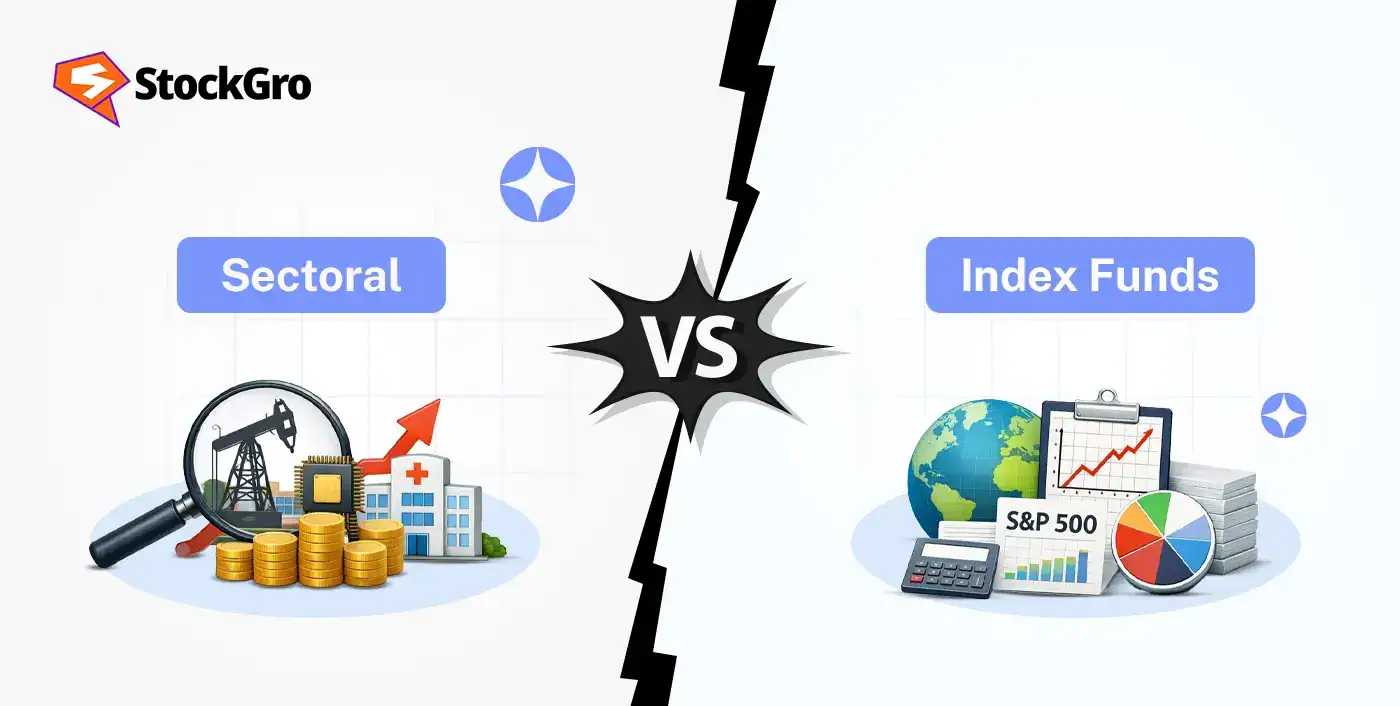
Every investor has to face the same question: whether to go broad or take a more focused approach. Index funds provide exposure to the entire market, offering stability and diversification. On the contrary, sectoral funds take a sharper route by concentrating on specific industries with the aim of capturing high growth when the timing is right.
This trade-off between consistency and opportunity defines your portfolio performance. Understanding this balance is essential for making investment decisions. This blog explains which approach fits your investment style and goals.
What Are Index Funds?
An index fund is a mutual fund designed to replicate the returns of a particular market index. They mirror the benchmark index by holding the same set of stocks in identical proportions.
Index funds follow a passive strategy, meaning there is minimal buying and selling based on predictions. This makes them cost-efficient and relatively easy to manage.
The key features of index funds are listed below:
- Diversification: Index funds are spread across multiple companies in an index, which reduces the risk.
- Low Expense Ratio: As the funds run on a passive investment approach, their operational costs are lower.
- Market-linked returns: Their performance closely mirrors the market movement, and thus, the returns depend on how the market is doing.
- Transparency: These funds follow the listed companies on an index, which makes tracking them convenient.
- Long-Term Focus: Index funds are suitable for investors who are aiming for steady wealth creation over time.
If you’re interested in investor funds, you can consider these options listed by their asset size as of March 24, 2026:
| Fund Name | AUM (₹ Cr) | NAV (₹) | Expense Ratio | 3-Year Returns (%) |
| UTI Nifty 50 Index Fund | 26,681 | 160.18 | 0.20 | 11.61 |
| HDFC NIFTY 50 Index Fund | 22,324 | 222.76 | 0.20 | 11.57 |
| ICICI Prudential Nifty 50 Index Fund | 15,391 | 240.83 | 0.19 | 11.57 |
| SBI Nifty Index Fund | 11,879 | 212.91 | 0.19 | 11.58 |
| ICICI Prudential Nifty Next 50 | 8,396 | 54.79 | 0.70 | 18.34 |
What Are Sector Funds?
Sector funds that invest in a specific sector or industry, like defence, banking, or technology. Their focus is not on diversification as they concentrate their investments within a single segment of the market.
This approach enables investors to gain from growth within a specific sector. However, it also increases exposure to sector-specific risks, making these funds more volatile compared to diversified options.
The following characteristics are associated with sector funds:
- Targeted Approach: Sector funds allow you to invest your capital only in industries or themes that you expect to grow.
- Active Management: Fund managers pick the top-performing stocks as per the targeted sector and adjust their allocation as per the market conditions.
- High Return Potential: Strong sector performance can generate significant returns.
- Elevated Risk: As the performance is dependent on specific sectors, it introduces more risk and makes investments volatile.
- Cyclical Nature: Similar to the sectors they invest in, these funds have cycles of high growth followed by little to no movement phases.
Let’s take a look at the top sector funds by the size of their total assets as of March 23, 2026:
| Fund Name | Sector | AUM (₹ Cr) | NAV (₹) | Expense Ratio | 3-Year Returns (%) |
| ICICI Prudential Technology Fund | IT | 13,572 | 181.27 | 1.01 | 8.67 |
| ICICI Prudential Banking and Financial Services Fund | Banking | 10,886 | 136.81 | 1.02 | 13.76 |
| SBI Banking & Financial Services Fund | Banking | 10,725 | 45.87 | 0.72 | 20.47 |
| Tata Digital India Fund | IT | 9,896 | 44.97 | 0.54 | 9.01 |
| Nippon India Pharma Fund | Pharmaceuticals | 8,306 | 552.02 | 0.91 | 23.86 |
Comparing Index Funds and Sector Funds
While both index funds and sector funds are popular investment choices, they serve very different purposes in a portfolio. A comparison table below highlights the key differences between them.
| Aspect | Index Funds | Sector Funds |
| Investment Focus | Tracks broad market index | Focuses on specific industry |
| Diversification | High across sectors and companies | Low, limited to one sector |
| Risk Level | Lower due to diversification | Higher due to concentration |
| Return Potential | Stable, market-linked returns | Higher potential, more volatile |
| Management Style | Passive, index-based investing | Active, sector-driven strategy |
| Cost | Lower expense ratios | Higher management costs |
| Volatility | Moderate market-linked fluctuations | High sector-driven fluctuations |
| Investment Horizon | Long-term wealth creation focus | Short to medium-term opportunities |
| Suitability | Beginners and conservative investors | Experienced, risk-tolerant investors |
| Objective | Match overall market performance | Outperform via sector bets |
What are the Pros and Cons of Index Funds?
Like any financial instrument, index funds come with both advantages and limitations.
Pros
- Broad Diversification: By spreading investments across various companies of an index, these funds reduce the risk of any one stock underperforming.
- Low Cost Structure: Since these funds do not require active management to beat the market returns, they typically have lower expense ratios. This allows investors to keep a larger portion of their investment returns.
- Consistent Market Returns: As these funds aim to replicate market performance, they provide predictable and stable returns that reflect overall economic growth rather than relying on stock selection or timing.
- Simplicity: They are simple to handle and don’t need constant monitoring. This makes them a good choice for investors who want a straightforward, hassle-free strategy.
Cons
- Market Risk: The funds are directly linked to the market performance. It means their value declines during market downturns, and there are no supportive measures to protect them.
- No Flexibility: Holdings are not adjusted as per the market conditions. It means the fund stays stuck on the index stocks and misses out on opportunities to capture short-term gains or avoid losses.
- Limited Upside: These funds aim to follow the market rather than outperform it, which may limit their return potential compared to actively managed funds.
- Tracking Error: The fund might lag and not match the index’s performance due to costs, management differences, and delays in adjusting the allocation of holdings.
What are the Pros and Cons of Sector Funds?
Sector funds can be rewarding, but their targeted nature means they need to be approached with caution.
Pros
- High Growth: Sector funds can generate substantial returns when the chosen industry performs well, as investment is concentrated in companies that are likely to benefit from sector-specific trends.
- Active Management: These funds run on an active style where qualified and experienced fund managers aim to surpass the market returns. Investors who lack time and knowledge get access to professional guidance.
- Targeted Investment: The focus of these funds is on specific industries, which allows more control over the portfolio, and exposure can be altered based on the market outlook and expectations.
- Opportunity to Capture Trends: Sector funds help investors take advantage of emerging trends, economic cycles, or policy-driven growth in specific industries.
Cons
- Concentration Risk: Since the investment is limited to a single sector, it means any slowdown in that industry can impact the overall returns and increase the portfolio risk.
- Higher Expense Ratios: An active management style translates to more costs as the management is constantly researching and making decisions to yield the best possible results.
- Greater Volatility: Sector funds tend to have sharper fluctuations compared to diversified funds as their performance is closely tied to the sector’s news, trends, or economic conditions.
- Requires Market Timing: For successful investing in sector funds, the time at which you enter and exit becomes crucial. It becomes a challenge for investors lacking experience with market cycles and timings.
Which Should You Choose?
Your market knowledge, risk appetite, and investment objectives determine whether you should select index funds or sector funds.
- Investors who want stable returns and portfolio diversification should opt for index funds. Their low cost structure, minimal monitoring requirement, and consistent returns make them appealing for beginners.
- Investors comfortable with higher risk in pursuit of better returns may choose sector funds. They allow us exposure to specific industries but require careful timing and constant tracking of market trends.
Adopting a balanced strategy can also work well. Use index funds as your core investment and allocate a smaller portion to sector funds. This helps in managing risk while capturing targeted growth opportunities.
Conclusion
Index funds and sector funds represent two different approaches to investing. One focuses on diversification while the other focuses on opportunity and targeted growth. Understanding how each fund works helps in aligning your investments with your financial goals and risk profile.
Choosing the right mix makes your investment strategy more effective and resilient.
FAQs
Index funds invest across a broad market index, offering diversification and lower risk. Sector funds invest in a specific industry, offering higher return potential but with increased risk.
Sectoral funds can be beneficial if you have a clear understanding of market trends and are willing to take higher risks. They are best used as a part of a broader portfolio rather than as the main investment.
Warren Buffett recommends index funds because they provide low-cost, diversified exposure to the market and consistently deliver returns over the long term without requiring active management.