
Summary
The information ratio measures the excess return a mutual fund generates over its benchmark for each unit of tracking error.
A higher positive ratio generally indicates stronger risk-adjusted performance, but it should be compared only among similar funds.
Investors should use it alongside returns, expenses, investment objectives and other performance measures.
What is the Information Ratio in Mutual Funds
The information ratio (IR) in mutual funds is a financial metric used to measure an investment portfolio’s risk-adjusted performance relative to its benchmark index. It is used alongside other metrics, such as the alpha, beta, standard deviation, and the Sharpe ratio, to evaluate the fund’s performance.
In other words, the information ratio helps investors to measure the additional return generated for each unit of risk compared to the benchmark. It helps investors to determine the value added on the investment portfolio through efficient decision-making rather than simply generating the minimum rate of return.
How is the Information Ratio Calculated?
The formula for the information ratio is mentioned below.
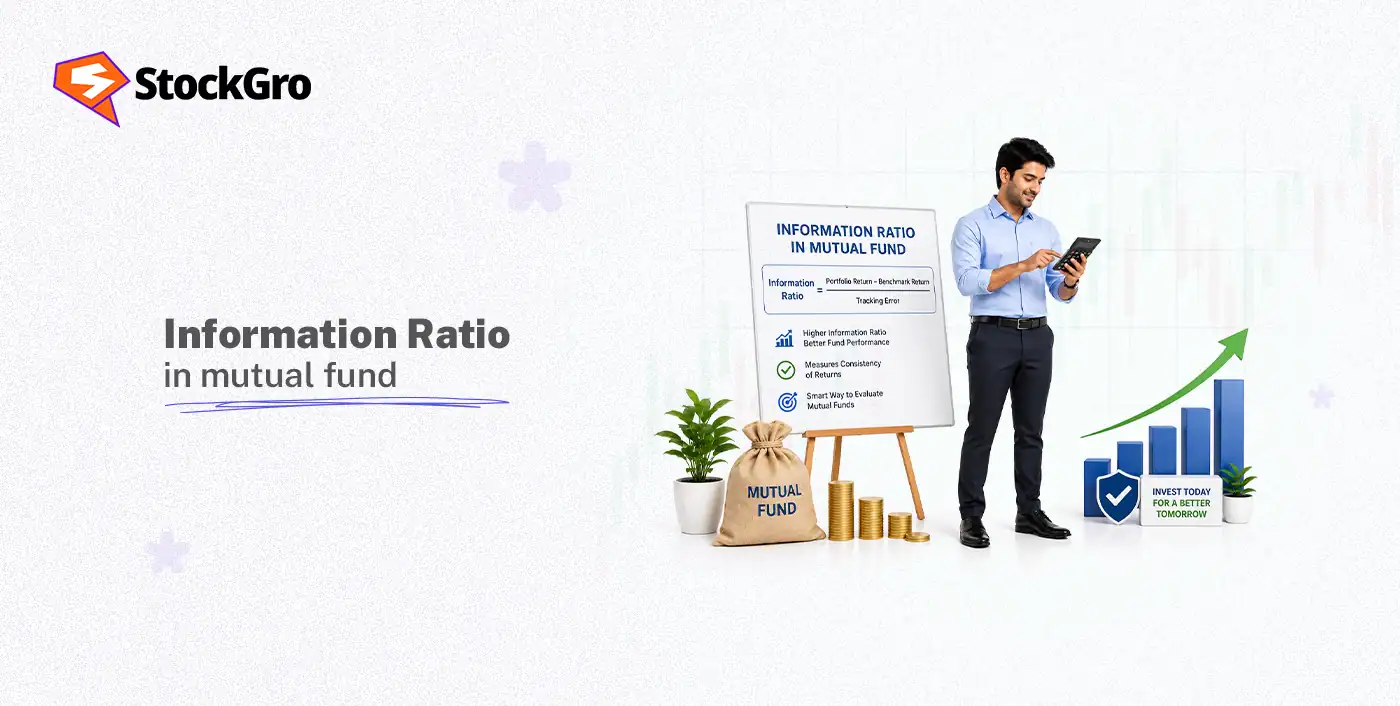
Information ratio (IR) = (Portfolio return – benchmark return) / Tracking error
Where,
Portfolio return = This represents the return earned on a mutual fund over a period.
Benchmark return = This represents the return earned against a performance index, such as the Nifty 50 or BSE Sensex.
Tracking error = Standard deviation of the difference between the portfolio’s excess return and the benchmark return.
If the ratio is more than 0.5, it is considered good and shows good performance. But if the ratio is less than 0.5, it indicates that the fund manager did not perform efficiently and hence, the results.
But it is only a broad rule of thumb. The result depends on the asset class, benchmark, time period, fees and calculation method.
For example,
Portfolio Return = 15%
Benchmark return = 10%
Tracking error = 5%
Information ratio = (15% – 10%) / 5% = 1
An information ratio of 1.00 means the fund generated one unit of active return for each unit of tracking error during the measured period.
Why does the Information Ratio matter for Investors?
The information ratio is essential for investors to evaluate a fund manager’s performance, considering the risk involved rather than focusing on returns. The essential aspects to understand are mentioned below.
- Measure risk-adjusted active return: The information ratio evaluates the excess returns generated over the benchmark, considering both the risk involved and the fund manager’s efficiency. A fund that generates high returns on controlled volatility is considered more efficient than a fund that provides similar returns but with consistent deviations. This helps investors to understand which fund is more efficient.
- Separate skills from volatility: The Information Ratio helps to separate returns generated by a fund manager’s skill and those resulting from temporary market movements or volatility. A highly skilled fund manager can consistently generate excess returns irrespective of the market volatility.
- Evaluates active management: Management is the most important factor required to earn excess returns on a fund over the benchmark. Earning consistent excess returns over the benchmark is possible only under efficient and skilled management.
- Manager comparison: The information ratio helps investors to measure the performance of multiple fund managers based on their ability to generate consistent returns more than the benchmark. This shows the skills and efficiency of a fund manager on whom the investors can rely with their investments.
Ideal Information Ratio: What is Good or Bad?
Certain ranges can be used to classify a fund’s performance to term an information ratio as good or bad.
- Below 0: the fund produced negative average active return relative to its active risk.
- Around 0: little or no average benchmark outperformance.
- Higher positive value: more active return for each unit of tracking error.
- Above 0.5: often viewed favourably, subject to context.
- Above 1.0: unusually strong historically, but not necessarily repeatable.
When the information ratio is between 0.0 and 0.1, it indicates an average or moderate fund performance.
When the information ratio exceeds 1.0, it indicates exceptional and efficient performance by the fund manager in generating consistent market-beating returns.
Common Mistakes Investors Make
While using the information ratio, investors make several mistakes. Some of them are mentioned below:
- Confusing IR with the Sharpe ratio: The most common mistake made by investors is confusing the information ratio with the Sharpe ratio. While both the ratios assess fund performances, they do not serve the same purpose. The information ratio evaluates the excess returns based on the unit of risk, whereas the Sharpe ratio measures the returns earned based on the unit of volatility.
- Ignoring absolute returns: The information ratio measures the fund’s performance based on the excess returns over the benchmark return. However, the actual returns may differ. Therefore, investors must consider the actual returns earned alongside the information ratio to ensure alignment with their financial goals.
- Using an inappropriate benchmark: Using a proper benchmark is essential for comparing multiple fund performances. Comparing a small-cap fund with a large-cap fund may not provide appropriate insight into the fund manager’s performance. It is important to ensure that the benchmark matches the investment style and objective.
- Over-evaluating short-term ratios: Considering information ratios calculated over short periods may not provide useful insight into the fund’s performance. They may be based on temporary market fluctuations. Therefore, evaluating the information ratio over a longer period is more reliable for reading a fund manager’s skill and performance.
- Ignoring high fees: Although a high information ratio may provide a high return, it is important to review the total expense of the fund. Even though a fund earns high returns over its benchmark, a high expense ratio may affect the overall return of the fund. Therefore, analyse the fund manager performance alongside the total management expense of the fund to assess benefits from the overall value of the returns.
Real-World Example: Evaluating Two Mutual Funds
Let’s understand the evaluation and use of the information ratio through an example.
Mr S is an investor who wants to invest in large-cap funds for the purpose of long-term wealth building. After evaluating multiple fund schemes, he shortlisted two fund schemes to further measure the performance of the two fund managers and check the consistency of the fund’s performance based on their skills.
Here are the fund details he collected to run through the information ratio.
Details based on the last 5 years’ annual values.
| Fund ABC | Fund PQR | |
| Portfolio return | 16% | 18% |
| Benchmark return | 12% | 12% |
| Tracking error | 3% | 7% |
The Information ratio of Fund ABC = (16% – 12%) / 3% = 1.33
The information ratio of Fund PQR = (18% – 12%) / 7% = 0.86
Therefore, Fund ABC indicates more efficiency and consistency of performance than Fund PQR over the last 5 years. Although the portfolio return of Fund PQR is more than that of Fund ABC, the management of risk and market volatility is inconsistent. This resulted in more deviation in the performance of Fund PQR.
How Investors Can Use Information Ratio in Practice
Investors can use the information ratio metric to evaluate several aspects before making an investment decision. They are mentioned below.
- Evaluating manager skills: Information ratio can help investors to evaluate the managerial skills of the fund managers and compare the performance with other fund managers with the same style of investments. This may provide them with insights into the consistency and efficiency of a manager’s decision-making skills to generate more returns than the benchmark.
- Comparing similar funds: The information ratio also helps in the comparison of similar funds. It helps investors to choose between funds that have similar benchmarks and evaluate if the excess returns are worth the risks associated with them.
- Evaluating overall performance: Combining the information ratio with other metrics helps investors to measure the overall performance of multiple funds within the same category and understand the consistency of excess returns, managers’ skill and risks involved before making an investment decision.
Final Thoughts
The information ratio is a risk-adjusted performance metric that investors use to evaluate the performance of a fund in generating excess returns based on its benchmark, considering the risk associated with it. It is useful for understanding the managerial skills and consistency of a fund manager.
However, when using the information ratio, investors may make a few mistakes, such as only focusing on the IR ratio, using the wrong benchmarks, overlooking expense ratios, and evaluating only short-term details. This may affect the result of an information ratio. Instead, investors can use information ratios and combine them with other ratios to evaluate the fund’s performance and risk, and compare similar funds and multiple fund managers.
FAQs
A higher information ratio is considered better compared to other funds with a low information ratio. However, it is also important to consider the risk profile, investment objective, and expenses before making an investment decision.
An information ratio ranging between 0.4 and 0.6 is considered to be a good information ratio. Although an information ratio that is more than 1.0 is considered to have stronger consistency.
The information ratio measures the excess returns considering the unit of risk. On the other hand, the Sharpe ratio shows the returns earned considering the volatility of the fund.
Yes, beginners can use this metric to compare multiple funds in the same category and understand the performance and risk associated with them.
The information ratio does not reliably predict future performance. It is a backward-looking measure, and a strong historical result may have been influenced by a particular market period or an exceptional event.
Tools such as spreadsheets, financial modelling platforms, quantitative software, and AMC websites facilitate the analysis of the information ratio easily.