Summary
A Riskometer is a SEBI-mandated tool that shows the risk level of a mutual fund scheme across six categories, from Low Risk to Very High Risk, based on the scheme’s underlying portfolio and prescribed risk-value framework.
It helps investors compare schemes, avoid unsuitable risk exposure, review portfolio changes, and choose funds that match their financial goals, investment horizon and risk tolerance.
What is a Riskometer and How does it Work?
A Riskometer is a standardised risk-measuring tool for indicating the degree of risk associated with a mutual fund scheme. It helps investors to quickly evaluate the fund’s risk profile and align with their financial goals and risk tolerance. The riskometer is generally displayed in the scheme information document and factsheets. It was introduced by SEBI to maintain transparency and help investors make informed decisions. Therefore, it is mandatory for fund houses to show their riskometer on their schemes.
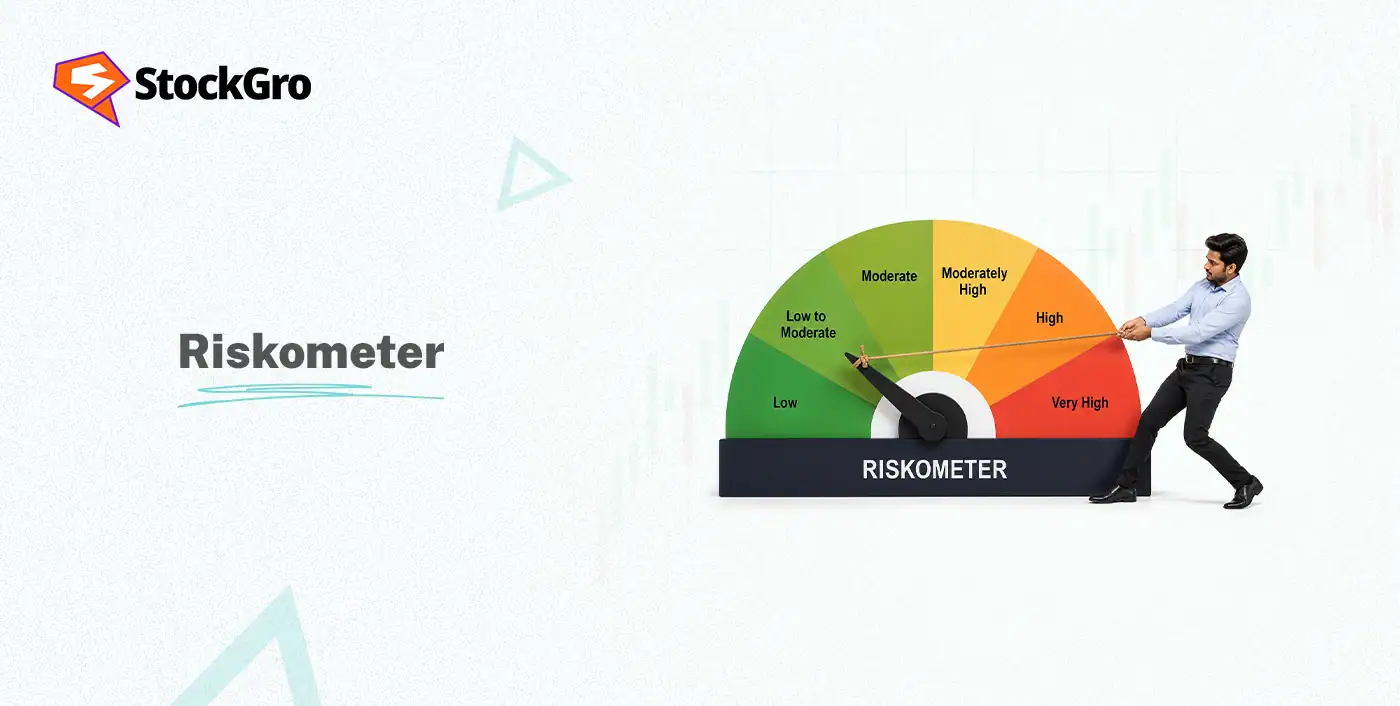
The riskometer consists of 6 different levels of risk. They are mentioned below.
| Riskometer level | Colour | Risk value | Explanation |
| Low risk | Irish Green | ≤ 1 | This shows low market volatility, which indicates relatively higher stability of the investment. |
| Low to moderate risk | Chartreuse | >1 to ≤2 | This shows relatively lower volatility compared with higher-risk schemes. |
| Moderate risk | Neon Yellow | >2 to ≤3 | This shows a calculated risk level, indicating balanced risk and return potential. |
| Moderately high risk | Caramel | >3 to ≤4 | This introduces significant market volatility, but may offer potential for higher returns. |
| High risk | Dark Orange | >4 to ≤5 | This indicates higher return potential, but also higher downside risk. |
| Very high risk | Red | >5 | This shows the highest level of volatility, with higher return potential and significantly higher downside risk. |
The Risk-o-meter is evaluated monthly. Mutual Funds and AMCs must disclose it with portfolio disclosures on their own websites and on the AMFI website within 10 calendar days from the close of each month. They must also disclose the annual risk level as of 31 March and the number of times the risk level changed during the year.
The calculation is not based on a simple judgement of volatility alone. SEBI’s methodology assigns risk values to underlying securities. For debt securities, it considers credit risk, interest rate risk and liquidity risk. The portfolio’s AUM as on the last day of the month is used for evaluation.
The different stages of risk help investors to understand the risk carried by a fund investment and make necessary decisions based on it.
Understanding Riskometer in Modern Investing
Understanding the use of Riskometer is crucial in modern investing. It provides necessary insights for making effective investment decisions.
- Risk-return alignment: The riskometer backs the financial rule that indicates higher risk has the potential for higher returns. By evaluating the riskometer, investors can assess the expected returns based on the risks associated with the fund scheme.
- Asset level evaluation: The riskometer helps investors to understand the risk profile of the investment based on the underlying assets it holds. It explains how different assets have contributed to the risks associated with them.
- Prevents unintended exposure: Riskometer acts as a protective shield to the beginners and investors who may have low risk appetite and does not prefer to be exposed to highly risk investments. It guides investors to choose investments according to their tolerance of risk.
- Goal alignment: A riskometer helps investors to choose investments suitable for them based on their financial objectives and risk appetite. Investing with an objective that makes the investment helps investors to fulfil their investment expectations.
How Riskometer Impacts Investment Decisions
The various ways through which Riskometer helps investors to make effective investment decisions are mentioned below.
- Preventing mismatched investments: A riskometer helps investors to avoid investments that do not align with their financial goals and risk appetite. It prevents new investors from investing their money in highly volatile investment schemes. Simply going through the riskometer can provide a clear idea about the degree of risk associated in the fund scheme.
- Comparing similar funds: A riskometer guides the investors who often struggle with fund schemes that suit their requirements. It is an indicator that helps investors to compare multiple fund schemes with different risk profiles and appropriately choose the scheme that offers a balance between potential risks and returns.
- Continuous portfolio monitoring: The AMCs regularly evaluate the market volatility and performance of the investment, making it easier for investors to review their portfolio and ensure the risk profile is safer for their investment.
- Encourages proactive risk management: By monitoring the riskometer, investors can be updated about the market volatility and take necessary measures to manage the risk efficiently. It may encourage them to bring necessary changes like diversification or a change in asset allocations, based on the changing market conditions.
Real-World Use Cases and Practical Scenarios
Let’s understand the importance of a riskometer with the help of examples.
Scenario 1: Miss B, a beginner investor, wants to start investing in mutual funds with the objective of wealth creation. Since she is new to investing and has very limited knowledge, it may make her uncomfortable to see constantly moving market conditions, which may lead to demotivating her.
Therefore, while choosing a fund scheme, she evaluated the various choices offered to her based on different returns and the risk of volatility they carry. After assessing, she chose a fund scheme that provides stable returns with low to moderate risk, suitable for her based on her financial goals and risk tolerance.
The riskometer helped Miss B to understand the risk level associated with each investment and make comparisons between multiple fund schemes to avoid investing in highly volatile fund schemes.
Scenario 2: Mr P, an experienced investor, has been active in investing for the last 10 years. He has experienced different types of markets and understood the cycle of how to manage the investment during volatile market conditions.
While reviewing for long-term investment opportunities, he compares multiple funds and chooses the fund scheme that provides higher returns and carries a very high degree of risk. Since he has been in this investing journey for a long time and has gained enough knowledge, it makes him suitable for investments with a high risk level.
The riskometer helped Mr P to evaluate the degree of risks associated in multiple fund schemes and choose the scheme that best suits his long-term investment goal and high risk appetite.
Common Mistakes and Risk Management Tips
There are a few mistakes that many investors make while using a riskometer. However, they can usually be managed by taking a few steps. Let’s understand the various mistakes made by investors and how to manage them.
| Common mistakes | Tips to avoid |
| Depending only on past performance | Always select fund goals and risk profiles suitable for you before making an investment, instead of evaluating simply the past performance of a fund |
| Choosing funds offering higher returns | Choose an investment that aligns with your tolerance level, instead of ignoring the high risk profile associated with funds offering higher returns |
| Focusing only in single asset | Diversify your investment and take advantage of the benefits offered by each asset |
| Not reviewing the portfolio periodically | Reviewing your portfolio regularly will provide insights into making necessary changes based on the changing market conditions |
Conclusion
A riskometer is an indicator used by investors to evaluate the degree of risk associated with an investment. It provides guidance and support to align the fund’s risk profile with investors’ risk tolerance. The various stages in the riskometer represent the classification of risks based on market volatility.
A riskometer is one of the essential factors that needs to be considered before investing in fund schemes. It provides assistance for risk management, portfolio reviewing, and making informed investment decisions according to the financial goals and risk-bearing capabilities of the investors.
FAQs
A riskometer is a risk-measuring indicator used by investors to understand the level of risk an investment holds and evaluate the risk associated in a fund scheme before investing.
No, a high riskometer simply indicates a high risk level. It is suitable for investors who want to earn high returns and have a high risk appetite.
The Risk-o-meter is calculated using SEBI’s prescribed methodology. It considers the underlying securities in the scheme portfolio and assigns risk values based on parameters such as credit risk, interest rate risk, liquidity risk, volatility, market capitalisation, impact cost, and other asset-specific factors.
Yes, a riskometer can change over time. The fund houses usually review the portfolio compositions, market conditions, and risk characteristics regularly and update the riskometer.
Beginners can use a riskometer to match the fund’s risk profile and objective with their risk tolerance and investment objective. Also, it can provide necessary assistance to compare multiple fund schemes offering different compositions of risk and returns.
A riskometer is important for investors because it helps them understand the risk level associated in a fund, compare multiple schemes, avoid uninformed risk exposure, and make necessary investment decisions.