Identifying the market trend can be tricky. With a plethora of tools to choose from, the Aroon indicator stands out as it offers a time-based perspective on the market momentum. Tracking how recently highs and lows occur, it highlights the emerging trends and the strength behind them.
In this guide, we’ll learn how to calculate the Aroon indicator and use it for trading.
What is the Aroon Indicator?
The Aroon Indicator is a technical analysis tool that is used to detect the strength of a trend and potential reversals. It measures the time elapsed between the highs and lows of an asset or stock’s price in the selected time period.
This makes it unique from other indicators as it focuses on the “trend timing’ rather than just the price movement.
Tushar Chande developed the Aroon indicator in 1995. The word “Aroon” comes from Sanskrit and means “Dawn’s Early Light,” symbolising the beginning of a new trend.
How does the Aroon Indicator work?
The Aroon indicator works by identifying how recently an asset has made a new high or low over a chosen lookback period.
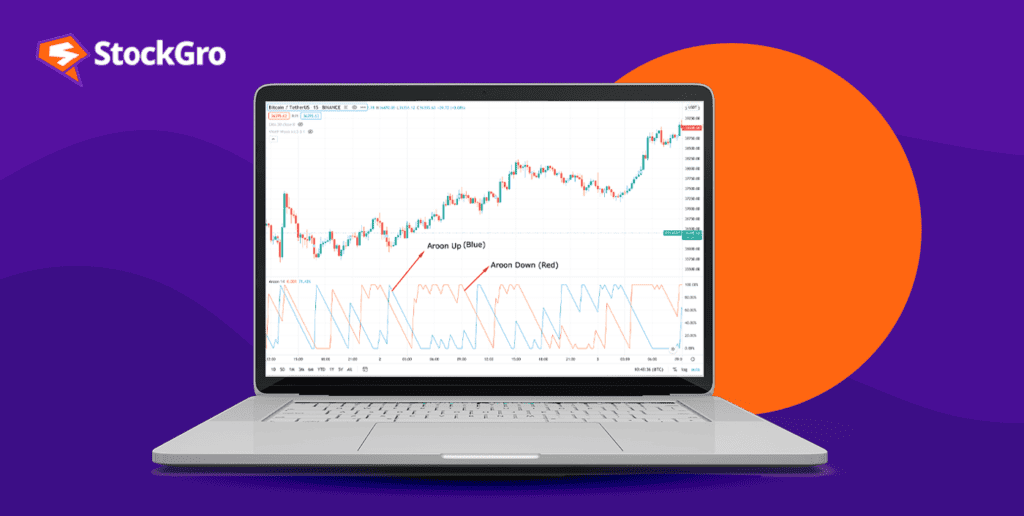
If the new high was formed recently, the Aroon Up will be near to 100. But, if the new low happened recently, the Aroon Down will be close to 100.
The interpretation of the Aroon indicator numbers is as follows:
- Aroon Up above 70 & Aroon Down below 30 → Strong uptrend
- Aroon Down above 70 & Aroon Up below 30 → Strong downtrend
- Both lines near 50 → Sideways or consolidation phase
- Frequent crossovers → Weak or choppy market
Calculation
The formula for calculating the Aroon Indicator is straightforward:
Aroon Up = [(Number of periods – Periods since highest high) / Number of periods] × 100
Aroon Down = [(Number of periods – Periods since lowest low) / Number of periods] × 100
Why is the Aroon Indicator important in Technical Analysis?
The Aroon indicator is an important tool for understanding the market movement. It is used in technical analysis for the following reasons:
- Trend Detection: The primary role of the Aroon indicator is to detect whether the current trend is upward or downward.
- Spot Early Reversals: It helps in spotting potential reversals before they become obvious on the price chart. When the Aroon up and down lines crossover, it signals a shift in the trend and the possible beginning of a reversal.
- Identify Consolidation: If both the Aroon Up and Down are close to 50, it means that the market is currently in a consolidation phase. This information is useful for avoiding false signals.
- Works Across Markets: Versatility is one of its key strengths. It can be used in different markets like stock, forex, and commodities, as well as in multiple timeframes.
Key components of the Aroon Indicator
The three key components of the Aroon Indicator are:
- Aroon Up
This line measures the strength of an uptrend by calculating the number of periods since the recorded highest high. It is also known as the bullish Aroon.
The closer its value is to 100, the stronger the upward momentum.
- Aroon Down
Also called the bearish Aroon, the Aroon Down finds the downtrend by measuring the number of periods since the lowest low in a specific timeframe.
As the Aroon Down moves closer to 100, the strength of the downtrend increases.
- Aroon Oscillator
The Aroon Oscillator moves between -100 and +100. It shows the difference between Aroon Up and Aroon Down.
Aroon Oscillator = Aroon Up – Aroon Down
- Positive values → Bullish bias
- Negative values → Bearish bias
- Near zero → Sideways movement
How to calculate the Aroon Indicator?
Let’s understand how to calculate the Aroon indicator with the help of a hypothetical example:
Step 1: Select the Lookback Period
Start by choosing the number of periods you want to find the Aroon values for. This determines how far back we’ll look to examine the price data.
We’ve chosen a 25-day period for this calculation.
Step 2: Identify the Highest High
Look at the prices for the last 25 days and find the highest price during this period.
Assume the highest price during these 25 days was ₹520, and it occurred on Day 20.
Current day = Day 25, Highest high occurred on = Day 20
Periods since highest high = 25 − 20 = 5 days ago
Step 3: Calculate Aroon Up
Find how recently the highest high occurred using the Aroon Up formula.
Aroon Up = [(Number of periods – Periods since highest high) / Number of periods] × 100
Aroon Up = [(25 − 5) / 25] × 100 = (20 / 25) × 100 = 80
Step 4: Identify the Lowest Low
Now find the lowest price during the same 25-day period.
Assume the lowest price was ₹460, and it occurred on Day 3.
Current day = Day 25, Lowest low occurred on = Day 3
Periods since lowest low = 25 − 3 = 22 days ago
Step 5: Calculate Aroon Down
Use the Aroon Down formula to measure how recently the lowest low happened.
Aroon Down = [(Number of periods – Periods since lowest low) / Number of periods] × 100
Aroon Down = [(25 – 22) / 25] × 100 = (3 / 25) × 100 = 12
Step 6: Interpretation
Now we compare both values:
Aroon Up = 80 & Aroon Down = 12
This indicates a strong bullish trend, and buyers are in control.
How to use the Aroon Indicator in Trading?
The Aroon Indicator can be used for trading in the following ways:
1. Trend Confirmation
The Aroon Indicator can be used to check whether a strong trend is in place or not. When one Aroon line constantly stays above 70, and the other line remains low, it means that the trend has sustained momentum.
Example: Suppose a stock is trading at ₹500, and the Aroon Up = 85, Aroon Down = 15.
The price gradually rises to ₹545 in the next few days, while the Aroon Up stays above 70. This means that it is a strong trend, not just a temporary move.
As long as the Aroon Up is over 70, it is logical to hold your long positions.
2. Crossover Strategy
This strategy is based on how the Aroon lines interact. When the Aroon Up and Aroon Down cross each other, it signals a possible shift in momentum.
Example: Assume a Stock XYZ is trading at ₹300.
Yesterday: Aroon Up = 35, Aroon Down = 60
Today: Aroon Up = 65, Aroon Down = 30
The crossover suggests that the momentum is shifting upwards. In the upcoming trading sessions, the price climbs from ₹300 to ₹325.
You can enter a position and ride with this momentum while closely tracking the Aroon lines.
3. Breakout Confirmation
This method is useful when the price breaks out from key support or resistance levels. The Aroon moves closer to 100, indicating a fresh high or low has been formed, adding to the breakout’s strength.
Example: A stock ABC breaks resistance at ₹700, and the Aroon Up rises to 92. In the following days, the price soars to ₹770.
As the Aroon number confirmed the breakout, it is better to trade along the breakout in this situation.
Best time to trade using the Aroon Indicator
The Aroon Indicator works best when the market is in a trending phase. It can be used to identify the trend’s strength and spot potential reversal points. Then, accordingly, you can set up your trades and exit strategy.
- Intraday traders can use minute or hourly timeframes.
- Positions and swing traders are better off with daily or weekly charts.
Traders should avoid using it in range-bound markets as it may produce false signals.
Conclusion
The Aroon Indicator is an effective tool that helps in gauging the strength behind a trend. By focusing on the timing, it adds another layer of perspective. When utilised with patience and effective risk management in place, it can support better and more confident trading decisions.
FAQs
The Aroon Indicator can be profitable when used in strong trending markets and combined with proper risk management. However, no indicator guarantees profits.
Yes. Fibonacci levels identify potential reversal zones, while the Aroon Indicator confirms whether trend strength supports continuation or reversal.
The Aroon Indicator is reliable in trending markets but may produce false signals during sideways conditions. Its accuracy improves when combined with other indicators.
The Aroon Indicator measures time since recent highs and lows, while Moving Averages smooth price data to identify direction. Aroon focuses on trend timing, whereas Moving Averages focus on price averaging.