- Summary
- Chemicals ETFs provide exposure to several chemicals-sector companies through a single exchange-traded fund, although diversification remains limited to one sector.
- India currently has two dedicated ETFs tracking the Nifty Chemicals TRI: Kotak Nifty Chemicals ETF and Groww Nifty Chemicals ETF.
- Since both track the same index, factors such as tracking difference, liquidity, expense ratio and AUM can help investors compare them.
- Chemicals ETFs carry Very High risk and can be more volatile than broadly diversified equity funds because of their sector concentration.
India currently has two dedicated ETFs tracking the Nifty Chemicals TRI: Kotak Nifty Chemicals ETF and Groww Nifty Chemicals ETF. Both provide passive exposure to companies from the chemicals, petrochemicals, fertilisers and agrochemicals segments.
Since both funds track the same underlying index, the main points of comparison include AUM, costs, liquidity and how closely each ETF tracks the benchmark.
What Are Chemicals ETFs?
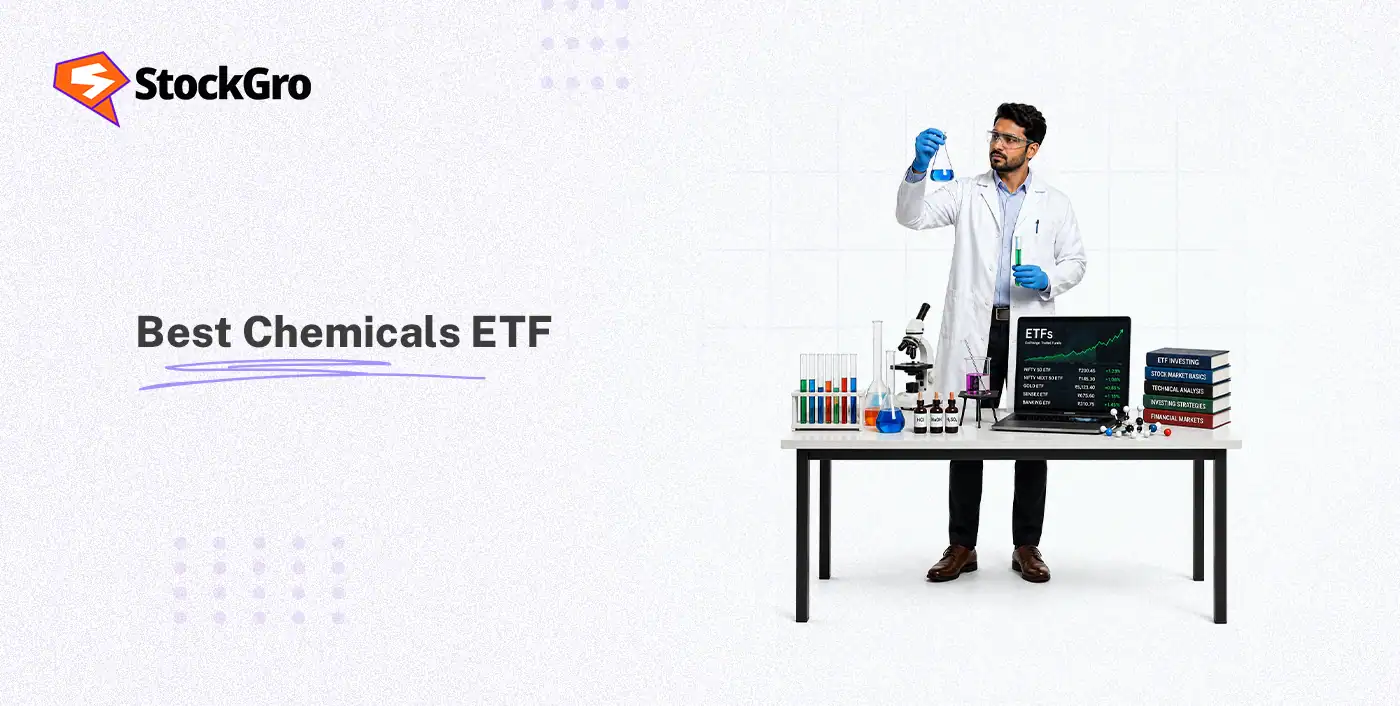
ETFs for chemicals are exchange-traded funds designed to invest in a portfolio of companies in the chemicals industry. In this way, investors do not need to purchase shares of individual chemical firms; instead, they can invest in ETFs and diversify with a single purchase.
In India, the dedicated chemicals ETFs track the Nifty Chemicals Index. The index can hold up to 20 stocks selected from eligible Nifty 500 companies in the chemicals sector, with weights based on free-float market capitalisation.
How Do Chemicals ETFs Work?
A chemicals ETF aims to replicate the composition and performance of its underlying index. The fund invests in the index constituents broadly in the weights specified by the benchmark, while expenses and tracking differences can cause its returns to vary slightly from the index.
ETF units are traded on the stock exchange during market hours through a demat and trading account. Their market price can move during the day based on the value of the underlying portfolio as well as market demand and supply.
Best Chemicals ETFs in India (2026 Updated List)
The following table provides a quick comparison of the selected best Chemical Funds ranked based on AUM as of 10th September, 2026
| ETF Name | 3 months CAGR | 6 Months CAGR | AUM | TER | Risk |
| Kotak Nifty Chemicals ETF | 3.98% | 12.32% | ₹106 Cr | 0.21% | Very High |
| Groww Nifty Chemicals ETF | 3.84% | 12.08% | ₹12 Cr | 0.40% | Very high |
Both ETFs track the Nifty Chemicals TRI. Kotak Nifty Chemicals ETF was allotted on 12 November 2025, while Groww Nifty Chemicals ETF was allotted on 13 January 2026.
Which is the Best Chemicals ETF for Beginners?
There is no one chemicals ETF that can be regarded as the best choice for every beginner investor. There are several ways to compare existing ETFs, including costs, benchmark tracking, liquidity, and portfolio composition.
- ETF with lower costs: Expense ratio is an important criterion, as it indicates the ongoing cost of managing the fund. In September 2026, Kotak Nifty Chemicals ETF has a reported expense ratio of 0.21%, while Groww Nifty Chemicals ETF has 0.40%. Nevertheless, cost should be compared to tracking difference and liquidity.
- ETF with a good benchmark: The listed dedicated chemicals ETFs have the same benchmark, Nifty Chemicals TRI. This means that a beginner investor should be familiar with the index before choosing the appropriate ETF. The index’s methodology determines which companies are included in the portfolio.
- ETF with higher liquidity: Liquidity may affect the process of buying or selling ETF units. Beginners should consider trading volumes and the bid-ask spread before placing an order. The ETFs with high trading volumes are usually more liquid.
How to Choose the Best Chemicals ETF
When selecting a Chemicals ETF, it is not enough to consider its recent stock market performance. It is necessary to know the ETF’s actual composition, how well it tracks its benchmark, and its expenses.
- Tracking difference: Compare how closely the ETF has followed the Nifty Chemicals TRI. A smaller long-term tracking difference generally indicates closer index replication.
- Trading liquidity: Review trading volumes and bid-ask spreads. A narrower spread can reduce the difference between the price at which units can be bought and sold.
- Costs: Compare the current TER on the same basis for both funds, since recurring fund expenses affect returns.
- AUM: Fund size can be considered alongside liquidity and tracking quality, although AUM by itself does not determine how well an ETF will perform.
Benefits of Chemicals ETF
These ETFs offer the diversity of a basket of stocks, as well as the convenience of exchange-traded funds.
- Multiple-company exposure: The Chemical ETF will track a basket of chemical-sector companies rather than a single stock. This will mean that one can gain exposure to a number of different companies with just one unit of the ETF.
- Convenience of sector investing: An investor does not have to conduct research or buy each company in the basket individually. By buying one ETF, you will gain exposure to a basket of companies in the chemical sector.
- Diversification of portfolio: The ETFs on chemicals provide investors with exposure to the chemicals industry. The companies held by the fund can come from various sectors of the chemicals industry. However, it is a diversification within one single industry only.
- Transparency of investment process: In general, the index-based ETFs follow the methodology of the index they track. The investor can analyse the holdings of the underlying index and ETFs to know where his/her money goes.
Risks of Investing in Chemicals ETF
The performance of Chemicals ETFs will be negatively affected when issues arise in chemical firms or in the broader stock market.
- Sector risk: Unlike common mutual funds, Chemicals ETFs are investment funds that specialise in the chemical industry rather than the whole stock market. Any problem that arises in the chemical industry will negatively impact several firms.
- Input price risk: Firms in the chemical industry utilise various raw materials. Any rise or fall in input costs will affect profits if firms are unable to pass the additional cost on to consumers.
- Demand-related risks: The chemical company is related to its industries and operations globally. Economic performance worldwide may cause reduced demand for certain chemicals. Exports and other changes may also impact the company’s operations.
- Risks related to regulation and the environment: Chemical companies are subject to environmental, safety, and pollution controls. Changes in regulations can cause increased expenses for business operations or production. Furthermore, firm-specific regulations can influence the underlying investment in ETFs.
Common Mistakes to Avoid before Buying a Chemicals ETF
First-time investors need to know the difference between a sector ETF and a market index ETF.
- Purchasing the ETF based on its past returns: An ETF which belongs to chemicals and produced great results in the past may not do so in the future, as the sector returns depend on valuation, demand, cost of commodities, and economic factors. Therefore, past returns can be used only as historical data.
- Overlooking the expense ratio: When making investment decisions, some investors focus solely on returns and fail to consider the fund’s expenses. The expense ratio decreases the return received by investors. It is especially useful when comparing two ETFs which follow the same benchmark.
- Overinvesting in one particular industry: In the case of chemicals ETFs, investors may find that the investments are narrow relative to the portfolio’s diversification. Overinvestment in a single industry increases concentration risk for investors.
How to Invest in Chemicals ETFs
Investing in a Chemicals ETF is just like investing in other exchange-traded funds listed on the stock exchange. Investors have to study the ETF prior to making a transaction.
- Create a demat and trading account: An active demat and trading account with a stockbroker is required for purchasing ETF units from the stock exchange.
- Study of the available ETFs: It will be good to compare the benchmark, expense ratio, portfolio composition, liquidity, tracking difference, among others. Before investing, it will also be important for investors to make a risk analysis of the chemical industry.
- Finding the ETF: The symbol of the desired ETF can be found on the trading website of the brokerage, and one has to make sure that one chooses the correct ETF, which would be, in this case, the Chemicals ETF.
- Placing Orders: Investors must specify the number of units to purchase and the type of order. When the matching market orders are found, the deal would be made in the stock market.
- Monitoring the Investment: After making the investment, the investors might have to monitor the ETF, its benchmark, portfolio, and sector. It may not always be possible for everyone to trade regularly through price movements alone.
Taxation on Chemicals ETFs in India
The following table shows the taxation applicable to focused mutual funds as of 10 September, 2026.
| Holding Period | Tax Treatment |
| Up to 12 months | Short-term capital gains taxed at 20% |
| More than 12 months | Long-term capital gains exceeding ₹1.25 lakh in a financial year are taxed at 12.5% |
| LTCG up to ₹1.25 lakh | Exempt, subject to applicable conditions |
Conclusion:
There are ETFs available that offer a straightforward way to invest in India’s chemicals sector with a single stock. Examples of ETFs developed specifically for India in the chemicals sector are few, including the Kotak Nifty Chemicals ETF and the Groww Nifty Chemicals ETF.
When investing in ETFs for Chemicals as a beginner investor, there are several factors beyond performance alone to consider when choosing which ETF to invest in. Some of these are expense ratio, index exposure, liquidity, tracking error, concentration, and sector risk.
FAQs
The best Chemicals ETF will be based on factors such as expense ratio, liquidity, benchmarking, and portfolio composition. Investors who have just started should analyse the Chemicals ETFs and shouldn’t choose one just based on its past performance. Underlying index analysis is vital before making an investment.
Investors can access Chemicals ETFs to invest in chemical companies; however, investment profits are not guaranteed. The performance of the ETF depends on many factors, such as industry cycles, material costs, government regulations, and global demand for the products. Risk tolerance levels are very important.
Investors can purchase Chemicals ETFs using a demat and trading account with the assistance of a stockbroker. First, you will need to compare the available ETFs and analyse their benchmarks, expense ratios, liquidity, and performance. Then, you can purchase ETF units in the stock market.
The performance of a chemicals ETF depends on the prices of the shares of the companies it comprises, as well as market conditions. There could be other factors, such as raw material costs, industrial demand, exports, international competitiveness, exchange rates, and environmental regulations, that may affect the performance of chemical companies and, in turn, the ETF.
Chemical ETFs can offer capital growth when the underlying chemical companies perform well. Nevertheless, there is no guarantee of earning good profits since sector investment can also suffer from sharp losses. Previous performance cannot be seen as an indication of future earnings.
Chemical ETFs can be taken as a sector play in an otherwise diversified portfolio. However, concentrating too much on any single sector would be risky. Investors need to consider their investment objectives, risk profile, current holdings, and overall asset allocation before adding a Chemicals ETF to their portfolio.