
- Summary
- A dead cat bounce is a temporary recovery in a stock’s price after a sharp decline.
- The rebound may occur due to short covering, temporary buying interest, or reduced selling pressure.
- A dead cat bounce can be identified through price structure, volume, moving averages, and renewed selling.
- The rebound may be temporary unless the stock shows sustained signs of a trend reversal.
What is a Dead Cat Bounce in Stocks
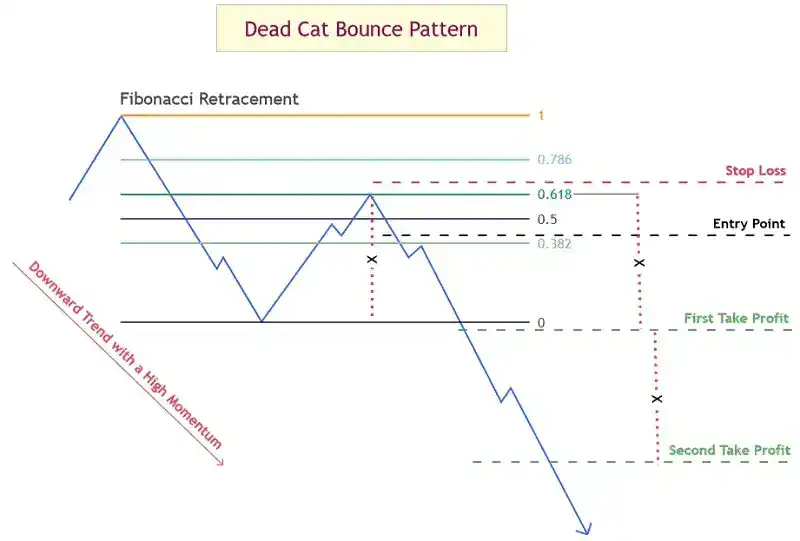
A dead cat bounce is a short-lived rise in the price of a stock after a significant decline, followed by a resumption of the downward trend. It is often associated with a bear market rally or a temporary recovery within a broader downtrend.
The term does not mean that every rise after a sharp fall is a dead cat bounce. A genuine recovery can also begin with a strong rebound. The difference becomes clearer only when the price action that follows confirms whether the stock can sustain the recovery.
For example, suppose a stock falls from ₹500 to ₹300 and then rises to ₹360. If it later falls below ₹300 and continues declining, the move towards ₹360 could be described as a dead cat bounce.
The pattern can occur because of temporary buying interest, short covering, bargain hunting, or a reduction in selling pressure. Research on the phenomenon also links temporary reversals to investors re-entering declining markets after suffering losses.
How a Dead Cat Bounce Works in the Stock Market
A dead cat bounce generally develops in a few stages:
- Sharp decline: The stock experiences sustained selling pressure because of weak results, negative news, poor market conditions, or other concerns.
- Temporary rebound: After the fall, buyers enter the market. Short sellers may also close positions, creating additional buying pressure.
- Optimism returns: The price rise may attract investors who believe the stock has reached its bottom.
- Selling resumes: If the underlying concerns remain unresolved, buying interest can weaken and the stock may start falling again.
- Downtrend continues: The stock may retest its previous low or fall below it.
The important point is that a dead cat bounce is usually identified after the rebound fails. Investors cannot know with certainty while the price is still rising whether the move will become a sustained reversal.
Dead Cat Bounce vs Trend Reversal: Key Differences
The first rise after a steep fall does not tell investors whether a stock has actually changed direction. Looking at the price pattern that follows can provide more useful clues.
| Factor | Dead Cat Bounce | Trend Reversal |
| Broader trend | Downtrend remains in place | Downtrend starts losing its structure |
| Price movement | Brief recovery | More sustained rise |
| Higher highs | Usually not sustained | May begin to appear |
| Higher lows | May not form or may fail | May form and hold |
| Volume | May not strongly support the recovery | Higher volume may support the move |
| Fundamentals | Earlier concerns may still exist | Conditions may show improvement |
| Confirmation | Often becomes apparent after another fall | Needs evidence that the upward move can hold |
One way to assess a possible reversal is to watch whether the stock begins forming higher highs and higher lows. Key support and resistance levels can provide additional context when judging the strength of the recovery.
Identifying a Dead Cat Bounce: Common Signs Traders Watch
No single indicator can confirm a dead cat bounce. Traders may instead look at several signals together, such as:
- The stock remains below key Resistance: A rebound that fails near an earlier support or resistance level may indicate that selling pressure is still present. If the stock cannot move above important price levels, the broader downtrend may remain intact.
- The rebound comes with weak volume: Trading volume can provide context for a price move. A price increase accompanied by relatively low volume may indicate weaker participation than a move supported by stronger trading activity. However, volume should not be used on its own to label a rebound as a dead cat bounce.
- The price remains below falling moving averages: Moving averages can help investors assess the direction of a trend. A stock that rebounds but remains below important moving averages may still be showing weakness. The 50-day and 200-day moving averages are commonly used to assess shorter- and longer-term trends.
- Previous lows are broken again: One of the clearest signs is a renewed fall after the rebound. If the stock breaks below the low from which it bounced, the earlier recovery may have been temporary.
- The underlying problem has not changed: A price rebound does not automatically resolve weak earnings, high debt, declining demand, regulatory concerns, or other fundamental problems. Investors should therefore consider what caused the original fall before interpreting the recovery.
Real-World Examples of Dead Cat Bounce in Stocks
Real price movements show why a sharp recovery does not always mean that a stock has entered a new uptrend.
Adani Enterprises
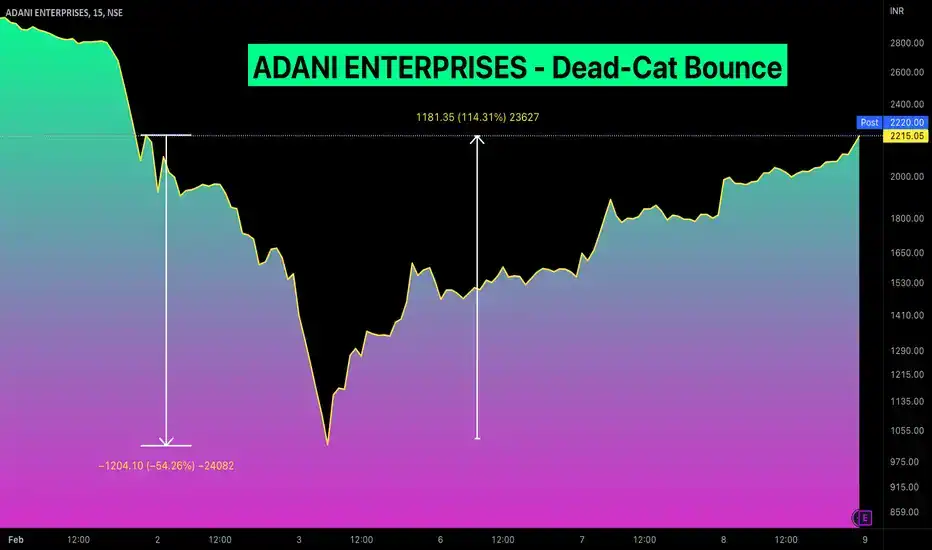
In early 2023, Adani Enterprises experienced a steep sell-off followed by a sharp V-shaped recovery. The stock doubled within one week during the rebound, but the recovery was described as a potential dead cat bounce because the broader price trend remained under pressure. The example shows how a strong short-term rally can occur even after a major decline.
Reliance Industries: On 6 February 2026, a technical analysis looked at Reliance Industries after a recent rebound. The stock was still structurally weak after moving out of a bullish Ichimoku setup and remained below the weekly equilibrium level. The analysis said the rebound could turn out to be a dead cat bounce unless Reliance reclaimed and held above the weekly mean.
Trading and Investing Strategies During a Dead Cat Bounce
A dead cat bounce can be approached differently depending on whether the objective is short-term trading or long-term investing. Some strategies include:
- Trend-following strategy: Trend following strategy means traders can follow the broader downtrend and look for signs that the temporary recovery is losing momentum before taking a position in the direction of the trend.
- Breakout confirmation strategy: This strategy waits for the stock to cross a significant resistance level and sustain the move before treating the rebound as a possible trend reversal.
- Short-selling strategy: Traders may consider short selling when a rebound shows signs of weakening and the broader downtrend remains intact. However, short selling carries significant risk if the stock rises instead.
- Mean-reversion strategy: A mean-reversion approach looks for prices that have moved significantly away from their recent average and may return towards it. Moving averages and Bollinger Bands can be used to identify such conditions.
- Value investing strategy: Long-term investors can assess whether the price decline has created a valuation opportunity by analysing earnings, cash flows, debt, and business prospects rather than focusing only on the rebound.
- Hedging strategy: Investors holding a declining stock can use hedging strategies, including suitable derivatives positions, to offset part of the portfolio’s downside exposure.
Common Mistakes Investors Make During a Dead Cat Bounce
| Common mistake | Why it can be risky |
| Assuming the bottom is confirmed | A rebound does not prove that selling pressure has ended. |
| Buying only because the stock has fallen | A lower price does not automatically make a stock undervalued. |
| Ignoring the original reason for the decline | The problem affecting the business or market may still exist. |
| Relying on one indicator | No single technical indicator can reliably confirm a reversal. |
| Chasing a sharp rally | A rapid rise can reverse just as quickly in a volatile market. |
| Ignoring risk limits | Sudden price movements can result in larger-than-expected losses. |
Limitations of the Dead Cat Bounce
A dead cat bounce can help describe price behaviour after a sharp decline, but it has limitations when used to assess what a stock may do next:
- It is easier to identify in hindsight: A rebound cannot be confirmed as a dead cat bounce while it is still rising. The pattern becomes clearer only if the stock later resumes its decline.
- It does not guarantee a further fall: A rebound can turn into a genuine trend reversal. Investors who assume every recovery is temporary may exit too early or miss a sustained recovery.
- The size of the rebound can be misleading: Historical analysis of 244 dead-cat-bounce formations across 500 stocks found that the average recovery bounce was around 19%, showing that a temporary recovery can still be substantial.
- Technical signals can give false indications: Price, volume, moving averages and momentum indicators may provide clues, but none can establish with certainty whether a rebound will fail. Research examining 93 market indicators found little evidence that such indicators consistently predict stock market returns.
- It does not explain the reason behind the decline: The pattern describes what happens to the price, but not whether the fall was caused by weak earnings, high debt, poor business prospects, market-wide selling or temporary news.
- The broader market can change the outcome: Interest rates, economic conditions, sector trends and new company-specific information can alter the direction of a stock after a rebound. Therefore, a dead cat bounce should be assessed alongside the factors driving the original decline.
What Should You Do When You Spot a Dead Cat Bounce?
If a stock rebounds sharply after a prolonged decline, avoid assuming that the recovery is either genuine or temporary based on the price rise alone. Instead, examine the following:
- Check whether the stock is making higher highs and higher lows.
- Compare the rebound’s volume with previous trading activity.
- Watch important support and resistance levels.
- Review the company’s recent financial performance and other fundamental factors.
- Look at whether the original reason for the price decline has been resolved.
- Take into account your investment timeframe and risk tolerance before making a decision.
The focus should be on assessing whether the recovery has enough support to continue, rather than trying to predict the stock’s next move.
Conclusion
A dead cat bounce is a reminder that a rising stock price does not always mean the downtrend is over. The strength of a recovery becomes clearer when price structure, volume, key levels, and the reasons behind the original decline are considered together. Looking at these factors can help investors distinguish a temporary rally from a recovery that has stronger evidence of becoming a lasting trend.
FAQs
Bearish. A dead cat bounce refers to a temporary recovery within a broader decline, after which the downward trend resumes.
It depends on the investor’s position and strategy. A temporary rebound can create trading opportunities, but mistaking it for a lasting recovery can lead to losses.
Not necessarily. The rebound itself may be positive for prices temporarily, but the term generally describes a recovery that fails and is followed by another decline.
Beginners can study historical charts and practise identifying trends, support, resistance, volume, and moving averages without risking real money. Paper trading can also help them test their observations.
It depends on what happens next. Higher highs and higher lows may support a trend reversal, while renewed selling could indicate a dead cat bounce.