- Summary
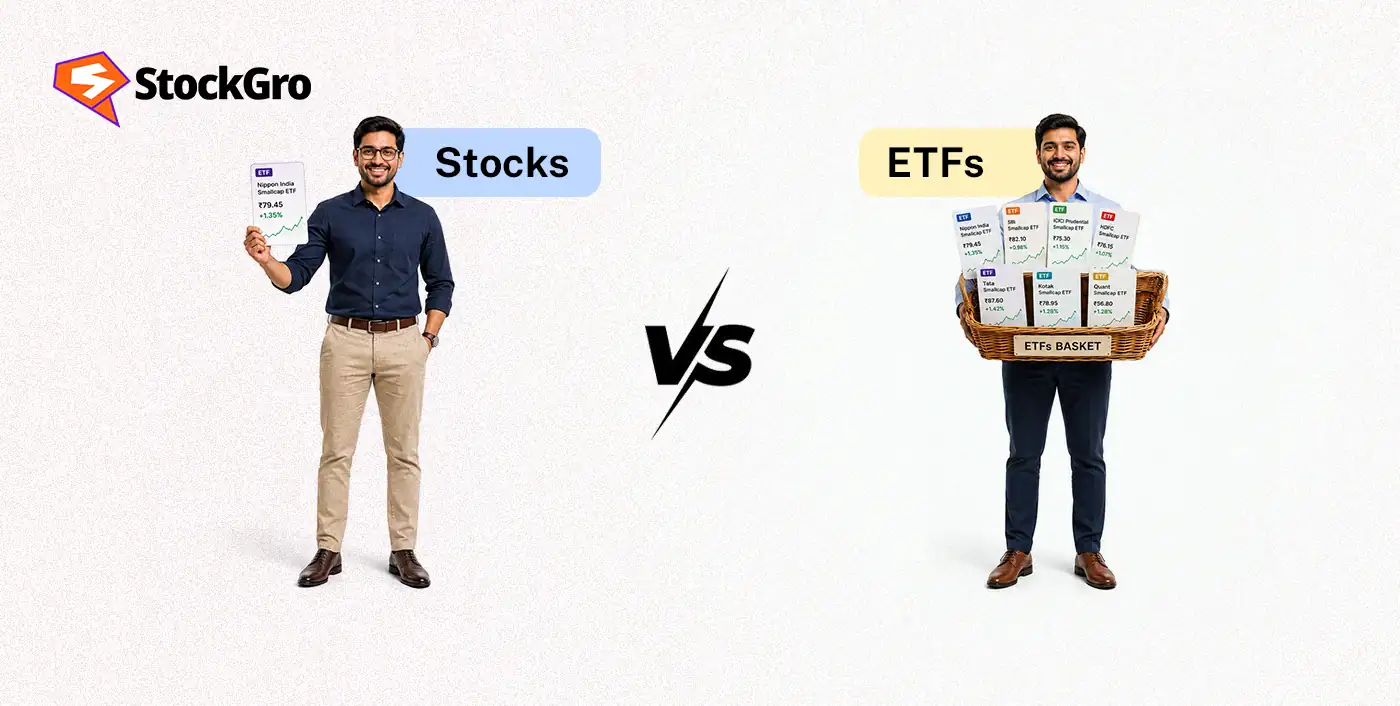
- ETFs provide diversified exposure to an index, commodity, bond or basket of assets, while stocks represent ownership in an individual company.
- Stocks offer direct exposure to a company and can provide returns through capital appreciation and dividends, but their prices may be more volatile.
- Combining ETFs and stocks can provide diversified core exposure while allowing investors to take focused positions in selected companies.
- The core-satellite strategy uses diversified ETFs as the core and individual stocks as a smaller satellite allocation.
ETFs and Stocks are two widely used investment instruments in the markets, but they have different characteristics. Therefore, the level of risk and the extent of diversification differ between them. The knowledge of the differences between the two is essential for making an informed choice.
What is an ETF?
An Exchange Traded Fund (ETF) is an investment fund that tracks the performance of an index, commodity, bond, or basket of assets. Unlike a regular mutual fund, an ETF is listed on a stock exchange and can be bought and sold during market hours like a share.
For example, an ETF for Nifty 50 holds the securities that comprise the Nifty 50 index. This is done to ensure that the gains made through the portfolio match those of the index within a certain margin of error called tracking error. Since ETFs are mainly passively managed, there is no selection of stocks.
What is a stock?
A stock is the share of ownership in a company. By purchasing stocks in a company, you will become its shareholder, owning a part of that company. Companies release stocks in order to raise funds for their business operations, whereas for investors, there can be profits in terms of capital gains or dividends
For example, if a company has 1,000 shares and you own 50 shares, you hold a 5% ownership stake in the company. The value of your investment can rise or fall depending on the company’s performance, market conditions and other economic factors. Dividends may also be paid to shareholders, but they are not guaranteed.
Key Differences Between ETFs and Stocks
The key differences between ETFs and stocks are given below.
| Basis | ETFs | Stocks |
| Ownership | Units of a fund holding a basket of securities | Shares representing ownership in a company |
| Investment objective | Usually tracks an index, commodity, bonds or another underlying asset | Provides direct exposure to a particular company |
| Price movement | ETF prices change during market hours based on trading and the value of underlying assets | Stock prices change during market hours based on demand, supply and company and market factors |
| Risk | Can spread company-specific risk across multiple holdings, although market risk remains | More exposed to company-specific and market risks |
Pros and Cons of Investing in ETFs
ETFs can offer a convenient way to invest in a diversified portfolio while trading units on a stock exchange. However, they also carry market and tracking-related risks that investors should consider before investing.
| Pros of Investing in ETFs | Cons of Investing in ETFs |
| Diversification: One ETF can provide exposure to several securities or assets, reducing dependence on a single investment. | Liquidity risk: Some ETFs may have lower trading volumes, making it more difficult to buy or sell units at the desired price. |
| Generally lower costs: Passively managed ETFs can have relatively low expense ratios compared with actively managed funds | Tracking error: An ETF may not exactly match the returns of the index or asset it tracks. |
| Exchange-based trading: ETF units can be bought and sold during market hours like stocks. | Market risk: The value of an ETF can fall when its underlying index or assets decline. |
| Transparency: ETFs generally disclose their portfolio holdings, making it easier for investors to understand the underlying exposure. | Brokerage and other charges: Buying and selling ETF units may involve brokerage and other transaction costs. |
Pros and Cons of Investing in Stocks
Stocks can give investors direct ownership in listed companies and the opportunity to benefit from their growth. However, stock prices can fluctuate significantly, and returns are not guaranteed.
| Pros of Investing in Stocks | Cons of Investing in Stocks |
| Direct ownership: Buying shares gives investors ownership in the company, along with shareholder rights where applicable. | Company-specific risk: Poor financial performance, management decisions or other company issues can reduce the value of an investment. |
| Long-term growth potential: Investors can participate in the growth of companies and the wider economy. | Loss of capital: An investor may lose part or, in extreme cases, all of the invested capital if the company performs very poorly or fails. |
| Dividend income: Companies may distribute part of their profits to shareholders as dividends, although dividends are not guaranteed. | Market risk: Stock prices can fall because of company, industry or broader market conditions. |
| Capital appreciation: Investors can earn returns if the market value of their shares increases. | Higher volatility: Individual stocks can experience sharp price movements over short periods. |
ETF vs Stock for Beginners: What Should You Choose?
An ETF may be a suitable starting point for a beginner who wants diversification and exposure to an index without selecting individual stocks. For example, a Nifty 50 ETF provides exposure to the securities represented in the Nifty 50 Index. Stocks may be more suitable for investors who are willing to research individual companies and accept the additional company-specific risk. Investors should consider their risk tolerance, investment goals, time horizon and knowledge of the market before choosing between the two.
ETFs can be used by investors for core diversification while holding certain stocks separately, as long as the whole portfolio falls within their risk tolerance and investment objectives.
Investment Strategies: Combining ETFs and Stocks
Combining ETFs and stocks may assist an investor in achieving diversification as well as exposure to a certain company. The ETF can become the base of the portfolio and, after that, stocks may be added according to the investor’s findings.
Core-Satellite Strategy: The core-satellite strategy combines diversified investments with a smaller allocation to investments selected for higher growth potential. In an ETF and stock portfolio, ETFs can form the core, while individual stocks can act as the satellite portion.
- Core: A larger portion of the portfolio can be invested in broad-based ETFs, such as a Nifty 50 ETF. This provides diversified exposure to a group of companies.
- Satellite: A smaller portion can be allocated to selected stocks based on the investor’s research and market views. This allows the investor to target specific companies or sectors.
Returns & Real-World Performance Insights
ETF and stock returns may differ in terms of the underlying asset classes, market situations and investment horizon. Performance history cannot ensure future returns. This is why investors need to take performance into consideration together with risk and cost factors.
ETF Returns: An ETF generally aims to track the performance of its underlying index or asset. Its return can differ slightly from its benchmark because of expense ratios, transaction costs, cash holdings, corporate actions and other factors. This difference is measured through tracking error and tracking difference.
Stock Returns: Individual stocks can generate higher or lower returns than a broad market index. A company with strong earnings growth, improving business prospects or favourable market conditions may see its share price rise significantly. However, a stock can also underperform or decline sharply because of company-specific problems or broader market conditions.
Real-World Use Cases & Learning Through Practice
Investors can understand the practical differences between ETFs and stocks by observing how each behaves in different market situations. For example, an investor may use a Nippon India ETF Nifty 50 BeES to gain diversified exposure to large-cap Indian companies, while investing separately in Reliance Industries to take a more focused position in one company.
Beginners can also learn by tracking a small portfolio, comparing ETF and stock returns against their respective benchmarks, and reviewing performance over different time periods. Starting with small amounts and maintaining a record of the reasons behind each investment can help investors understand risk, volatility, diversification and the impact of market movements without relying solely on short-term returns.
For example, imagine an investor invests ₹1 lakh in Nippon India ETF Nifty 50 BeES and an additional ₹1 lakh in the share price of Reliance Industries. With a 10% gain in a year from the ETF, the investment will grow to ₹1.10 lakh. With a 20% gain in the year in the share price of Reliance Industries, the investment will grow to ₹1.20 lakh. On the other hand, with a 10% loss in the share price of Reliance Industries, the investment will reduce to ₹90,000.
Final Thoughts
ETFs and stocks play their own role in the investment portfolio. For instance, with the help of ETFs, an investor can gain diversification across one asset class or market with a single investment. Meanwhile, individual stocks give an opportunity to have positions in particular companies. There is no one best choice; the decision depends on a variety of factors.
For beginners, ETFs can be a practical choice to gain broader market exposure, while investors with the time and knowledge to research may choose to invest in individual stocks. A combination of both can also be used through a core-satellite approach.
FAQs
An ETF helps mitigate company-specific risk because it typically holds multiple assets. However, an ETF does not eliminate risk entirely since its value will fall if the assets that it holds or the overall market falls. Stocks can have higher risks than an ETF due to company-specific risk.
Yes, an ETF can outperform an individual stock over a particular period, but the reverse can also happen. ETF returns generally depend on the performance of the index or assets they track, while individual stocks can experience larger gains or losses based on company-specific performance and market conditions. Past returns do not guarantee future performance.
Beginners who want diversification and broader market exposure may consider ETFs. Investors who are comfortable researching individual companies and accepting higher company-specific risk may consider stocks. Investors can also combine both based on their goals and risk tolerance.
Some ETFs may distribute income received from their underlying securities to investors, depending on the ETF structure and applicable rules. The treatment and timing of such distributions can differ from dividends received directly from individual stocks.
Yes. ETFs are listed on stock exchanges, and their units can generally be bought and sold during market hours, similar to shares. Their market price changes throughout the trading session based on market demand and supply and the value of their underlying assets.