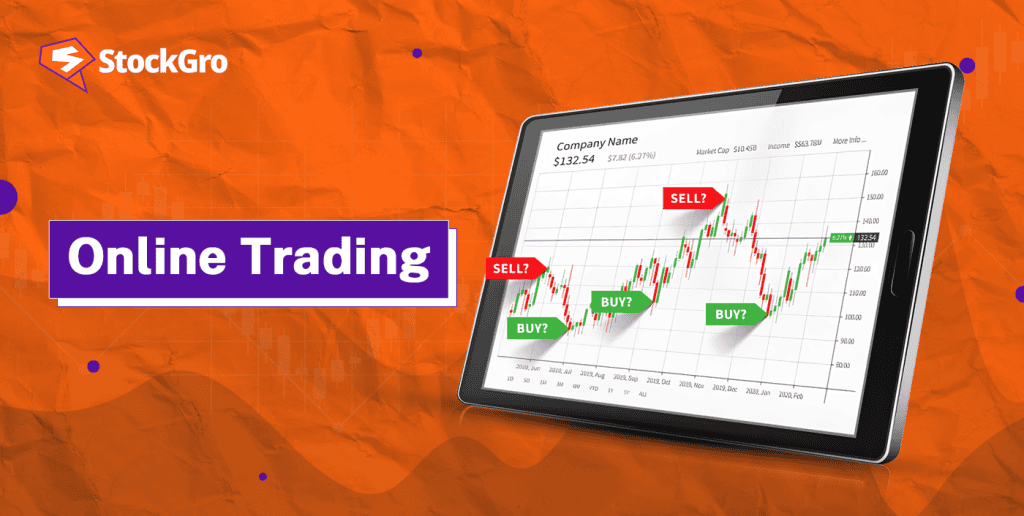
Do you want to invest without leaving the comfort of your home? Online trading has reshaped the structure of investing in India. From listed securities to IPO applications, everything is now available at your fingertips. Discover how online trading works and how you can invest using digital platforms.
What is online trading?
Online trading means buying and selling of financial instruments like bonds. Stocks and commodities through an internet-based platform. Instead of going to a stock exchange or contacting a broker, you place orders using an online trading website or application.
In India, this digital shift has been rapid. There are more than 21 crore demat accounts as of December 2025. The National Stock Exchange (NSE) had an average daily turnover of ₹1.12 lakh crore in FY25. These figures show that the online mode of trading now dominates the market.
How does online trading work?
Online trading looks effortless, but it follows a structured system. Let’s understand how it works with a hypothetical example:
Placing the Order
Suppose you want to buy 100 shares of XYZ Ltd, currently trading at ₹250. Your total investment amounts to ₹25,000.
You log in to your trading platform and place the order for the same. The order is immediately sent to the stock exchange.
Order Matching
Once your order reaches the exchange, it enters the order book.
Suppose there is another investor who wants to sell 100 shares of the same company at the same price. The exchange matches the orders and executes them within seconds.
Trade Confirmation
After execution, your broker generates a digital contract note. This document includes the trade price, brokerage, transaction charges, and taxes.
Assume:
Brokerage = ₹20
STT and other charges = ₹30
Total charges: ₹50
Your total cost becomes ₹25,050.
Clearing and Settlement
In India, a T+1 settlement cycle is followed. On the next business day, 100 shares of XYZ Ltd are credited to your demat account.
The clearing corporation ensures that both buyer and seller fulfill their obligations.
How to trade online
Here’s a step-by-step approach one should take when learning how to start trading online:
Step 1: Select a Broker
Start by choosing a broker registered with the SEBI. Understand the services they provide, the user interface, and customer support.
Step 2: Account Opening
Open a demat account and trading account with the broker by completing the formalities and KYC requirements. The demat account is used for holding the securities, and the trading account is used for placing orders.
Step 3: Fund the Account
Link your bank account to the demat and trading account. This will be used to transfer funds for placing orders and to receive money when securities are sold.
Step 4: Research and Analyse
Before placing orders, deeply study about the company. Evaluate how it makes money, the debt level it maintains, and past performance. Also, check its valuation and price trends.
Step 5: Place Orders
Once you gain confidence, start by placing orders. It is preferable to start with delivery-based strategies instead of using leverage and trading in derivatives.
Types of Online Trading
Trading styles differ based on time horizon and risk appetite. Some of the most common types are:
Intraday Trading
In intraday trading, shares are bought and sold within the same trading session. The aim here is to benefit from short-term price movements.
Example: A day trader, Raj, buys 100 shares of ABC Pharma trading at ₹500 at 11:00 a.m. The stock rises to ₹510 by 2:15 a.m. He immediately sells at this price, booking a profit of ₹1,000.
Swing Trading
Swing trading is concerned with short-term price swings that can last from days to a couple of weeks. This style is more flexible than day trading, but it still requires regular tracking.
Example: After noticing a temporary dip in the tech sector over the weekend, Riya buys an IT stock at ₹1,200 on Monday. The stock recovers after 4 days. Riya now exits her position at ₹1,285 on Friday, registering 7% gains.
Positional Trading
In positional trading, the stocks are held for weeks to months to benefit from the broader market trends. Instead of volatility, the focus is on fundamentals and macro signals.
Example: A trader is anticipating a surge in stock prices of EV companies. He buys shares of Tesla and starts to hold them, ignoring minor fluctuations and daily noise. He sells after 5 months, when shares have climbed up, delivering him 35% returns.
Long-term Trading
Also known as investing, long-term trading’s objective is wealth creation through business growth and compounding. The stocks are held for several years to realise the benefit of long-term growth.
Example: Mohan buys shares of a blue-chip company at ₹800. He has held the position for 10 years, and let compounding do its work. His investment grows over this time and soars to ₹4800, giving him multibagger returns of 500%.
Scalping
In scalping, multiple quick trades are executed in a single session to receive a small margin but a high frequency of profits. Scalping requires quick decision-making.
Example: A trader observes that a stock is fluctuating close to ₹200. He buys 10,000 shares at this price, and just after 30 seconds, he sells at ₹200.50. He repeats this 20 times during the day, and the ₹0.50 profit margin adds up to a ₹10,000 profit at the end of the trading session.
Is it safe to trade online?
Online trading is safe when done with the right measures. You can take the following measures:
- Know your stockbroker: Ensure that the broker is registered with the SEBI. Check its market reputation and perception by other users.
- Security Measures: Use a stable and secure internet connection and two-factor authentication. Also, only trade through official and registered websites and applications.
- Avoid High Leverage: Trading with leverage can amplify the losses. Keep your bid portions under control.
- Stay Alert: Track updates on market trends and news. Be aware of fraud and scams.
Benefits of Online Trading
Online trading gives the following benefits to the market participants:
- Cost-Effective: Online trading eliminates the need for middlemen (brokers). It reduces the operating costs and results in lower brokerage fees for the investors.
- Convenience: The markets can be accessed anytime and anywhere with an internet connection. It makes online trading convenient as traders don’t have to be physically present or rely on brokers.
- Fast Execution: The place orders are instantly sent to the stock exchange and processed as soon as a match is found. It quickens trading and helps in capturing the price fluctuations.
- Greater Autonomy: Investors have full control over their holdings. They can add, modify, or sell without any external intervention.
- Diverse Investment Options: Traders are not limited to equity shares only. They can invest in commodities, bonds, and IPOs through digital platforms.
Online trading vs offline trading
Many are still confused about the method they should choose for trading. The given table presents the difference between online and offline trading:
| Parameter | Online trading | Offline trading |
| Order Execution | Executed instantly through digital platforms | Placed manually through broker calls |
| Market Access | Trade anytime with internet access | Limited to broker working hours |
| Brokerage Charges | Flat fee or low commission structure | Higher percentage based brokerage fees |
| Control | Direct control over buy sell decisions | Decisions are often guided by broker |
| Research Tools | Built in screeners and analytics tools | Dependent on broker research reports |
| Security | Online platforms have multi-layered digital security | Depends on the integrity of the broker and manual checks |
Choose the right trading platform for online trading in India
There are a plethora of options available for online trading. Keep these pointers in mind when choosing the trading platform:
- User Interface
A friendly interface enhances the user experience and makes it easy to place orders and manage investments. - Involved Costs
The brokerage fees and other transaction charges vary from one platform to another. Compare them as these costs can add up and affect the overall returns. - Asset Variety
Not all platforms deal with every kind of asset. Their operations can vary and include different combinations of equity, debt, commodities, and mutual funds. Choose a platform that allows trading in the asset classes of your interest. - Tools and Features
Trading platforms offer market insights, charting tools, technical indicators, and screeners. Look for platforms that provide all the features you will use for trading.
Things to remember before starting online trading
Online trading offers convenience, but complete access in the hands of a trader can be a double-edged sword. Before you start your online trading journey, remember this:
- Develop a basic understanding of the market. Learn how instruments work, trading mechanisms, and the impact of macroeconomic conditions on the market.
- Start with small amounts. You can increase your investment size with time and experience.
- Select the right broker. Check if they follow regulations and whether you’re comfortable with their user interface.
- Avoid impulsive decisions. Market swings can cause panic. Rely on analysis, not emotion, when trading.
Conclusion
Online platforms have made trading simpler and more accessible. With digital mechanisms handling millions of trades every single day, participation in the regional markets has expanded rapidly. However, trading success is not random. It requires patience, knowledge, and proper risk management. When used wisely, online trading makes your financial journey easier.
FAQs
Online trading simply means buying and selling financial products using the internet. Instead of calling a broker, you place orders through an app or website and track everything digitally.
People make money by buying a stock at a lower price and selling it at a higher price. Some also earn by investing in companies that pay out dividends.
You begin by opening a demat and trading account, linking your bank account, and adding funds. After researching stocks, you place buy or sell orders through the platform and monitor your investments regularly.
Online trading can be profitable if you approach it with research, patience, and discipline. However, markets fluctuate daily, so profits are never guaranteed. Proper risk management plays a key role in protecting your capital.
Trading online is generally safe when you use a SEBI-registered broker with proper security systems. Still, you must protect your login details, avoid unknown links, and stay cautious against online fraud.
You can teach yourself by reading about stock markets, learning basic financial concepts, watching market trends, and practising with small investments. Starting slow and reviewing your mistakes helps you improve over time.