

What is a Gap in the Stock Market?
A gap forms when a stock opens at a price noticeably higher or lower than where it closed the previous session, leaving a blank zone on the chart where zero trades happened. That empty space is not just visual noise. In the stock market, it tells you that something shifted in sentiment while the market was shut, and the price had to jump to catch up.
When the opening price is completely over the previous day’s high, it is known as a full gap. If the price opens higher but is still within the range of the previous session, the gap is said to be partial. Both gaps matter, but the full ones tend to carry stronger signals.
Example: A clear gap is visible in UltraTech Cement’s stock price movement. It closed around ₹11,500 on April 13, 2026. On the next trading day, April 15, 2026, it opened near ₹11,840, a rise of roughly ₹340 with no trades in between. The blank space between those two candles is the gap.
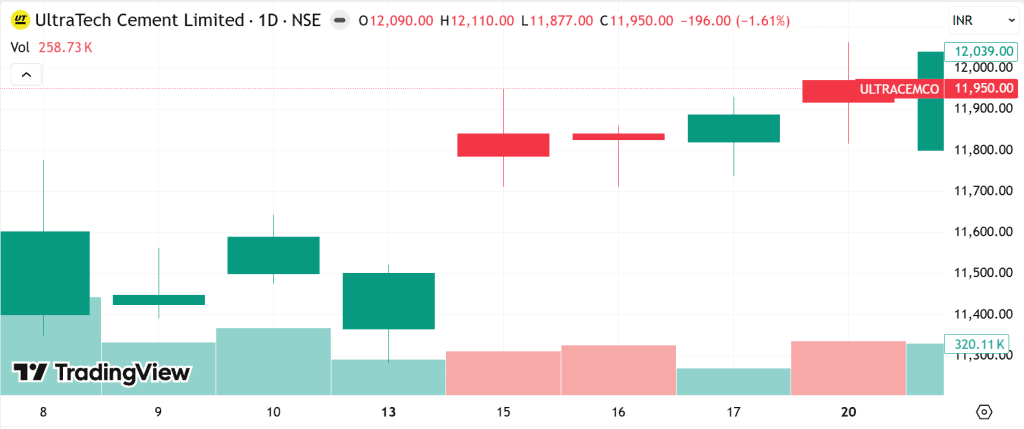
UltraTech Cement NSE daily candlestick chart showing a gap between April 13, 2026 and April 15 2026
Types of Gaps
Not all gaps are the same. Understanding each type helps to properly deal with them. Here are the main categories:
- Common Gap
The most frequently seen type, a common gap occurs without any major news or catalyst. It tends to be small in size and usually gets filled within a few days. Volume during a common gap is generally average, which is part of why traders do not assign it much significance. - Breakaway Gap
A breakaway gap occurs when the price moves beyond a consolidation zone it has been stuck in for a while. It signals the start of a fresh trend and usually comes with a clear jump in volume. These take time to fill, sometimes months, because the reason behind the move is structural, not just noise. - Runaway Gap
A runaway gap shows up in the middle of a trend already in motion. It is also called a continuation gap. Traders who had missed the initial move join in, moving the price forward again. It confirms that the original trend still has momentum left. - Exhaustion Gap
The exhaustion gap looks almost identical to a runaway gap but appears right at the tail end of a prolonged move. It is a trap for the unaware. Huge volume, big price jump, and then the trend quietly dies. The giveaway is context. If the stock has already run hard for weeks, a sudden gap should raise eyebrows, not excitement.
Trading Strategies for Gaps
There are a few ways traders actually use gaps rather than just observe them.
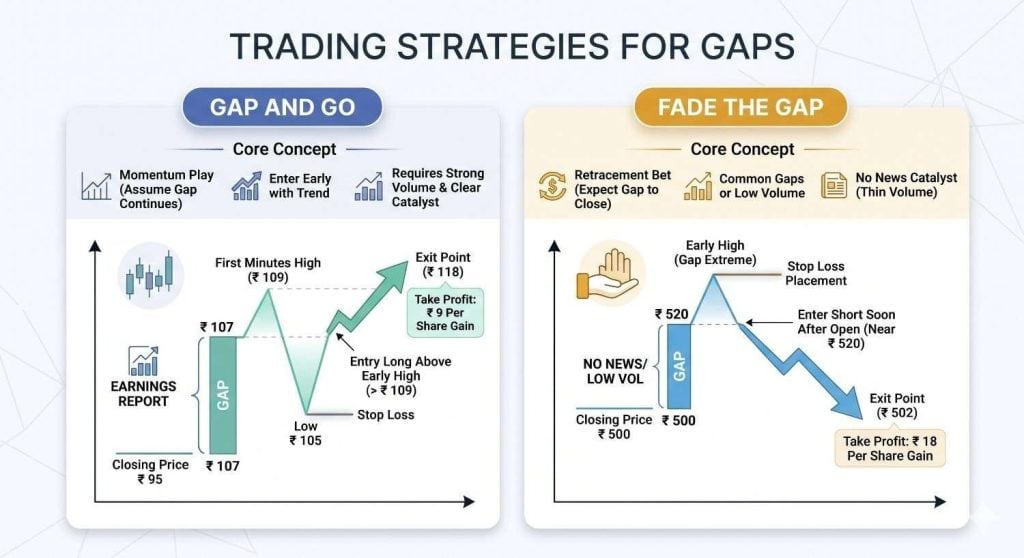
Gap and Go
Pure momentum play. The trader assumes the gap will keep moving in the same direction and enters early with the trend. Works well when volume is strong and a clear catalyst exists.
Example: Stock ABC closes at ₹95. Overnight, a strong earnings report drops. It opens at ₹107 the next morning. In the first few minutes, the high is ₹109, and the low is ₹105. The trader enters above ₹109, stop placed at ₹105. The stock climbs to ₹118 before stalling, and the position is closed for a ₹9 per share gain.
Fade the Gap
The opposite bet. Here, the trader expects the gap to close, meaning the price will retrace back toward where it came from. This tends to work on common gaps or gaps that open on thin volume with no real news underneath them. Entry is taken soon after the open, and the stop is placed just beyond the gap extreme.
Example: Stock XYZ closes at ₹500. The next morning, it opens at ₹520 with no significant news driving the move, and volume is below average. A trader enters a short position near ₹520, placing a stop above ₹525. The stock drifts back to ₹502 by afternoon, and the trader exits with an ₹18 per share gain.
How to Interpret Stock Gaps
A gap on a chart is a starting point, not a conclusion. Here is what to actually look at before acting:
- Volume: High volume behind a gap adds credibility. A gap with weak volume is often meaningless.
- Gap type and position in trend: A breakaway gap at the start of a move reads very differently from an exhaustion gap after a long rally.
- Gap size: A very big gap, especially in a mid or small-cap stock, may indicate panic buying or selling. These often see sharp reversals as traders book profits or cut losses.
- Supporting indicators: Technical indicators like moving averages and the Relative Strength Index (RSI), or candlestick patterns near the gap zone, can confirm whether the momentum will hold or fade.
Why Do Stock Gaps Fill?
More often than not, gaps eventually get filled. The reasons vary.
- Overreaction: The initial reaction to news or events tends to overshoot the prices. Once regular trading begins and more participants weigh in, the prices get corrected.
- No follow-through: A gap that opens big but attracts no fresh orders simply drifts back.
- No support or resistance: As no trades happened in the gap zone, the price has nothing to lean on if it returns, so it slides through cleanly.
- Profit booking: Traders sitting on gains from the prior session use the gap open to exit, which pulls the price back down.
Breakaway and runaway gaps are the exceptions. Because they reflect genuine shifts in momentum, they can stay unfilled for extended periods.
Risks Associated with Gap Trading
Gap trading is not a clean setup. A few things can go wrong fast.
- False breakouts
A gap that looks like a breakaway can turn out to be noise if the volume does not back it up. Traders enter expecting continuation and get stopped out quickly. - Volatile openings
The first few minutes after a gap are messy. Spreads are wide, price discovery is still happening, and entries at that stage often come at worse prices than expected. - Cause unknown
Entering a gap trade without knowing what caused it is a gamble dressed up as a strategy. - Tight stops get hit
The choppy price action right after a gap makes stop placement genuinely difficult. Too tight and you get shaken out before the move begins. - Overconfidence from the setup
A clean-looking gap can create excitement that overrides judgment. That emotional pull is one of the more consistent ways gap trades go wrong.
Final Thoughts
Gaps show up in every market, every week. Most are not worth noticing. The ones that deserve attention share a few things. They are formed by a clear reason, occur with strong volume, and let the traders take a sensible position. Rather than chasing every gap, the focus should be on developing a clear framework which guides your decisions.
FAQ‘s
The four main stock market gaps are common gaps, breakaway gaps, runaway gaps, and exhaustion gaps. Each reflects different market conditions, momentum strength, and trader behaviour.
A stock gap occurs when a stock opens significantly above or below the previous session’s closing price, leaving an empty price area with no trading activity in between.