Summary
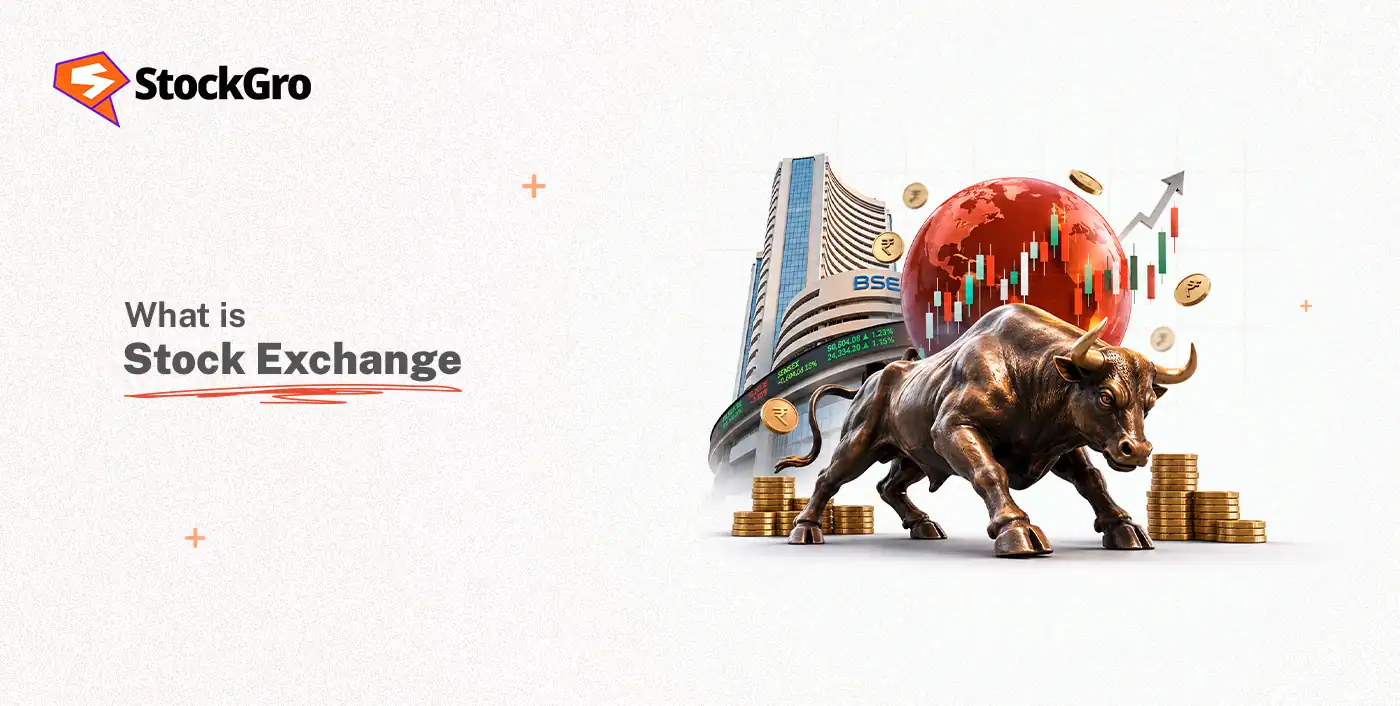
A stock exchange is an exchange facility that enables investors to trade securities openly, with fairness and liquidity.
Investing needs discipline and knowledge; thus, conduct a proper analysis before investing.
What Is a Stock Exchange?
The stock exchange is an organised stock market that allows individuals to trade different financial securities such as shares, ETFs, bonds, and derivatives. It serves as a platform for companies to raise funds and investors looking for opportunities for wealth creation. Rather than trading directly, buyers and sellers place their orders with brokers, and the exchanges facilitate this process efficiently.
Stock exchanges in current days use sophisticated electronic trading, and hence the processes are quick, safe, and transparent. They are regulated by the SEBI, ensuring fair trading practices. They play a vital role in the economic growth and encourage investment practices.
What Is the Main Purpose of a Stock Exchange?
The key role of a stock exchange is to offer a safe and structured platform for trading securities. Securities offer companies and businesses the opportunity to raise capital from the public and enable them to have stock in their firm. The link between the investors and the companies helps channel savings into productive economic activities.
Liquidity is also one of the most important factors. This is because stock exchanges allow investors to comfortably sell their securities whenever they need money, instead of searching for a buyer. They provide flexibility, making it attractive to investors.
How Does a Stock Exchange Work?
The stock exchange facilitates its operations through an electronic trading system that brings together the buyers and sellers in real time.
- When an investor wants to buy or sell stocks, an order is placed through a registered stockbroker using an online transaction system. The order is then relayed to the exchange, where it will be matched with other orders considering various parameters, such as price and time.
- If the buyer agrees to the price quoted by the seller, both of them will continue with their transactions. After the transaction, the clearing and settling phase begins.
- The shares are delivered to the buyer’s demat account, while the investor receives the payment after the settlement period.
The stock exchange monitors all transactions in order to maintain integrity and fairness, and to identify any misconduct in the market. They also enforce regarding trading practices and listing. During the trading hours, the prices keep changing depending on various factors such as the demand and supply of the stock, the company’s performance, the overall economy, and investor sentiment.
Types of Stock Exchanges and Their Functions
Electronic exchange: The electronic exchange market is a digital platform for exchanging or trading stocks and other securities with the use of computer networks. Order executions are based on matching price and time, which helps in increased speed, transparency, and efficiency of the trades. Modern stock exchanges, such as the NSE, work on the principle of electronic exchange.
Auction market: The auction market is characterised by competition between bidders and offerers in a centralised market. TRdes take place as soon as the maximum bid price meets the minimum offer price. Thus, market prices are determined considering current demand and supply of the securities.
Dealer market: The dealer market functions under the financial intermediaries, called dealers or market makers. They are trading on the stock market with their own stocks and bonds. Therefore, there is no direct interaction between buyers and sellers, but investors trade with their dealers, quoting buying and selling prices.
Over-the-counter market: Over-the-counter market is the type of market where securities are traded privately without listing on any stock exchange. This market is mainly used for securities from smaller firms, corporate bonds, and other securities that cannot be listed on a stock exchange.
Derivatives/commodities market: In the derivatives and commodities market, contracts related to assets such as stocks, indices, currencies, precious metals, agricultural products, or crude oil are traded through these markets. This market is mainly for hedging purposes, price discovery, and speculation.
Major Stock Exchanges in India and Around the World
The two major stock exchanges of India are where most of the share deals take place in the nation. The Bombay Stock Exchange is one of the oldest stock exchanges in the world and was founded way back in 1875. It has thousands of companies listed on it from all kinds of businesses. The other stock exchange in India is the National Stock Exchange (NSE), which was formed in 1992 and has introduced electronic trading in India. They are one of the largest stock exchanges in India now. Both these stock exchanges come under the purview of SEBI.
There are many stock exchanges, which play an important role in global finance. In America, there are the New York Stock Exchange (NYSE) and the Nasdaq, where the major players of the world trade. There is also the London Stock Exchange (LSE), which plays an important role as the financial centre in Europe. The Tokyo Stock Exchange (TSE) is another large stock exchange in Asia. There are also the Hong Kong Stock Exchange (HKEX) and Shanghai Stock Exchange (SSE).
Why Stock Exchanges Matter for Investors and Traders
Let us understand how stock exchanges impact both investors and traders.
- Establish a regulated platform for trade: Stock exchanges function according to strict rules and regulations that provide for the safe trade of securities.
- Maintain liquidity: Buyers and sellers are allowed convenient trading and exchanging stocks because they provide an easier way to connect the participants.
- Enable fair price discovery: The price is determined by the market, allowing competitive and fair trading of securities.
- Contribute to economic development: It allows interaction between both buyers and sellers, creating employment opportunities and contributing to overall economic growth.
How Is a Stock Exchange Different from the Stock Market?
Let’s learn what makes stock exchanges different from the stock market, while being closely related to each other.
| Basis | Stock Exchange | Stock Market |
| Meaning | A specific platform where securities are bought and sold | An overall ecosystem where securities are traded |
| Scope | Refers to a single organised trading venue | Covers all stock exchanges, investors, brokers, and listed companies |
| Functions | Provides technology and infrastructure to execute trading | Represents the entire process and environment of securities trading |
| Relationship | Narrower concept; it is a part of the stock market | Wider concept; it includes one or more stock exchanges and other market participants |
Benefits of Investing Through a Stock Exchange
Learn the advantages of investing through regulated exchanges, from transparency to long-term wealth creation.
- Access to investment opportunities: Investors are allowed to invest in several companies of different industries on a single trading platform, increasing accessibility.
- Liquidity: Investor are able to buy and sell the securities whenever required, enabling them to get quick access of their holdings and increasing liquidity.
- Opportunities for wealth creation: Long-term investments in companies with a strong financial performance history have the potential to generate wealth through dividends and capital gains.
- Diversification of investments: It enables investors to distribute their investments across various companies and industries, thus decreasing potential risk.
Real-World Example of How a Stock Exchange Helps Build Wealth
Consider an investor who starts investing ₹5,000 each month in the stocks of TATA Consultancy Services (TCS) listed on the NSE. Instead of trying to guess the future price movements, the investor maintains an SIP, which means he keeps investing in the stocks consistently for many years, despite any temporary downturns in the market.
The growth of the companies would eventually lead to the appreciation of the share prices of such companies. Further, some companies might declare dividends, which could be another source of earnings from the same investment. The investor can consider reinvesting the dividends to buy more stocks, which would help him benefit from the compounding effect of investments.
Despite temporary fluctuations in market prices, consistent investing in the long run has helped many investors generate wealth. It is because of the stock exchange, which has made it possible to invest in quality companies with fair price discovery and trading of stocks whenever required.
Common Risks and Mistakes to Avoid When Trading on Stock Exchanges
Learn about the common investing pitfalls and practical ways to reduce risk while trading.
| Common Mistakes | How to avoid them |
| Investing without conducting thorough research | Conduct adequate research on the company fundamentals, business models, industry trends, and future growth of the company before investing |
| Depending on market hypes and rumours | Avoid following unverified tips that come through social media or making investment decisions following your friends. |
| Poor diversification | Ensure that the portfolio of investments is diversified by investing in various sectors and industries so that a failure in one investment does not affect the entire portfolio |
| Emotional investing | Try to stay in an investment plan rather than letting your emotions make the decision. Avoid greed or panic reactions during changing market conditions |
How Beginners Can Start Learning the Stock Market
Learning about the stock market is a continuous process. Beginners are advised to get the basic knowledge before investing in the real market. First of all, learn about the basic notions such as shares, stock exchanges, market indices, risk, return, and diversification. Learning the idea of how companies earn profit and how the whole market works will help you feel more confident in your investments.
Once you have learned the basics of investing, you can create a demat and trading account through an officially registered broker and get acquainted with the stock market through small investments. As a beginner, avoid trying to predict the market. Instead, begin investing in regular intervals. Over time, steady learning and a patient approach can make a meaningful difference in your investment journey.
Final Thoughts
The stock exchanges include much more than simply the buying and selling of securities. Stock exchanges are important financial institutions that allow businesses to raise capital and for investors to create wealth. Through regulation and transparency, the investment process becomes efficient and leads to improved fairness in trading.
For beginners, knowing how stock exchanges operate is the first step towards making the right investment. Although every investment involves certain risks, one can reduce them by accumulating information, diversifying one’s portfolio, and being persistent. Instead of seeking faster ways to earn money, investors should concentrate on patience and consistency.
FAQs
Yes. Beginners can invest through a registered stockbroker after opening a demat and trading account. Starting with small investments while learning the basics is generally recommended.
The two primary stock exchanges in India are the National Stock Exchange (NSE) and the Bombay Stock Exchange (BSE). Both are regulated by SEBI.
Stock exchanges operate under strict regulatory guidelines, use secure electronic trading systems, and require listed companies to follow disclosure and governance norms, making trading more transparent and reliable.
Yes. Many brokers and educational platforms offer virtual or paper trading accounts that allow beginners to practice trading strategies without risking actual money.
The Securities and Exchange Board of India (SEBI) regulates stock exchanges, protects investor interests, and oversees the functioning of the Indian securities market.
Yes. Companies can raise funds privately through private placements or other methods. However, shares of unlisted companies are not traded on recognised stock exchanges.
A stockbroker acts as an intermediary between investors and the stock exchange. Brokers execute buy and sell orders, provide trading platforms, and facilitate the settlement of transactions.
Yes. Stock prices can fluctuate due to market conditions, economic events, and company performance. However, proper research, diversification, and a long-term investment approach can help manage these risks.