Moving averages simplify price data and help in understanding the overall market direction. Knowing how moving averages work is important for interpreting price behaviour and managing uncertainty. They support decision-making, especially when identifying potential entry and exit points. This article explains how moving averages are used across different market situations.
What Is a Moving Average (MA)?
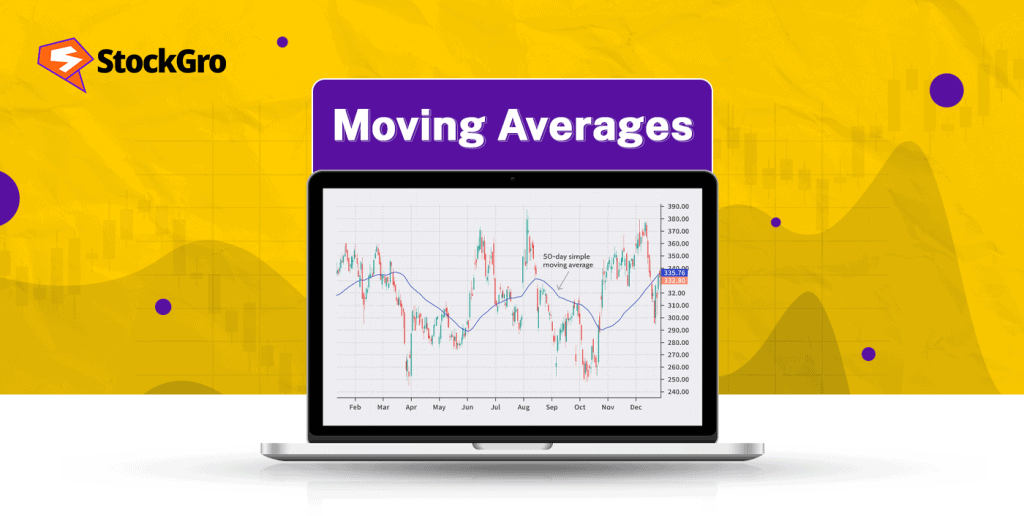
A moving average is a technical analysis tool that smoothes out price information over a predetermined time period. Rather than acting on every small price movement, it combines several points of information into one continuous line.
When prices are averaged, short-term market noise is reduced and overall market direction – upward, downward, or sideways is revealed.
Technical analysts employ moving averages to determine market trend strength, potential areas of support and resistance, and market entry or exit points.
At its core, a moving average is about perspective. It slows the market down so the trend becomes visible.
Example of an MA
Assume we want to calculate a 5-day simple moving average using hypothetical closing prices.
| Day | Day 1 | Day 2 | Day 3 | Day 4 | Day 5 |
| Closing Price | 100 | 104 | 102 | 106 | 108 |
Step 1: Add all closing prices
100 + 104 + 102 + 106 + 108 = 520
Step 2: Divide by the number of days
520 / 5 = 104
The 5-day moving average value is 104.
On the next trading day, Day 1 is removed and Day 6 is added. The average recalculates again using the most recent five prices. This rolling process is what makes the average move forward with time.
How a Moving Average (MA) Works
A moving average recalculates itself every time a new price is added. Older prices gradually lose relevance as they drop out of the calculation.
Shorter period moving averages respond quickly to price changes but can fluctuate often. Longer period moving averages move slowly but provide a more stable view of the trend.
Because of this trade-off, traders choose moving average periods based on how much sensitivity or stability they prefer.
Types of MAs
Moving averages are calculated using different methods, each applying a specific way of averaging price data over time.
Simple Moving Average (SMA)
The Simple Moving Average calculates the average price by giving equal importance to all values in the selected period.
Formula: SMA = ΣP / n
In this formula, ΣP refers to the sum of prices over the selected period, and n is the total number of periods.
SMA is preferred by investors interested in the overall market trend rather than focusing on short-term market fluctuations.
Exponential Moving Average (EMA)
The Exponential Moving Average is created to respond to recent changes in the market price. This is done by giving higher weights to recent prices.
Formula: EMAₜ = (Pₜ × k) + EMAₜ₋₁ × (1 − k)
Here, Pₜ is the current price, EMAₜ₋₁ is the previous EMA value, and k is the smoothing factor calculated as 2 / (n + 1).
This structure causes recent prices to influence the average more strongly. As a result, EMA follows price action more closely than SMA, which makes it useful for timing entries and exits.
Weighted Moving Average
The Weighted Moving Average allows prices within the period to have different levels of influence. Typically, more recent prices receive higher weights.
Formula: WMA = (P₁w₁ + P₂w₂ + … + Pₙwₙ) / (w₁ + w₂ + … + wₙ)
Every price value P is multiplied by a corresponding weight w, and the sum of the weighted prices is divided by the total of all assigned weights.
This method makes the system more sensitive while allowing traders to dictate the level of importance assigned to each price.
SMMA (Smoothed Moving Average)
The Smoothed Moving Average focuses on long-term trend stability by reducing the impact of short-term price fluctuations.
Formula: SMMAₜ = (SMMAₜ₋₁ × (n − 1) + Pₜ) / n
SMMAₜ₋₁ represents the previous smoothed average, Pₜ stands for the current price, and n indicates the chosen time period.
This calculation gives more weight to the previous average and blends in new prices gradually. As a result, SMMA changes direction slowly and is often used to observe sustained trends rather than short-term signals.
HMA (Hull Moving Average)
The Hull Moving Average is designed to reduce lag while maintaining smoothness. It uses weighted averages and mathematical adjustments to respond faster than traditional averages.
Formula: HMA = WMA(2 × WMA(n / 2) − WMA(n), √n)
This formula accelerates trend response by emphasising shorter averages and then smooths the result using a square root period.
HMA is often used when traders want early trend signals without excessive noise.
JMA (Jurik Moving Average)
Mark Jurik developed the Jurik Moving Average, which provides a clear price trend with reduced lag compared to traditional moving averages.
Formula concept: adaptive smoothing based on volatility
Instead of applying a fixed smoothing rate, the Jurik Moving Average adjusts how quickly it responds depending on price behaviour. When price movement becomes stronger and more directional, the average reacts faster. When price movement slows or becomes uneven, the smoothing increases.
Arnaud Legoux Moving Average (ALMA)
The Arnaud Legoux Moving Average uses a statistical weighting approach to reduce lag and noise.
Formula: ALMA = Σ(Pᵢ × Gᵢ)
Pᵢ is the individual price values, and Gᵢ is the Gaussian weights that regulate the impact of the prices within the window.
This design enables ALMA to follow the trends smoothly with less impact of the market noise.
AMA (Adaptive Moving Average)
The Adaptive Moving Average is intended to adjust its sensitivity according to changes in market conditions.
Formula: AMAₜ = AMAₜ₋₁ + SC × (Pₜ − AMAₜ₋₁)
Here, AMAₜ₋₁ represents the previous adaptive moving average value, Pₜ denotes the current price, and SC is a smoothing constant derived from price efficiency.
Unlike the fixed-period moving average, the AMA speeds up in a strong market and slows down in a sideways market.
Difference Between Simple Moving Average (SMA) vs Exponential Moving Average (EMA)
Although both SMA and EMA follow the price movements, they react differently to the market changes.
| Parameter | SMA | EMA |
| Price weighting | All prices in the selected period are given equal importance in the calculation | Recent prices are given higher importance, while older prices gradually lose influence |
| Calculation approach | Uses a straightforward arithmetic average of past prices over a fixed period | Uses an exponential formula that adjusts the average using a smoothing factor |
| Sensitivity | Less sensitive to short term volatility and random price fluctuations | More sensitive to short term price movements and sudden market reactions |
| Lag in signals | Higher lag, which may result in delayed trend identification | Lower lag, allowing earlier recognition of trend changes |
| Usage | Commonly used to identify long term trends and broad market direction | Commonly used for timing entries, exits, and short to medium term analysis |
Importance of Moving Average Method
The importance of moving averages can be explained through the following key points.
- Market structure understanding
Moving averages help traders understand how prices behave over time by revealing the underlying structure of market movement. - Trend phase identification
They help in identifying whether it is a trending phase or not, which is essential for selecting an appropriate strategy. - Alignment of the timeframe
Moving averages help in aligning the short-term market movement with the medium or long-term market movement. - Comparative context
They help in creating a reference point to compare the current prices with recent history. - Analytical foundation
Moving averages form the base for many other technical indicators and trading systems, making them a core analytical tool.
Merits of the Moving Average Method
There are several benefits of using moving averages that make them a popular choice among traders.
- Clarity on trends: Moving averages help in smoothing out the price action and make it easier to understand the overall market trend.
- Control over emotions: Moving averages help traders control their emotions and make objective trading decisions.
- Dynamic support and resistance: Moving averages can serve as dynamic support and resistance levels based on the movement of prices.
- Universal usage: Moving averages can be applied to stocks, indices, commodities, and forex, as well as on any time frame.
- Compatibility: Moving averages can also be combined with other indicators, such as RSI or MACD.
Demerits of Moving Averages
However, there are some disadvantages of moving averages that should be considered before applying them.
- Lagging indicator: The moving average is based on past prices, and the signal is received after the actual movement has taken place.
- False signals: In a sideways market, the moving average can produce false signals, which can lead to faulty decisions.
- Sensitivity: Some moving averages are sensitive and tend to fluctuate, which makes understanding the market trend difficult.
- No prediction: The moving average only shows the past movement and does not predict future prices.
- Dependence: Using the moving average without market context can result in incorrect interpretations.
Conclusion
Moving averages matter because they slow the market down just enough to make sense of it. When prices are volatile, they quietly filter out the noise and reveal what has been going on. When used thoughtfully, moving averages can be a powerful tool for better decision-making.
FAQs
Neither is universally better. EMA responds faster to recent price changes, while SMA provides a smoother and more stable trend view. The choice depends on trading style and timeframe.
There is no particular good moving average. Commonly used moving averages include 20, 50, and 200 periods, as they represent short-term, medium-term, and long-term trends, respectively.
The purpose of a moving average is to smooth price data, identify trend direction, and provide context for market movement.
They are analysed by observing their slope, crossovers, interaction with price, and alignment with broader market trends.