

There are days when the market drifts, and days when it delivers a decisive message. 30 March 2026, belonged to the latter!
The equities opened the week on a weaker note, with significant declines across major indices. The fall was driven by global tensions, rising crude oil prices, and persistent selling pressure. Investors and traders responded by turning cautious as risks began to build.
Read ahead to understand the exact reasons behind today’s market fall.
Why did the Stock Market Go Down Today?
The stock market crash on 30 March 2026 came as multiple negative factors hit the investor’s sentiment at the same time.
The intensifying tensions in the Middle East pushed Brent crude oil prices close to $115/barrel, increasing concerns about inflation and prolonged high interest rates. At the same time, weak global markets and continued selling by foreign investors added to the pressure.
Additionally, the Reserve Bank of India caps the foreign exchange positions of the banks, which unsettled the financial stocks. As a result, the Sensex dropped around 1,636 points, and the Nifty closed at 22,331. The sell-off wiped around ₹9.00 lakh crore of the market capitalisation of all companies listed on BSE, dragging it down to ₹413.00 lakh crore, marking another episode in recent stock market crash history with broad-based selling across sectors.
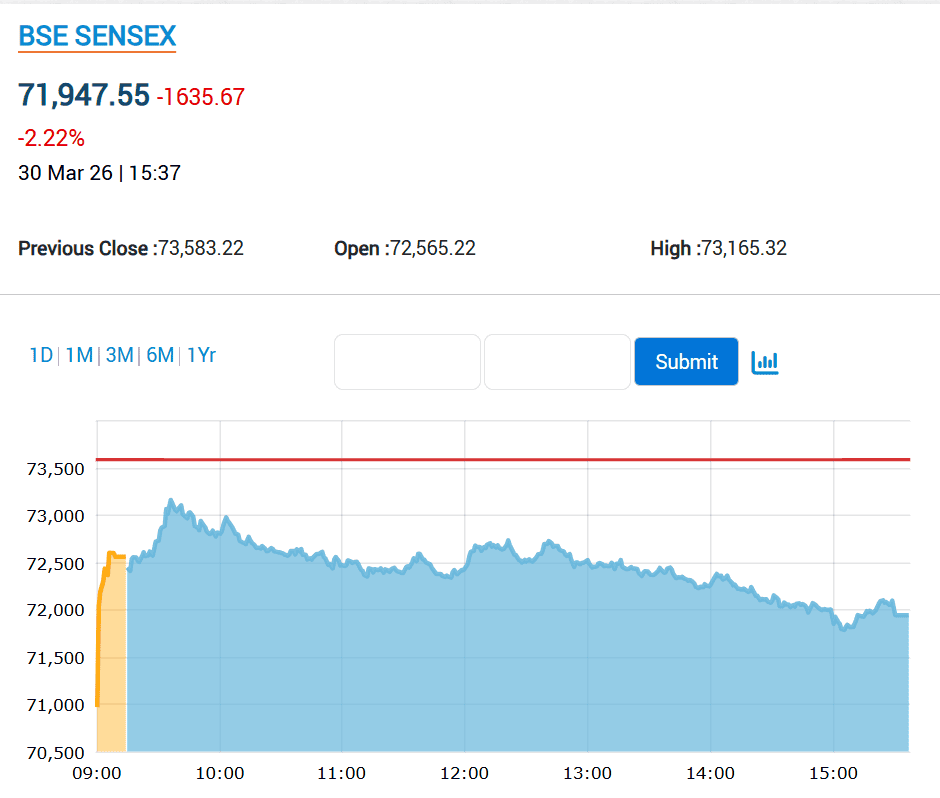
Today’s stock market Status
| Date | Nifty Open | Nifty Close | Change today | %Change |
| 30/03/2026 | 22,549.65 | 22,341.65 | –474.45 | –2.08% |
Reasons for the Stock Market Down
A mix of global tensions, rising oil prices, foreign investor selling, weak international cues, domestic policy moves, and technical breakdown triggered a sharp and broad-based sell-off across markets. Let’s break these 6 key reasons down:
1. Rising Tensions Between the US and Iran
The war began earlier this month with US-Israeli strikes that killed Iran’s Supreme Leader, triggering strong retaliation from Tehran and spreading tensions across the Middle East.
This situation has weakened investors’ confidence, while the absence of diplomatic progress raises fears of prolonged instability, pushing the investors away from equities and triggering widespread selling across the markets.
2. Crude Oil Prices Remain High
As a result of rising volatility in the Middle East, Brent crude futures on MCX surged over 3.4% to trade at $115/barrel, at around 08:00 AM.
There is also caution regarding the crude oil price might reach $200/barrel, if the war continues through mid-year and the Strait of Hormuz remains closed.
This intensifies concerns regarding inflation and economic stress for oil-importing countries like India. The higher crude prices are increasing inflation and widening the fiscal deficit. The situation also raises concerns about future interest rate pressure and corporate margins. As a result, sectors sensitive to fuel costs saw selling, pulling the market lower during the session.
3. Heavy Selling by Foreign Investors
The Indian stock market is witnessing continued selling by foreign investors. This weakened the rupee value by 1.5 times against the USD, at ₹95/Dollar. Data from NSE shows that FIIs remained net sellers for the 20th consecutive session, offloading shares of around ₹4,367 crore on Friday, 27 March 2026.
While this figure does not reflect the current session, the persistent outflows in recent weeks have weakened the investors’ confidence.
4. Weak Global Markets
Global markets traded significantly lower, making no exception for Dalal Street. Japan’s Nikkei fell more than 3%, while South Korea’s Kospi dropped around 3%. Taiwan’s weighted index declined 1.5%, and Hong Kong’s Hang Seng slipped nearly 1%.
The weakness extended to the US, where the S&P 500 fell about 1.7%, and the Nasdaq dropped over 2% in the previous session. European markets also ended lower, with Germany’s DAX down over 1%, France’s CAC losing 0.9%, and the UK’s FTSE closing in the red.
5. Negative Domestic News and Policy Concerns
Bank stocks have come under pressure after the Reserve Bank of India asked banks to limit their foreign exchange positions to $100 million by the end of each day.
This move is expected to reduce certain trading strategies that the banks use to profit from currency differences. As these positions are unwound, banks might sell dollars in the domestic market.
While this supports the rupee, it led to a significant fall in banking stocks, adding another layer of uncertainty at a time when global risks were already elevated.
6. Technical Breakdown and Panic Selling
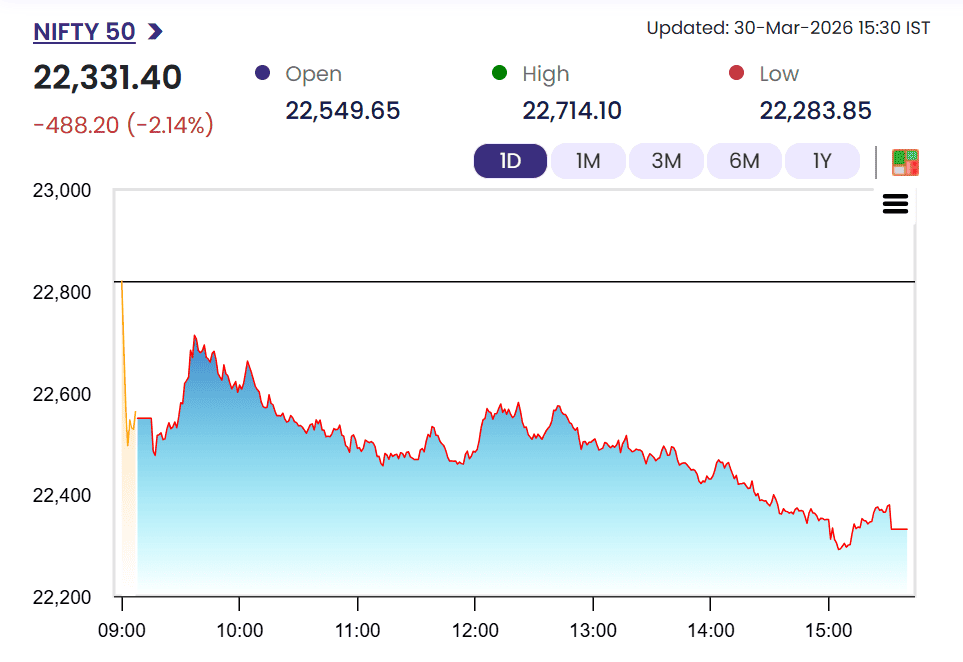
Today’s fall gathered pace as the Nifty slipped below key support levels during the session. After opening above 22,500, the index moved lower and closed near 22,342, down about 447 points or 1.95%.
The breach of intraday support near 22,400 triggered stop losses, leading to faster selling. As the index trended downward, traders exited positions, which added to panic-driven selling pressure.
Final Thoughts
Today’s fall reflects how quickly sentiment can reverse when multiple risks build up. Rising oil prices, global uncertainty, and sustained selling pressure created a challenging environment for equities.
While predicting stock market crash moments with precision is never easy, such phases often develop when several warning signs align. What matters now is how these factors unfold and whether stability returns in the coming sessions.
FAQs
The market is falling due to a combination of global and domestic pressures. The rising tensions in the Middle East have pushed oil prices higher, increasing inflation concerns. At the same time, foreign investors are continuously selling, global markets are weak, and policy changes in India have affected banking stocks. Together, these factors have reduced investor confidence and triggered selling across sectors.
The Indian market still has strong long-term fundamentals supported by economic growth, domestic demand, and corporate earnings. Short-term volatility may persist due to global uncertainties and fluctuations in oil prices. However, if geopolitical tensions ease and inflation stabilises, markets can gradually recover.
The sectors linked to commodities and defence may benefit from the current situation. Oil and gas companies, especially upstream players, tend to gain from higher crude prices. The defence sector companies may also see increased interest due to rising geopolitical tensions.