
- Summary
- Day orders stay active until market close, whereas an IOC order attempts immediate execution and cancels any unfilled quantity.
- A day order allows more time for price matching than an IOC order, which suits trades requiring immediate execution.
- The outcome of both the order validity types depends on available liquidity, matching prices and order priority.
What is a Day Order?
A day order is a buy or sell order placed by a trader with a broker to buy or sell a security, such as stocks, commodities or derivatives, which remains valid only for the duration of the current trading session or day.
In the case the order is not executed, meaning the order is not matched with a corresponding buy or sell order, the order stays pending until the market hour closes and is then cancelled automatically by the broker.
If you wish to execute the trade, you should place a new order the next day. So, if someone asks you “what is a day order?”, remember that its validity period begins when submitted and ends at the close of the current trading session.
What is an IOC Order?
An Immediate or Cancel (IOC) order is a buy or sell order that must be executed immediately, either fully or partially, when placed. Any unfilled quantity is cancelled automatically by the exchange, rather than remaining pending in the market.
An IOC order attempts to match with available orders as soon as it enters the market. If only part of the requested quantity is available at the specified price, that portion is executed and the remaining quantity is cancelled. Unlike a day order, an IOC order does not remain pending in the market.
Key Differences Between Day and IOC Orders
Day orders and IOC orders are two different time-in-force orders that tell the exchange how long an order should remain active.
The key day order vs IOC differences are:
| Feature | Day order | Immediate or Cancel (IOC) order |
| Validity | Stays active throughout the trading session and expires automatically at market close if unexecuted. | Cancelled immediately if not filled. For a partially filled order, the unfilled remainder is cancelled immediately. |
| Execution | Execution can happen anytime throughout the active trading hours. | The exchange executes the order immediately, either in full or for the available quantity. |
| Partial fills | Allowed. The remaining unfilled portion stays active in the order book. | Allowed. The remaining unfilled portion is immediately cancelled. |
| Waiting | It waits in the order book for a matching price until execution or market close. | It does not sit or wait in the order book (“execute or cancel”). |
| Purpose | When you want a specific price and are willing to wait. | For immediate liquidity, high-speed execution or large orders without waiting. |
The Other Order Validity Types
Apart from Day and immediate or cancel orders, other order validity types determine how long an order remains active and when it expires or gets cancelled. Availability depends on the broker, exchange and trading segment.
- Minutes Order: This order remains active for a specified number of minutes and is automatically cancelled if it remains unexecuted when the time expires.
- Good Till Triggered (GTT) Order: A GTT order remains active until its specified price trigger is reached or its validity expires, prompting the broker to place an order.
- Smart Limit Order: This broker-specific option allows traders to set an end time for an order, which expires according to the configured conditions if unexecuted.
Note: Good Till Cancelled (GTC) and Good Till Date (GTD) are other recognised order validity types internationally, but they are not currently available as regular exchange orders on India’s NSE equity market.
How to Place a Day or IOC Order
While placing a buy or sell order, you set it to a Day or IOC order in the settings of your trading app or website. The exact steps and location of the validity setting however vary by platform and trading segment.
Let us see how you can get into it in general!
- Log in to your trading app and open the stock, commodity or derivative you want to trade.
- Tap Buy or Sell to open the order window.
- Enter the quantity and select the order type, such as Market or Limit.
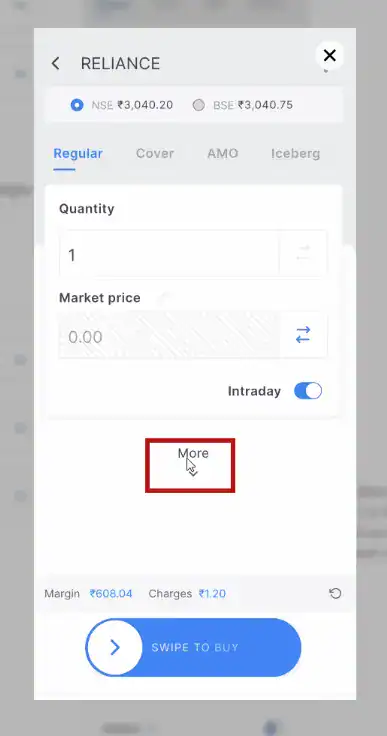
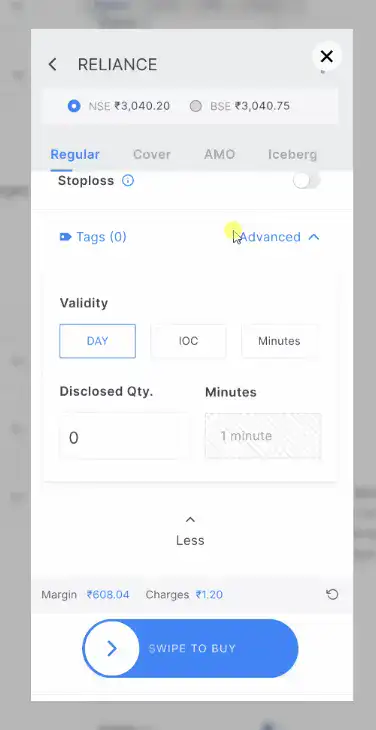
- Look for the Advanced, More or the equivalent section in the order window. Select Day or IOC, depending on your trading requirement.
Here is a trading order window of Zerodha showing the Advanced Options menu for selecting order validity:
Display of Day and IOC options under the order validity settings:
- Review the order details and submit it. Check the order book to see whether it was executed, partially executed or cancelled.
IOC with Market vs Limit Orders
IOC orders can be placed as either a market order or a limit order, provided that the broker and exchange support this combination. The difference is how the order is priced, while the IOC condition determines what happens to any unfilled quantity.
- Market Order: The order attempts to buy or sell immediately at the best available market prices. Any quantity that cannot be filled immediately is cancelled, and the final execution price may differ from the last traded price.
- Limit Order: The IOC limit orders specify the maximum price a buyer will pay or the minimum price a seller will accept. It executes immediately against matching orders within that price limit, while any unfilled quantity is cancelled.
But can IOC be used in every segment?
The answer is no. IOC availability depends on the exchange, trading segment, instrument and broker. The NSE recognises IOC validity in its equity and derivatives trading systems, but individual brokers may restrict certain order combinations or instruments.
Using IOC in F&O and Options
Traders can use an IOC order in options and futures to attempt immediate execution when entering or exiting a derivatives position. The order is sent to the exchange for matching as soon as it is placed. If only part of the quantity matches, that portion is executed and the remaining quantity is cancelled.
For example, if you place an IOC limit order to buy 50 lots of a Nifty option at your specified price, but only 30 lots are available at that price, the 30 lots may be executed while the remaining 20 lots are cancelled.
IOC orders can be useful when you want to act on a price quickly without leaving an unfilled order in the market. Despite this, the execution depends on available liquidity and matching prices. IOC availability and permitted order combinations may vary by broker, exchange and derivatives segment, so check your trading platform’s rules before placing an order.
When to Use Day Orders
A day order can be useful in the following situations:
- Buying a stock below its current price: You place a limit order and give the market the rest of the trading session to reach your target price.
- Selling shares at a target price: You set a selling price and allow the order to remain active throughout the session for a possible match.
- Placing a non-urgent trade: You want to enter or exit a position during the day but do not need immediate execution.
- Trading frequently traded stocks: You place a limit order on a liquid stock and allow intraday price movements to create a matching opportunity.
- Avoiding orders carrying over: You want any unfilled quantity cancelled at market close rather than remaining active for the next trading session.
When to Use IOC Orders
An IOC order is useful in specific, time-sensitive situations, which include:
- Sudden market movements: An IOC order attempts to execute a trade immediately when prices move rapidly, cancelling any quantity that cannot be matched.
- Partial order execution: When only part of an order can be filled, the available quantity is executed and the remainder is cancelled automatically.
- Avoiding pending orders: Orders that must not remain active after the initial execution attempt can use IOC validity to cancel any unfilled quantity automatically.
- Checking immediate liquidity: An IOC limit order can test what volume is available at a specific price point without leaving an open order behind, though if no liquidity is present at that price, the entire order cancels.
- Time-sensitive trade entries or exits: When a trading opportunity requires immediate action, IOC validity allows available quantities to execute without waiting for the entire order to fill.
Pros and Cons of Day and IOC Orders
Day and IOC orders differ in how long they remain active and how they handle unfilled quantities. Each has advantages and limitations.
The pros and cons of day orders include:
| Pros | Cons |
| Remains active throughout the trading day, allowing more time for execution. | Execution is not guaranteed before market close. |
| Works with limit orders, allowing traders to specify their preferred price. | Unfilled quantities are cancelled at market close, even if the target price is nearly reached. |
| Suitable for non-urgent trades that can wait for a price match during the session. | May miss execution if the price briefly reaches the target but the order does not get matched. |
Whereas the pros and cons of IOC orders are as follows:
| Pros | Cons |
| Attempts immediate execution, with any unfilled quantity cancelled automatically. | May result in partial execution or complete cancellation. |
| Eliminates the need to monitor or manually cancel unfilled quantities later. | The order may be cancelled if no matching order is available immediately at an acceptable price. |
| Avoids leaving an order pending as market prices change. | May miss later trading opportunities because the order is cancelled after the initial attempt. |
What Partial Fills Cost You
A partial fill happens when available buyers or sellers at your specified price match only part of your total order. Depending on the broker’s pricing model, this can affect the partial fill brokerage you pay.
In India, most discount brokers charge a flat fee per executed order or a small percentage per trade. This means multiple trades/fills resulting from a single order in the same day are typically clubbed together and billed as a single order.
However, if a broker uses a per-contract or per-trade execution model or if the remaining part executes across a separate session or day, it may trigger additional charges.
Exchange transaction charges, securities transaction tax (STT), GST and other applicable levies may also apply to executed quantities. Before placing your orders, check your broker’s tariff, contract notes and applicable intraday trading charges to understand the total cost of partial executions.
Real-World Examples and Case Studies
Let us say a trader wants to buy 200 shares of a company before its quarterly results are announced. The stock is trading at ₹498. But the trader sets a maximum purchase price of ₹495.
- Using a Day Order: The trader places a limit buy order for 200 shares at ₹495. If the stock reaches this price and enough sellers are available, the order may be filled. If only 120 shares are purchased by market close, the rest 80 shares are cancelled.
- Using an IOC Order: The trader places the same limit order when the stock is trading at ₹495. If 120 shares are immediately available at that price, those shares may be purchased, while the remaining 80 are cancelled. If no matching shares are available immediately, the entire order is cancelled.
Under this scenario, a day order provides time for the target price to match orders during the session. On the contrary, an IOC order attempts immediate execution without leaving an unfilled quantity pending.
But neither of these validities guarantees execution, even if the stock reaches the specified price. As in, even if the stock price hits ₹495, execution depends on available sellers at that specific price point and your position in the order queue.
Conclusion:
Selecting the right order type based on a day order vs IOC order depends on your trading plan, price expectations and urgency. Before you place your next trade, decide whether you want to wait for your target price or need an immediate execution. Also, check your broker’s order validity options, charges and execution rules, then select the order that best fits your strategy.
FAQs
No. IOC availability depends on the exchange, segment, instrument, trading session and broker. Check the validity options available on your trading platform before placing the order.
Day orders suit trades that can remain active during the session while waiting for a match. IOC orders suit trades requiring an immediate execution attempt without leaving any unmatched quantity pending.
If only part of your IOC order matches with available orders, the matched quantity is executed and the remaining quantity is cancelled immediately. For example, if 30 out of 50 shares are available at your limit price, 30 shares may be purchased and the remaining 20 cancelled.
No, an unexecuted Day order does not carry over to the next trading session. The exchange automatically cancels any remaining quantity at market close. To attempt the trade again on the next trading day, you must place a new order with your preferred price and quantity.
An IOC order may suit a fast-moving stock when immediate execution is the priority and you do not want unfilled quantities to remain pending. A Day order may be more suitable if you can wait for your target price. Neither guarantees execution, as matching depends on price, liquidity and order priority.