
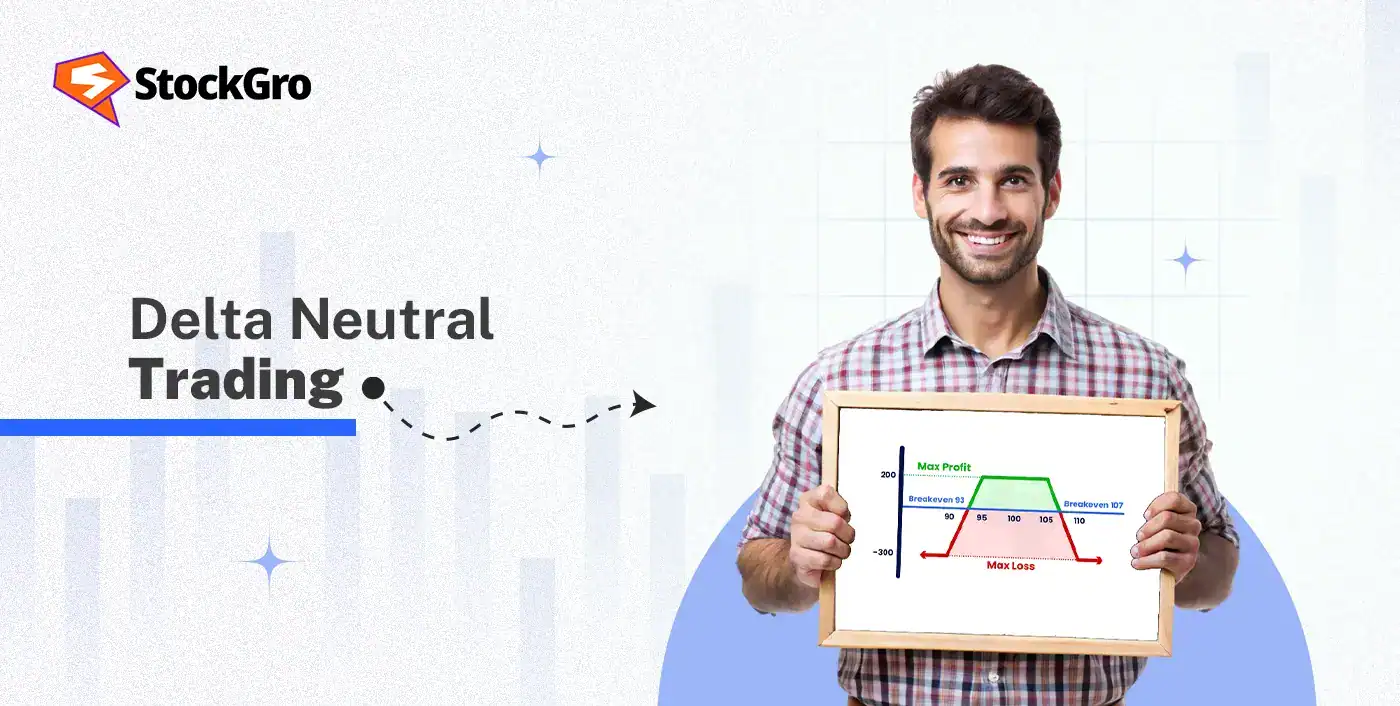
In the domain of derivatives, delta-neutral trading represents a structured approach to balancing exposure while moderating directional risk.
Delta-neutral trading is used to offset positive and negative deltas within an options portfolio so that the net delta approximates zero. By doing so, traders attempt to reduce the price risk arising from movements in the underlying asset, while positioning the portfolio to benefit from volatility, time decay, and adjustments in implied volatility.
In practice, market participants view delta-neutral strategies as tools of disciplined risk hedging rather than instruments of outright speculation, especially in environments marked by uncertain price direction.
Read further to know more about delta-neutral trading, strategies, risk hedging methods, and option Greeks.
What is Delta Neutral Trading?
First, let’s understand delta: In options trading, delta measures how much an option’s value is expected to move when the underlying asset changes by one unit.
Now, delta neutral trading is an approach in options trading in which positions are arranged so that the combined delta of the portfolio remains at or near zero. A zero-delta position is created by structuring holdings in options and, where necessary, the underlying asset so that positive and negative deltas counterbalance one another, resulting in a combined delta that remains close to neutral. The objective is to limit the impact of price fluctuations in the underlying asset while allowing the position to derive value from time decay and variations in implied volatility.
Thus, a delta-neutral strategy shifts the trader’s focus from forecasting price direction to managing risk through calculated balance. In a market where certainty is elusive, neutrality becomes a deliberate and disciplined bias rather than a passive one.
Why Use Delta Neutral Strategies in Trading?
In derivatives markets, uncertainty in price direction often exceeds the trader’s capacity for accurate prediction. While traditional approaches emphasize directional conviction, professional participants frequently adopt delta-neutral strategies to isolate other measurable components of return within options trading.
- Risk control:
A delta neutral position limits sensitivity to directional price movements through the systematic balancing of positive and negative deltas within the portfolio. With this, the trader reduces the portfolio’s responsiveness to minor price variations in the underlying instrument.
- Volatility participation:
Delta neutral trading allows participation in changes in implied volatility. When structured properly, a portfolio may benefit from volatility expansion even if the underlying price remains range-bound.
- Time decay advantage:
As an option moves closer to its expiry date, its time value gradually diminishes, a process referred to as theta decay. The delta neutral strategies are designed to collect this time premium systematically, provided price movement remains within anticipated boundaries.
- Strategic flexibility:
Unlike directional trading, delta-neutral strategies are adjusted as the market evolve. Traders may rebalance positions to maintain neutrality, thereby converting market movement into an opportunity for recalibration rather than distress.
How Delta Works (The Option Greek Explained)
An analytical examination of delta within the framework of option Greeks, clarifying its measurement of price sensitivity and its role in constructing balanced, risk-adjusted derivatives positions.
What is a Delta Neutral Position?
Within the framework of option Greeks, delta indicates how much an option’s premium is likely to change when the underlying asset moves by 1 unit. A delta-neutral position arises when the combined delta of all positions equals zero or remains sufficiently close to it.
For example, a trader buys a call option with +0.60 delta. Since one option contract usually represents 100 shares, the total delta becomes +60. This means the position behaves as though the trader owns 60 shares of the stock.
To offset this position, the trader enters a short sale of 60 shares in the underlying stock. Each share carries a delta of +1.00, so selling 60 shares creates a delta of –60.
The +60 delta from the call option and the –60 delta from the short shares offset each other. The net delta becomes approximately zero. As a result, changes in the underlying asset’s price exert only limited influence on the overall value of the position, thereby moderating its directional bias.
In such a structure, profit and loss become less dependent on price direction and more influenced by other option Greeks, including gamma, theta, and vega.
How to Construct a Simple Delta Neutral Trade
| Step–1 | Determine delta of selected option contract | This information is provided by the trading platform and forms part of the standard option Greeks. |
| Step–2 | Calculate total delta | Multiply the option’s delta by the contract size, usually 100 shares per contract. |
| Step–3 | Offset the exposure | Take a counterbalancing trade to neutralise the original delta. |
| Step–4 | Verify net delta | Add the deltas of all positions to confirm that the combined value approximates zero. |
| Step–5 | Monitor and adjust | Since delta changes as price moves, the position requires periodic recalibration to maintain neutrality. |
Delta Neutral vs Directional Trading
Here’s a comparison of trading approaches, distinguishing between strategies that target profit from price direction and those structured to moderate directional exposure within derivatives markets.
| Aspects | Delta Neutral Trading | Directional Trading |
| Primary Objective | Targets to minimise directional risk by maintaining near-zero net delta | Targets to profit from anticipated upward or downward price movement |
| Dependence on Market Forecast | Relies less on predicting price direction and more on volatility and time factors | Relies heavily on accurate price forecasts and trend identification |
| Risk | Moderates immediate price sensitivity through balanced positions | Exposed directly to price fluctuations of the underlying asset |
| Profit Drivers | Influenced by volatility changes, time decay, and adjustments in delta | Influenced primarily by favourable price movement |
| Position Management | Continuous monitoring and frequent recalibration are necessary due to the changing nature of delta | Management focuses on entry, exit, and stop-loss level |
| Suitable Market Conditions | Employed in uncertain or range-bound markets | Favoured in trending market conditions |
Role of Other Greeks (Gamma, Theta, Vega)
See how other options Greeks influence the behaviour and stability of a delta-neutral position:
- Gamma:
Gamma indicates how delta itself varies as the underlying asset’s price changes. A position with high gamma causes delta to shift fast, thereby necessitating more frequent adjustments to preserve neutrality.
- Theta:
Theta represents the rate of time decay in an option’s value. In delta-neutral structures involving short option positions, the passage of time may contribute positively to returns as expiry approaches.
- Vega:
Vega reflects the degree to which an option’s value responds to variations in implied volatility. Even where delta remains neutral, fluctuations in volatility can significantly affect the portfolio’s valuation.
Delta Neutral Strategies
Delta neutral structures form an important class within professional derivatives practice. These arrangements are designed to balance positive and negative deltas so that the overall position remains largely insensitive to small movements in the underlying asset. Within established option trading strategies, such structures are frequently employed to concentrate on volatility behaviour and time decay rather than price direction alone.
Delta Neutral Straddle
A straddle involves holding both a call and a put contract with identical strike price and expiration date, established either through purchase or through writing the pair. When constructed at or near the at-the-money level, the positive delta of the call and the negative delta of the put tend to offset one another.
Delta Neutral Strangle
A strangle is constructed by taking positions in an out-of-the-money call and an out-of-the-money put that share the same expiry date but carry distinct strike prices. As both contracts begin out-of-the-money, their delta values are comparatively modest in size at initiation.
When structured appropriately, the positive delta of the call and the negative delta of the put may approximate balance.
Iron Condor & Butterfly Spreads
An iron condor is formed by establishing a call spread and a put spread on opposite sides of a central price zone, creating a defined range within which the position is structured. The deltas of the short options are offset by the long options at further strikes, producing an overall net delta near zero at initiation.
The butterfly spread, whether constructed with calls or puts, centres upon a middle strike where opposing positions are balanced by protective wings. At initiation, the deltas of the outer options counterbalance the central short position, often resulting in near neutrality.
Adjusting Positions to Maintain Neutrality
Delta neutrality is not static! Therefore, a position that begins with a net-zero delta may acquire directional bias over time.
Maintenance involves periodic recalculation of aggregate delta. If the position develops a positive net delta, partial sale of the underlying asset or addition of negative-delta options may restore balance. If the net delta turns negative, purchasing shares or incorporating positive-delta options may be appropriate.
This process of recalibration reflects a central principle in derivatives management. Neutrality at entry provides structure, yet disciplined adjustment sustains that balance throughout the life of the trade.
Pros & Cons of Delta Neutral Trading
The pros and cons of delta neutral trading arise from the balance it attempts to establish between direction, volatility, and time.
| Pros | Cons |
| Reduces sensitivity to short-term price fluctuations in the underlying asset | Requires continuous monitoring and periodic adjustment as delta changes |
| Allows participation in volatility shifts and time decay independent of market direction | Transaction costs may increase due to frequent rebalancing |
| Encourages disciplined risk management through option Greeks | Profit potential may be limited if volatility remains subdued or mispriced |
Conclusion
Delta neutral trading represents a structured method within derivatives practice, balancing opposing deltas to moderate price sensitivity. Rather than relying upon directional conviction, a delta-neutral position integrates volatility assessment, time decay, and disciplined adjustment. Its effectiveness depends upon accurate calculation, continuous monitoring, and prudent cost management. When applied with rigour, delta neutrality provides a measured framework for risk hedging across varying market conditions.
FAQ‘s
Delta neutral reduces risk by balancing positive and negative deltas so that the portfolio’s net delta approaches zero. This limits sensitivity to small price movements in the underlying asset, thereby moderating directional impact on overall valuation.
Directional trading relies upon forecasting upward or downward price movement for profit. Delta neutral trading, by contrast, balances positions to reduce reliance on direction, deriving returns from volatility changes, time decay, and structured adjustments.
Yes, returns may arise from time decay, changes in implied volatility, and periodic rebalancing. Profit does not depend solely upon price direction, though disciplined management and accurate pricing assumptions remain essential to sustained performance.
The common delta neutral strategies include the at-the-money straddle, out-of-the-money strangle, iron condor, and butterfly spread. Each combines options with offsetting deltas at initiation, allowing balance while focusing on volatility behaviour and time-related effects.
Risks include shifts in volatility, adverse gamma effects causing delta imbalance, transaction costs from frequent adjustments, and misjudgment of market conditions. Although directional sensitivity is moderated, the position remains influenced by other option Greeks.
First, calculate the delta of each position and multiply by the contract size where applicable. Then, add all positive and negative deltas. If the total equals zero or approximates it, the portfolio is considered delta neutral.
You can remain delta neutral by monitoring aggregate delta regularly and adjusting positions when an imbalance occurs. This may involve buying or selling shares or modifying option positions to restore the net delta to near zero.
A delta-neutral algorithm is a rule-based system that automatically recalculates portfolio delta and executes trades to maintain neutrality. It integrates real-time pricing data with predefined thresholds for systematic adjustment.