- Summary
- SEBI GMP advisory issued on 23 November 2026 advises the discontinuation of publishing unofficial IPO GMP figures.
- It advises all the SEBI-registered intermediaries and market participants to refrain from publishing, displaying or circulating GMP figures across platforms.
- Investors who engage in grey market transactions will have no recourse through SEBI or stock exchange grievance redressal mechanisms.
- Investors should refer to the official disclosures and apply through SEBI-registered intermediaries and authorised platforms.
What did SEBI announce on 23 November 2026?
The Securities and Exchange Board of India (SEBI), on Monday, 23 November 2026, issued an advisory regarding the discontinuation of publishing IPO Grey Market Premium (GMP) figures.
SEBI GMP advisory cautioned investors that these figures are unofficial, unverified and unregulated. Further, the shares are supposedly traded at this price even before they are officially listed for trading on recognised exchanges.
What is IPO GMP (grey market premium)?
GMP, also stated as unregulated pre-listing premium, is the extra amount of money investors quote over the issue price of an IPO in the grey market before the shares are listed on the stock exchange. It acts as a sentiment indicator.
Here is an example. Say that the issue price or upper price band of an IPO is ₹125.00/share and its GMP is ₹15.00. So the unofficial market price is now ₹140.00/share.
Why did SEBI step in now?
SEBI IPO grey market advisory stepped in for the following reasons:
- Widespread Publication of IPO GMP: SEBI noted that the GMP figures are widely published across websites, digital platforms, newspapers and even on SEBI-registered intermediaries and market participants.
- Misleading Listing Price: IPO grey market figures were being portrayed as indicators of likely listing prices and anticipated returns, despite being unofficial, unverified and unregulated.
- Lack of Investor Protection: The grey market transactions are not regulated and take place outside the recognised stock exchange, regulatory oversight, settlement guarantees or formal price-discovery process.
- Risk to Market Transparency: Circulating these unregulated pre-listing premiums can further harm investors and go against transparency and accountability in the securities market.
Who has to stop publishing GMP?
SEBI circular advises all SEBI-registered intermediaries and market participants to stop publishing, displaying or broadcasting GMP figures for upcoming IPOs.
This applies to the following communication channels:
- Websites or digital platforms
- Newspaper and other publications
- SMS
- Social media platforms
What the advisory does not change
The SEBI advisory focuses on the publication and use of unofficial GMP figures. It does not announce any changes to the existing IPO process.
- IPO application process: Investors will continue to apply for IPOs through ASBA and UPI using authorised channels.
- Issue price: Issuers and merchant bankers continue to determine IPO price bands and cut-off prices through the standard book-building or fixed-price mechanisms.
- Share allotment: The existing allotment process and rules are unchanged.
- Stock exchange listing: The IPOs will continue listing on recognised stock exchanges as per their announced schedules.
- Listing gains: Listing gains are unaffected since it is a market outcome. The shares can still open above their issue price based on actual exchange demand.
What happens if you lose money in a grey market deal?
Investors cannot claim regulatory protection if a dispute arises from a grey market deal. If the other party fails to pay or deliver the agreed shares, investors cannot access the following mechanisms per the recent SEBI circular:
- Investor protection benefits offered by SEBI or stock exchanges.
- Complaint resolution mechanisms managed by stock exchanges.
- Online Dispute Resolution (ODR) portal (smartodr.in) managed by stock exchanges and depositories.
Such defaults have occurred in the past. Take the case of Reliance Power’s IPO in 2008. After the shares listed below expectations, several grey market participants refused to make payments. As of 14 February 2008, grey market deals worth around ₹250 crore remained unsettled.
Although investors may pursue other applicable legal remedies, they cannot rely on the regulatory safeguards available for authorised securities market transactions.
SEBI’s second warning: fraudsters posing as registered intermediaries
On the same day, there was also an issue of SEBI warning about fraudsters as registered intermediaries on WhatsApp, Telegram and other social media platforms.
These fraudsters offer free stock tips and promise high returns. They use fake trading apps, misuse SEBI registration details and claim to know SEBI officials to gain investors’ trust. They then ask investors to transfer money to third-party bank accounts.
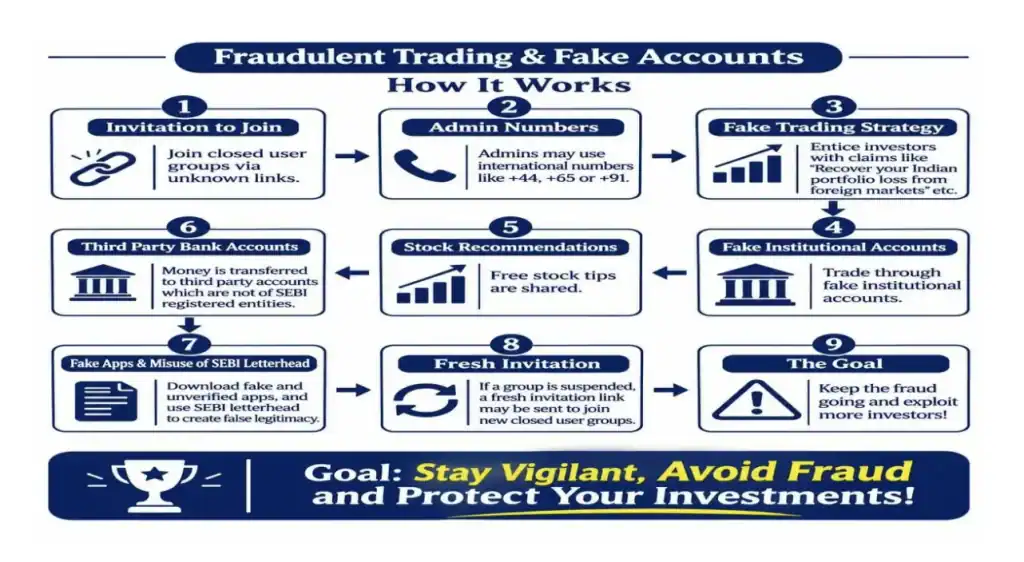
To stay safe from such frauds, SEBI has asked investors to:
- Verify the registration status of intermediaries on SEBI’s website.
- Be cautious of offers promising assured returns, institutional trades or foreign market investments from unverified sources.
- Avoid unverified trading platforms and bank accounts shared by unknown individuals.
- Check for the verified badge when downloading trading apps from the Play Store.
- Check the list of authorised trading apps on SEBI’s website.
- Verify bank account details and UPI IDs through SEBI Check.
- Avoid joining private social media groups through invitations from unknown individuals.
What should IPO investors look at instead of GMP?
Instead of tracking the IPO grey market, investors should study the company’s business, financial health and IPO valuation. Most of this information is available in the Red Herring Prospectus (RHP). You can find the RHP on the SEBI, NSE/BSE or the company websites. For easier access, check StockGro’s coverage on IPOs for key details and analysis.
Here are a few things to check before applying for an IPO:
- IPO details: Check the price band, issue size, fresh issue, offer for sale and minimum investment required.
- Key performance indicators: Check the company’s profit margins, debt-to-equity ratio and return on equity (ROE) to understand how well the business is performing.
- Financial performance: Look at the trend in the company’s revenue, total assets and profits over the past three years.
- About the company: Understand what the company does, the business models, the products or services and promoters.
- IPO objectives: Understand why the company is going public and how it plans to use the funds.
- Strengths & risks: Understand what gives the company an edge over its competitors and what could affect its business.
- IPO subscription status: Check the demand from different investor categories. However, high demand does not always mean listing gains. For instance, Hyundai Motor India’s IPO in October 2024 was subscribed 6.97 times by qualified institutional buyers (QIBs), yet its shares listed at a discount of 1.33% on NSE.
- IPO anchor investors: Check which institutional investors have participated in the anchor portion of the IPO.
Will a regulated pre-listing platform replace the grey market?
SEBI has explored two different mechanisms to facilitate regulated trading of shares before their official listing. However, neither has been launched yet.
In January 2025, then Chairperson Madhabi Puri Buch discussed a ‘when-listed’ trading platform. It would allow investors to buy & sell IPO shares post allotment but before listing through a regulated platform.
On 20 November 2026, current Chairman Tuhin Kanta Pandey confirmed that SEBI is working on a framework for pre-IPO share trading. However, the rules, eligibility criteria and trading process are yet to be finalised.
Therefore, it’s too early to say whether such a platform will fully replace the IPO grey market.
FAQs
The recent SEBI circular warns market participants to stop publishing GMP figures. There is no indication of a blanket ban on grey market trades.
SEBI advises against trading in the grey market. However, private deals are possible outside bourses.
As per the SEBI advisory, market participants should stop publishing GMP figures on websites and other platforms. There’s no specification of a deadline or separate enforcement measures. Thus, it is unclear whether all independent GMP websites will follow the advisory.
No. You can apply for the IPOs as before through any of the authorised platforms.
Regulatory dispute resolution services are unavailable for such deals. You may have to seek help through other legal channels.
The main difference in GMP vs kostak is how the amount is quoted. GMP is quoted per share, whereas kostak is a fixed amount per IPO application, regardless of allotment.
Unofficial premiums reflect market sentiment. The actual listing price may differ from these estimates.