Crude oil trading is the process of dealing in futures contracts to benefit from changes in price movements. It moves on Organisation of the Petroleum Exporting Countries (OPEC) decisions, geopolitical tensions, and weekly U.S. inventory reports. Without a clear crude oil trading strategy, this market is an expensive lesson. This blog covers strategies, risk management, and what separates disciplined traders from those who quit early.
Crude oil trading strategy
A crude oil trading strategy is a systematic plan that tells you when to enter a crude oil trading, how much to risk, and when to exit regardless of whether the trade moves in your favour or against you. Trading without one is reacting to price, not planning for it. The most practical strategies for beginners are as follows:
- Trend following
Market direction can be assessed using the 20-day and 50-day moving averages. An upward crossover, where the shorter average rises above the longer one, suggests a potential buy setup. A downward crossover, where the shorter average falls below the longer one, signals a potential sell setup. A core rule is to align with the current market direction rather than going against it.
- Breakout trading
Crude oil tends to consolidate in a price range before making sharp directional moves. Breakout traders mark support as well as the resistance zones and enter trades once price moves beyond these levels with strong volume. Volume confirmation is critical. A breakout without volume is frequently a false move that reverses quickly.
- Swing trading
Swing trading approach involves keeping trades open for a few days, making it ideal for those who do not track markets all day. RSI and Bollinger Bands are the most commonly used tools for identifying swing entries and exits in crude oil.
- Scalping
Scalping involves making multiple small trades within the same session, targeting small price movements per barrel. This requires fast execution, tight spreads, and strong discipline. It is not recommended for beginners as even one unmanaged loss can wipe out several small gains quickly.
- Spread trading
It consists of entering two positions simultaneously in contracts that expire at different times. The focus here is on the price gap between two contracts rather than the overall crude price. Spread trading typically requires lower margin and carries less volatility than outright directional positions.
How the crude oil market works for traders
Multi Commodity Exchange (MCX) is the primary commodity exchange for crude oil futures trading in India, handling daily volumes above ₹3,000 crore. MCX offers two contract sizes suited to different trader profiles:
- Crude oil main: 100 barrels per lot. Suited for experienced or institutional traders.
- Crude oil mini: 10 barrels per lot. Preferred by beginners due to the lower capital requirement.
Trading hours for MCX crude oil run from 9:00 AM to 11:30 PM IST, with a later close of 11:55 PM when U.S. daylight saving time applies throughout Monday to Friday. Trading activity is often higher between 6:30 PM and 11:30 PM IST due to NYMEX participation. The weekly EIA report, released around 8:00 PM IST (10:30 AM Eastern time on Wednesdays, often brings increased liquidity as global markets overlap.
Since MCX crude is cash-settled, traders do not deal with physical barrels, making it accessible for retail trading.
News-based and event-driven oil trading strategy
Some of the sharpest crude oil moves happen around specific, predictable events. Knowing when these occur gives traders a clear edge. The main events to track are as follows:
- EIA weekly inventory report
The U.S. Energy Information Administration releases its Weekly Petroleum Status Report every Wednesday at approximately 10:30 AM Eastern Time (ET), which is 8:00 to 8:30 PM IST as per Indian time. A larger-than-expected draw in U.S. crude inventories typically pushes prices higher. A larger-than-expected build pushes them lower. MCX crude can move 200 to 400 ticks within the first three minutes of this release.
- OPEC and OPEC+ meetings
OPEC meetings set production quotas for member countries. Any decision to cut or increase output can move Brent prices significantly within hours. Traders often reduce position sizes ahead of OPEC decisions to avoid unpredictable gap moves at the open.
- Geopolitical events
Conflicts, sanctions, and supply disruptions from major producing regions can cause sharp and sustained Brent price spikes. These are unpredictable in timing but are worth tracking through financial news sources daily.
Risk management for Crude oil traders
Crude oil is more volatile than most stocks and currencies. Risk control is an integral element, not just an added concept. The key principles are as follows:
- Always employ a stop-loss
A stop-loss level must be decided before entering any trade. For MCX crude oil trades, a stop-loss of 12 to 15 points per barrel is commonly used depending on volatility at the time of entry.
- The 1 to 2% rule
Only a small percentage, typically 1 to 2%, of total capital should be exposed in one trade. If your capital is Rs 50,000, your maximum acceptable loss per trade should not exceed Rs 500 to Rs 1,000. This approach helps traders stay active even after multiple losses.
- Limit open positions
Avoid holding more than two to three crude oil positions simultaneously. Overexposure amplifies losses sharply when the market moves against you.
- Understand margin requirements
MCX crude oil futures currently require an initial margin of approximately 34% to 37% for overnight positions and around 17% to 18.5% for intraday trades. Since crude prices and volatility change daily, the actual margin needed in rupee terms fluctuates accordingly. Always verify your capital requirements using your broker’s real-time margin calculator before placing any trade.
- Never average a losing position
Adding to a losing crude oil trade hoping it will recover is one of the most damaging habits in commodity trading. Cut losses quickly and protect your capital.
Real-world example: trade setup in crude oil
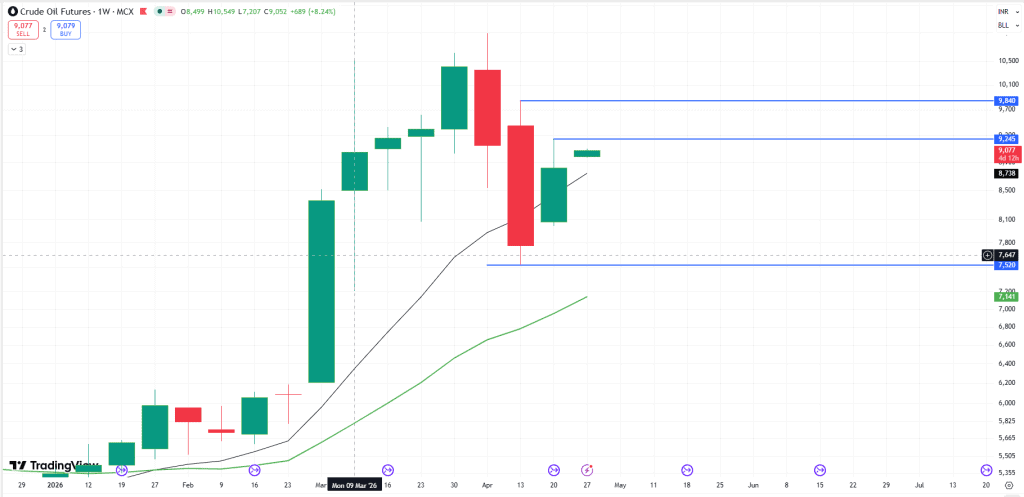
The weekly chart dated April 27, 2026 in the Crude Oil Futures MCX chart given above serves as a practical application of the Breakout Trading strategy discussed earlier. Periods of consolidation show the market building up for its next move. The specific trade plan hinges on two critical price boundaries:
- Bullish breakout: A sustained move above the 9250 resistance level signals a strong upside toward targets of 9650–9850.
- Bearish breakdown: A price drop below the 8750 support level indicates a sharp downside move likely reaching 7300.
- Market view: The overall sentiment remains bullish as long as the price stays above 8750 on the weekly chart.
By waiting for volume confirmation at these levels, traders avoid reacting to noise and instead execute a systematic plan with defined risk. This disciplined approach separates professional traders from those who guess based on emotion.
Common mistakes to avoid in oil trading
New crude oil traders tend to repeat the same errors. The most damaging ones are as follows:
- Trading without a plan: Entering based on a tip or a feeling without defined entry, stop-loss, and target is not trading. It is guesswork.
- Ignoring global indications: MCX crude follows global Brent and WTI prices directly. Not checking overnight global price movements before trading leads to gap surprises.
- Overtrading: More trades mean more transaction costs, more emotional decisions, and more exposure to random price noise. Quality over quantity.
- Ignoring the rupee: MCX crude prices factor in the USD/INR rate. A strengthening rupee can push MCX crude lower even when global crude rises. Tracking both together is non-negotiable.
- Holding through major events without protection: Trading into EIA releases or OPEC meetings without adjusting stop-losses or reducing position size is one of the most common ways beginners take large, avoidable losses.
Final thoughts
A clear crude oil trading strategy, combined with an understanding of MCX contract specs, key market events, and strict risk management, gives new traders a genuine foundation to build on. Start with the Mini contract, paper trade before going live, and define your risk before every single trade. Consistency and discipline matter more than forecasting for long-term trading success.
FAQs
Yes, you can learn crude oil trading without risking money by using demo accounts and paper trading. Most beginners start this way to understand price movements, strategies, and risk management before using real capital.
Crude oil can be suitable for beginners due to high liquidity, but its volatility makes it risky. Starting with smaller contracts like crude mini and strict risk control is important for beginners.
The most effective indicators for crude oil trading include moving averages, RSI, Bollinger Bands, and support-resistance levels. Many traders also use EMA crossovers and volume to confirm entries and exits.
The capital required for crude oil trading depends on the contract size, margin requirements, and trading style. Beginners often start with smaller positions and limited capital to manage risk effectively.