
Summary
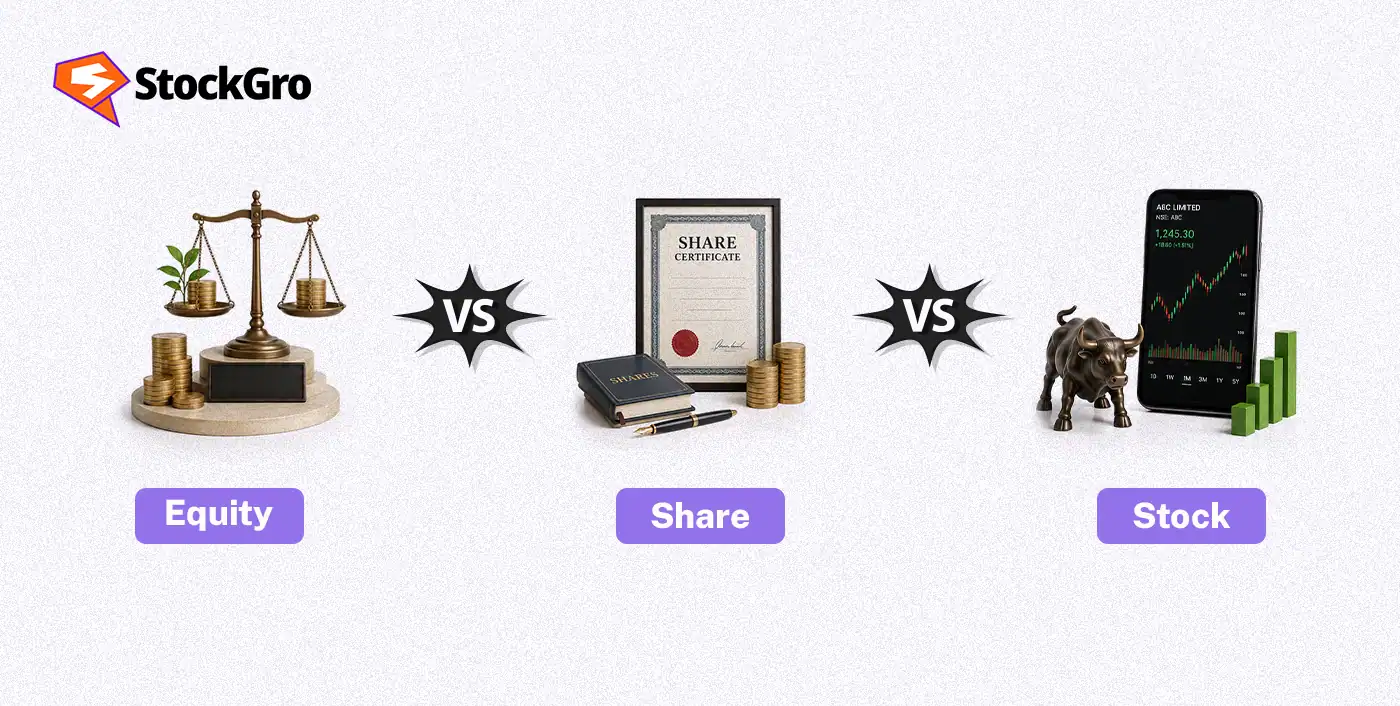
Equity refers to the ownership value of a company; a share is the smallest unit of a company.
a stock is the overall holdings in one or more companies.
Investors should understand these terms to be used correctly in the world of investing.
What is Equity?
Equity is when you own a part of a company. When you invest capital in a company, you acquire a proportionate piece in exchange. Individuals who invest in equity carry voting rights in important decision-making. As the business grows and does well, your equity holding becomes more valuable. And if it does not, the value goes down.
What is Share?
A Share represents the smallest possible unit of ownership you can hold in a company. They cumulatively create the entire ownership, which can be divided across multiple investors. This makes it easier for investors to claim ownership of a company by allowing them to own as many units as they want and own a fraction of the company.
What is Stock?
A stock is the term that describes owning part of one or more shares. Stock generally refers to an investor’s overall ownership holdings or investment portfolio. Stock refers to all the shares you own in companies, which make up your investment portfolio.
Key Differences Table: Equity vs Share vs Stock
Equity, shares, and stocks are compared side by side, including their meaning, scope, and usage in investing.
| Basis | Equity | Share | Stock |
| Meaning | Ownership share in a business entity | A lone unit that represents a stake in a company | General ownership in one or multiple companies |
| Scope | Broad concept | Specific concept | Collective concept |
| Represent | Net ownership value | Fraction of equity | Holdings across companies |
| Ownership | Complete ownership interest | Portion of ownership | Collection of shareholdings |
| Financial statement usage | Appears in the balance | Appears in share capital details | Rarely appears in accounting statements |
Equity vs Share vs Stock – Key Differences Explained
Equity is the portion of a company’s worth that belongs to its investors. Anyone holding shares in a company effectively owns a proportional part of its overall equity. When a company requires funds and issues equity, it is basically giving ownership of the company to the people who buy the equity.
Companies can not sell ownership all at once. Therefore, they split it into smaller parts and named each unit a share. Each share is a fraction of the company’s equity and represents a certain percentage of ownership. Owning shares comes with the privilege of voting on important company matters.
Stock usually means holding ownership in a company or multiple companies. When people talk about stock, they often just mean they have some ownership in a company without mentioning the number of shares. All it indicates is that they are investing in businesses. This can be in any company.
Real-Life Usage in Investing & Trading
When you use brokerage apps or watch the news, you will see that people often mix up the terms stocks, shares, and equity.
Listed are some examples.
- When a news anchor says “stocks rallied today,” it means the overall stock market, where investors can buy and sell securities, went up in value.
- If your demat account statement shows “50 shares of Infosys”. This indicates that you hold 50 units of shares in the company ‘Infosys’.
- When a startup shows “20% equity” on their cap table, it means they are considering the percentage of the company they own. It does not reveal how many units are actually held.
Common Mistakes & Misconceptions
Listed are some common mistakes that many investors make when introduced to investing terminology.
- Confusing equity with shares: Not every business has shares. Sole proprietors also have equity, which represents their net worth. But it does not include any shares because the ownership is not yet divided. Hence, it stays with the proprietor.
- Using stocks and shares interchangeably: Stocks and shares are closely related. However, they both carry different meanings. Stocks are considered a broader concept, or a category, while shares are specifically about a company.
- Assuming equity means only listed companies: Investors generally assume that only listed companies have equity. But private companies also include equity as founders, venture capital, and angel investors that are not listed on the stock exchanges.
- Believing all shareholders get dividends: Dividends are not fixed returns. Businesses often use their profits to invest in their growth rather than distributing them among the shareholders.
Real-World Examples & Use Cases
Let us understand each term using practical examples.
- Equity: A start-up founder gets ₹2 crore from investors and offering 20% equity in the company. Instead of lending money to the investors, the company offered them ownership that would benefit them as the company grows in future.
- Share: Supriya bought 200 shares of Infosys Ltd. using her demat account. Each share of her holding represents a part of the company’s ownership. When the company distributed its dividend after paying tax on its profit, Supriya received her fraction of the dividend based on her holdings, i.e, 200 units.
- Stock: Surya has invested in multiple companies, including HUL, Bharti Airtel, Kotak Mahindra Bank, and ITC. When someone asks him how he utilises his savings, he says that he has invested in stocks in multiple companies. He uses the term stocks because he holds ownership in multiple companies.
Final Thoughts
Equity, shares, and stocks are not rival terms. Instead, they are closely related. Equity is the value of ownership, and shares are the parts that make up the value. Stock is the term used in investor language which represents the overall ownership held by an investor, irrespective of the number of companies.
At the end, it is not about memorising the definitions. The important thing is understanding what holding ownership is and how it is measured. Equally essential is recognising the terms used to describe these holdings when investing.
FAQs
Equity represents ownership in a company, a share is one unit of that ownership, and stock is a general term for ownership in one or more companies.
They are closely related but not identical. Shares refer to ownership in a specific company, while stocks broadly describe investments in one or multiple companies.
Equity and stock are not different investment terms. Equity is the ownership itself, while stocks refer to the overall investments. Long-term returns depend on the quality of the companies you invest in.
Yes. Shares of listed companies can be bought and sold in real time on stock exchanges during market hours.
Companies issue shares to raise capital for business expansion, debt repayment, acquisitions, or other growth initiatives without borrowing money.
Start by understanding fundamental concepts, use virtual trading platforms if available, invest gradually through regulated brokers, and focus on long-term investing rather than short-term speculation.