

Summary
A share represents ownership in a company and entitles the holder to a portion of its profits.
Shareholders may receive dividends and capital appreciation as the company grows.
Owning shares also gives voting rights, allowing investors to participate in key corporate decisions and influence company policies.
What Is a Share?
A share is a unit of ownership in a company. When you buy a share, you become a partial owner of that company and gain a claim on its profits and assets. It represents a fraction of the company’s total capital, and each share contributes to your proportional ownership in the business.
When a company needs funds for expansion, research, or debt repayment, it divides its value into equal parts called shares, each with a defined face value. For example, if a company has 1,000 shares and you own 10, your ownership stake is 1%. In today’s stock market, shares are held digitally and act as legal proof of ownership, making it easier than ever for investors to participate in business growth and build diversified portfolios.
How Shares Work in the Stock Market
The lifecycle of a share begins with an Initial Public Offering (IPO) and continues through daily trading on secondary markets. The process of share circulation follows a structured path through several financial entities:
- The primary market (IPO): This is where a company sells its shares to the public for the first time to raise capital directly.
- The secondary market: Once issued, shares are traded between investors on stock exchanges like the NSE (National Stock Exchange) or BSE (Bombay Stock Exchange).
- Price discovery: The price of a share fluctuates throughout the trading day based on the laws of supply and demand.
- Stock exchanges: These act as the marketplace where buyers and sellers meet, ensuring transparency and regulation.
- Depository participants: In India, entities like NSDL and CDSL hold your shares in digital (dematerialised) form in a demat account.
Types of Shares Every Beginner Should Know
Shares represent ownership in a company and are one of the most common investment instruments in the stock market. Companies issue different types of shares to raise capital while balancing ownership, voting rights, and dividend distribution.
Understanding the different types of shares is important because each category comes with unique rights, risks, and return potential. Investors often choose shares based on their financial goals, risk appetite, and investment horizon.
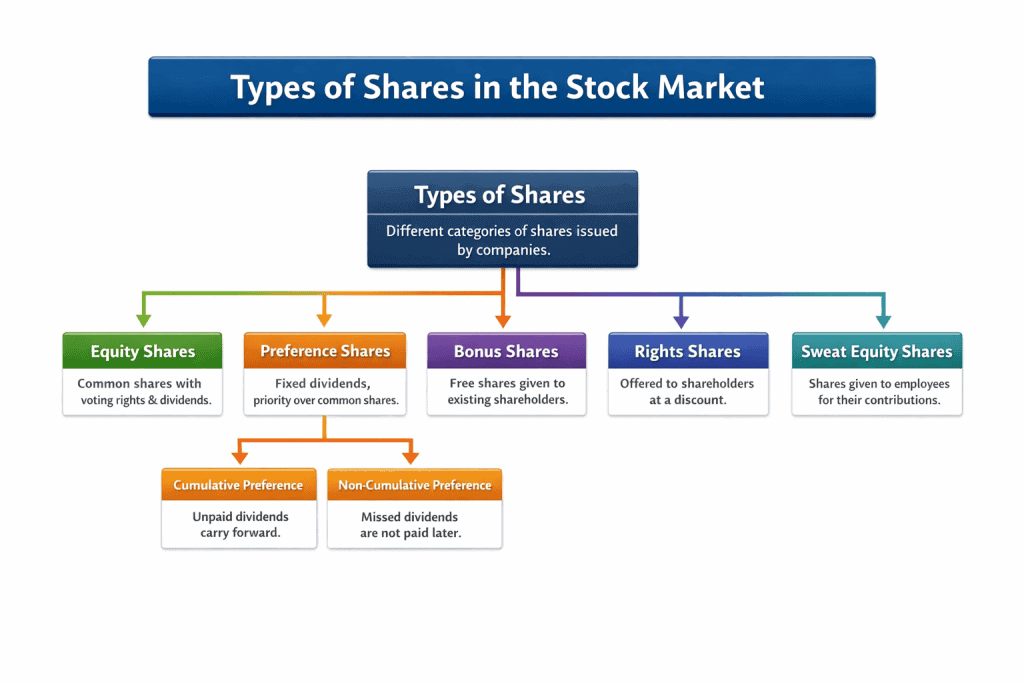
Below are the major types of shares commonly found in the stock market:
Equity Shares (Ordinary Shares)
Equity shares(Ordinary Shares) are the most commonly traded shares in the stock market. Shareholders get ownership rights in the company along with voting rights.
The returns from equity shares mainly come from:
- Capital appreciation
- Dividends
However, dividends are not fixed and depend on company performance. Equity shareholders also carry higher risk because they are paid after all liabilities are cleared during liquidation.
Preference Shares
Preference shareholders receive dividends before equity shareholders. These shares generally offer fixed dividend payouts, making them comparatively stable.
However, preference shareholders usually have limited or no voting rights. They also receive priority over equity shareholders during liquidation.
Preference shares are suitable for investors seeking relatively stable income with lower risk compared to equity shares.
Voting and Non-Voting Shares
Voting Shares
These shares provide shareholders the right to vote on company matters such as board appointments, mergers, or corporate decisions.
Non-Voting Shares
Non-voting shares do not provide voting rights but may offer higher dividend benefits in some cases.
Companies sometimes issue non-voting shares to raise capital without diluting management control.
Bonus Shares
Bonus shares are additional shares issued by a company to existing shareholders free of cost. These are distributed from accumulated reserves or profits.
Formula:
Bonus Ratio = Existing Shares : Additional Shares Issued
For example, a 1:1 bonus issue means shareholders receive one extra share for every one share held.
Bonus shares increase the total number of shares but do not change the company’s overall value immediately.
Rights Shares
Rights shares are offered to existing shareholders at a discounted price before being offered to the public. This allows companies to raise additional capital.
Existing shareholders get the right—but not the obligation—to purchase these shares.
Rights issues are commonly used for expansion, debt reduction, or funding new projects.
Sweat Equity Shares
Sweat equity shares are issued to employees or directors as a reward for their contribution, expertise, or intellectual property.
Instead of cash compensation, companies provide ownership through shares. This helps align employee interests with company growth.
Convertible and Non-Convertible Preference Shares
Convertible Preference Shares
These shares can be converted into equity shares after a specific period based on predefined conditions.
Non-Convertible Preference Shares
These shares cannot be converted into equity and continue as preference shares throughout their tenure.
Growth Shares
Growth shares belong to companies expected to grow faster than the market average. These companies usually reinvest profits instead of paying high dividends.
Investors buy growth shares expecting long-term capital appreciation.
However, growth stocks can also experience higher volatility due to elevated market expectations.
Value Shares
Value shares are stocks that appear undervalued compared to their intrinsic worth. These shares often trade at lower valuation multiples despite having stable fundamentals.
Investors purchase value shares expecting the market to recognise their true value over time.
Blue-Chip Shares
Blue-chip shares belong to large, financially stable, and well-established companies with strong market reputation.
These companies generally:
- Have consistent earnings
- Pay regular dividends
- Maintain strong market presence
Blue-chip shares are often preferred by long-term investors seeking stability.
Defensive Shares
Defensive shares belong to sectors that remain relatively stable even during economic slowdowns, such as FMCG, healthcare, and utilities.
These shares are considered less volatile because demand for their products remains consistent regardless of market conditions.
Why Investors Buy Shares
People invest in shares mainly to grow wealth and beat inflation over time.
Capital Appreciation
Share prices increase as companies grow. This helps investors earn returns by selling shares at higher prices.
Dividend Income
Some companies distribute profits as dividends. This provides regular income apart from price gains.
Wealth Creation Formula
Total Return = Capital Gain + Dividend Income
For example, if you buy a share at ₹100 and it rises to ₹150, your capital gain is ₹50 plus any dividends earned.
Risks of Investing in Shares & Common Mistakes to Avoid
Risks of Investing in Shares
Prospective shareholders should be aware of the following risks before committing their capital:
- Market risk: Share prices are likely to decline because of overall economic conditions, global events, or changes in interest rates that affect the entire market. These events are beyond a company’s control but can still cause stock prices to drop. For example, the recent conflict involving the Mideast war has triggered a sharp fall in Indian markets, where indices like the Nifty and Sensex have dropped and nearly 83% of BSE 500 stocks traded in the red during the sell-off.
- Business risk: A specific company might perform poorly due to bad management, loss of market share, or technological obsolescence.
- Liquidity risk: For small-cap or penny stocks, there may not be enough buyers when you want to sell your shares.
- Regulatory risk: Changes in government policy or tax laws can negatively impact specific sectors or the market as a whole.
- Inflation risk: If your shares don’t grow faster than the rate of inflation, your purchasing power actually decreases.
Common Mistakes Beginners Make
Many beginners incur losses in the stock market due to common mistakes and lack of proper investment planning.
- Investing without research: Beginners often buy shares based on tips, social media, or news without understanding the company.
- Putting all money in one stock: Lack of diversification increases risk because one bad stock can affect the entire investment.
- Trying to time the market: Many beginners wait for the perfect time to invest, which is very difficult even for experts.
- Panic selling during market fall: Beginners often sell shares in fear when prices fall, which leads to losses.
- Expecting fast returns: The stock market usually rewards patience, and wealth is generally created over the long term rather than instantly.
- Investing without a plan: Without clear goals and strategy, investments become random and risky.
- Ignoring risk management: Beginners sometimes invest more money than they can afford to lose.
- Following the crowd: Buying stocks just because everyone else is buying is a common mistake.
How to Start Investing in Shares
Step 1: Obtain a PAN card: A Permanent Account Number (PAN) is the mandatory first step for all financial investments in India, acting as your primary tax and identity link.
Step 2: Choose a depository participant (DP): Choose a SEBI-authorised broker who acts as the link between you and the stock exchanges.
Step 3: Open demat & trading accounts: While the demat account stores your shares in electronic form, the Trading Account is the platform used to actually buy and sell those shares.
Step 4: Complete KYC verification: Submit digital copies of your Aadhaar (for e-KYC), address proof, and a canceled cheque to verify your bank details and identity.
Step 5: Link your bank account: Link your savings account to your trading account so that money can be transferred for buying shares.
Step 6: Log in and research: Use your broker’s terminal or mobile app to search for companies using their specific ticket symbol. (e.g., RELIANCE for Reliance Industries).
Step 7: Submit a purchase order: Enter the number of shares you want to buy and choose either a market order or a limit order.
Step 8: Settlement and storage: After the order is completed, the payment is deducted and the shares are credited to your demat account, usually within one business day (T+1).
Real-Life Examples & Use Cases of Share Investing
Investing in shares can be seen in everyday life through well-known companies.
Example 1: Long-Term Investment
If someone invested ₹10,000 in a strong company 10 years ago and it grew at 12% CAGR:
Final Value = Principal × (1 + r)^t
= 10,000 × (1.12)^10
≈ ₹31,058
This shows the power of compounding in the stock market.
Example 2: Dividend Earnings
A company paying 3% dividend annually on ₹1,00,000 investment provides ₹3,000 yearly income.
Example 3: Retail Investor Participation
Many retail investors today invest in companies like IT, banking, and FMCG due to easy access through trading apps.
Share vs Stock: Is There a Difference?
People often use the terms shares and stocks interchangeably, but there is a slight difference in how they are used in finance. The table below explains it:
| Basis | Shares | Stocks |
| Meaning | Indicates ownership in a particular company. | Indicates ownership spread across one or multiple companies. |
| Usage | Used when talking about a particular company | Used in a broader sense for multiple companies |
| Scope | More specific | More general |
| Context | Often used in company-specific discussions | Used in general investment discussions |
| Terminology | Common in formal/legal context | Common in general conversation |
| Technical difference | Represents a portion of a single company | Represents a collection of shares from different companies |
Conclusion
Shares are one of the most powerful tools for wealth creation in the stock market. They allow investors to become part-owners of companies and benefit from their growth.
While investing in shares comes with risks, proper research, diversification, and a long-term mindset can significantly improve success chances.
Understanding how shares work is the first step toward building financial independence and participating in the growth of businesses and the economy.
FAQs
A share is a small unit of ownership in a company. Buying shares makes you a part-owner of that company.
Beginners can start by opening a Demat account, researching companies, and investing small amounts initially.
Shares refer to ownership in a single company, while stocks refer to a collection of shares or investments in the market.
Risks include market volatility, company performance issues, and emotional decision-making.
Yes, shares can generate strong long-term returns through compounding and capital growth if invested wisely.